Tuesday, June 30, 2009
Rome Travel Diary I
I have been in Rome since Sunday, after several days spent in England with family in Derbyshire last week. Here in Rome I am sharing an apartment in the Trastevere district with my family and other friends. I have found Rome wonderful so far and the visit to the Coliseum yesterday the highlight -- quite breathtaking. I found time when I was last here in 2004 for a beer at a cafe next door to the coliseum, but this was my first proper visit. You can watch any number of documentaries, read any number of books and articles, but being inside the real thing is exhilarating.Today we walked to Vatican city and spent time in St Peter's Square before going to the Vatican Museum and the Sistine Chapel. With feet aching by early evening, we walked back with thunderstorms behind us and found a nice little pizzeria off the beaten track near our apartment. Likewise last night -- a super little streetside restaurant, very reasonably priced. On both occasions I have eaten proper Italian pizza and it's been excellent.
Tomorrow morning I will be properly reminded why I am here, to participate in the SBL International Meeting which got underway tonight. It is my first SBL International and I look forward to sharing my first thoughts tomorrow. I'm on at 9am, I think, in the Pauline Epistles section, so I will need to be up bright and early.
Labels: SBL Rome, Travel diaries
Monday, June 29, 2009
Handout for SBL International Talk
Here's the handout for my talk tomorrow entitled "Does περιβόλαιον mean “testicle” in 1 Corinthians 11.15?":
Handout (PDF)
Friday, June 26, 2009
The last time I was in Rome
Labels: who wrote the bible?, YouTube
Wednesday, June 24, 2009
What is "redaction"? The MPs and the NT

. . . . Last night I received a text message from an Oxbridge-educated friend who works for the Times Literary Supplement from time to time, asking “What does redaction mean?” From the context, he’d clearly been watching Newsnight, which ran a piece about MPs’ expenses, and I realised that I only knew what it meant myself because I’d looked it up when we began to break this story. Before that I don’t recall ever having heard it, so to a pleasing extent it’s time and place specific - a word that the Telegraph can make a small claim on. Obviously the purpose of language is communication, but if a newspaper can’t popularise words, who can?Hartley's post confirms that the term has been relatively unknown in the British media, at least until recently, and the post concludes:
In my dictionary, (product placement alert) kindly supplied to the Telegraph’s offices by the Oxford University Press, it says under redact: rare. Edit text for publication. Similarly, redaction: the process of editing text for publication . . . .
So redaction is bureaucrat-speak for drawing a big black line through something. And now it’s also a small part of history.
Definition: Redaction Criticism is the study of the way in which the evangelists (= “redactors”) moulded their source material, with a view to discovering their literary and theological agendas
Aim of redaction-criticism: to discover the evangelists’ agendas, and to learn more about the communities from which they came.Focus of redaction-criticism: the evangelists and their communities.
- Why did they include the traditions they included?
- Why did they mould their traditions in the ways they did?
- Why did they add, omit and change what they did?
- What can we know about them and their communities?
Heyday of redaction-criticism: 1950s – present.
Labels: NT Pod, redaction, redaction criticism
Tuesday, June 23, 2009
NT Pod 3: What is "Redaction"?
Friday, June 19, 2009
NT Pod 2
Labels: NT Pod
Tuesday, June 16, 2009
Discovering iTunes U and Duke's iTunes U
Many universities and colleges have their own iTunes U sites, including my own, Duke University, which has an impressive iTunes U site with lots of materials of interest. A lot of it consists of audio materials from conferences or public lectures, but some is created specially for the web. Here's the link to Duke's iTunes U site:
Duke on iTunes U
The links on that page will encourage an iTunes application to launch, so you will need to have iTunes installed if you don't have it already.
So what's available in our area over at Duke's iTunes U site? If you look to the left on the main menu, you will see Religion listed as one of the topics. Included under this topic is one thing that I have mentioned previously, the link to Dale Allison's 2008 Kenneth Clark Lectures. See also Carol Meyers on Women in Scripture; Beyond the Da Vinci Code with Bart Ehrman and Richard Hays; and Two Views of the Resurrection with Gary Habermas and Joel Marcus. And now also the NT Pod, with me!
Labels: Clark Lectures, Duke iTunes U, NT Pod
Monday, June 15, 2009
NT Pod on iTunes
NT Pod at iTunes
Or just go to iTunes and search for the NT Pod.
The NT Pod will also be on iTunes U in due course, over on Duke's iTunes U section. More on that when I have it, I hope by the end of the week.
Labels: NT Pod
Biblioblogs interview with John Anderson
Labels: biblioblogs.com
Friday, June 12, 2009
New Podcast: the NT Pod
Episode 1 is on Matthew 1.1-17 and you can download it or subscribe to listen to each episode as it becomes available. Within a few days, you should be able to find me on iTunes and iTunes U but for the time being iTunes users can subscribe manually by using the podcast feed.
Wednesday, June 10, 2009
The Gospel of Thomas and Q
[Q] is entirely unlike the canonical gospels in which the sayings of Jesus are interwoven with a continuous narrative. During the 1950s this peculiarity of Q was used as an argument against it. No such sayings gospel was known from the early Christian period, the critics charged. Q proponents needed to postulate not just a single text but an entire unknown genre of Christian literature. Ironically, just a few years earlier an amazing document had been unearthed, a document whose existence would turn this argument on its head . . . .The argument sounds persuasive because it relies on the notion of "prediciton confirmed", but the premise, that Thomas is like Q, is faulty. I devoted the last chapter of The Case Against Q to setting out the case that the first third of Q has a clear narrative sequence, with a chronological, geographical, cause-and-effect progression, of the kind that is quite foreign to a sayings Gospel like Q. I argued that these differences between Q and Thomas were actually more telling than the similarities in that they pointed to a source-critical rather than a genre-critical solution to the problem. The reason that the first third of Q is rich in narrative and in narrative sequence is that it corresponds to the section of non-Marcan elements in Matthew's reworking of Mark, located in Matt. 3-11. After that point Matthew works closely with the Matthean order, and it is inevitable that double tradition material loses its narrative sequence.
. . . . Such discoveries are exceedingly rare, and historians must usually be content with rearranging old data in new ways. Short of finding an actual copy of Q, more striking support for the Q document hypothesis can hardly be imagined. From the analysis of gospel interrelationships a hypothetical document had been reconstructed. That document required the existence of a previously unknown literary genre, the sayings gospel. The discovery of the Gospel of Thomas now confirmed that assumption. What had been seen as a weakness of the Q document hypothesis was suddenly transformed into a brilliantly successful prediction.
For Q has to be allowed to possess a strongly narrative exordium, not to mention narrative incidents elsewhere interspersed. It is no simple manual of Christ's teaching. It tells us with considerable fullness how John Baptist preached before the public manifestation of Jesus, and how Jesus, appearing in fulfilment of John's prophecies -- and, it would seem, undergoing baptism at his hands -- endured a threefold temptation in the wilderness, after which he ascended a mountain, and was joined by disciples there. Having delivered beatitudes and precepts of life, he "concluded his words" and presently made his way into Capernaum, where his aid was invoked by a centurion on behalf of his servant . . .There are things that Farrer missed in his discussion, and there are some emphases that might be a little different from ours, but Farrer had seen the problem with the Q document that the Q hypothesis implied, and he had seen it more clearly than many of the advocates of the hypothesis. The Q-Thomas alignment is only persuasive on a kind of simple, basic level; it does not bear closer examination.
. . . . . This pattern of symbolism and narrative finds a natural place in St. Matthew's text, where, in our opinion, it indubitably originated. But what sort of place would it find in the imaginary Q? After an exordium so full of dogmatic weight and historical destiny, is it credible that the book should peter out in miscellaneous oracles, and conclude without any account of those events which, to a Christian faith, are supremely significant? . . . What is hard to believe is that he should supply the exordium, while omitting the conclusion; that he should set in train the only story of unique importance, and break it off. (On Dispensing with Q, 59-60)
Labels: Gospel of Thomas, Synoptic Problem
Historical Jesus Missing Pieces IV: Placing the Baptsm
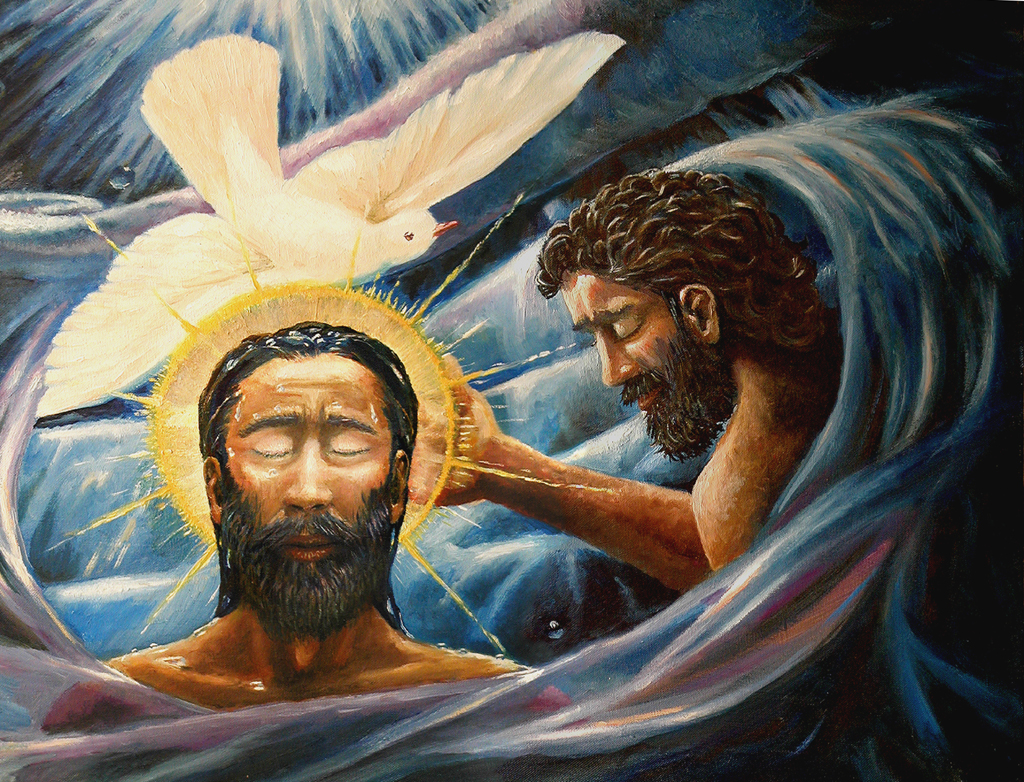
I have been reflecting here for a while about the problem of the Missing Pieces in the Historical Jesus puzzle. One of my concerns is that we might be putting the right pieces in the wrong places, or arranging them into the wrong pose. I wanted to concentrate on the phenomenon in those posts, and to dwell for a little on the dinosaur analogy, but now I would like to try to illustrate what I am talking about in the first of a couple of examples.Let's take the example of Jesus' baptism by John the Baptist. This is generally regarded as one of the most secure pieces of data we have about the Historical Jesus, and many use it as a key piece in their reconstructions. I am inclined to think that they may be right and that this is a reasonably secure piece of data. Now, for the sake of argument, let's assume that it is indeed a good piece of data, the equivalent of finding a dinosaur fossil, and ask about how we integrate it into the picture as a whole.
"Jesus went out into the wilderness to be baptized by John. The fact that we know almost nothing of Jesus' life prior to his baptism by John suggests that John's baptismal ministry inaugurated Jesus' own public work."Paul J. Achtemeier, Joel B. Green, Marianne Meye Thompson (eds.), Introducing the New Testament: its literature and theology (2nd edition, Grand Rapids: Eerdmans, 2001), 211.
Indeed a careful reading of the texts suggests that the Marcan construct is just that, a Marcan construct. There are indications that the two men were active at the same time. John 3.22-26 depicts Jesus baptizing alongside John, with the clear acknowledgement that the two men had parallel careers, at least for some time. Other traditions like Mark 2.18 (mentioning the disciples of John) may also witness to overlapping careers. My guess would be that John the Baptist did die before Jesus, as the Gospels suggest, and that it could have caused some reflection by Jesus on his own death, but that is a guess.
Labels: Historical Jesus, Missing Pieces
Monday, June 08, 2009
Michael White on the Synoptic Problem
I recently came across L. Michael White, From Jesus to Christianity, a book I had previously missed. As usual, I couldn't help checking out its discussion of the Synoptic Problem and I was pleasantly surprised to see that White does not adhere to the now rather tired narrative common in American introductory level books that goes something like, "Once there was the Griesbach Hypothesis but Marcan Posteriority was seen to be so implausible that we need the Two-Source Theory, which is believed by everyone." Instead, Griesbach is lined up as an alternative alongside the Farrer theory. And, still better, the Farrer theory gets its own diagram (114) and there is a recommendation of E. P. Sanders and Margaret Davies, Studying the Synoptic Gospels as the best discussion. Well, that's all very encouraging.But it is not all good news. First, it is called "the Farrar-Goulder Hypothesis" (his name is spelt "Farrer"). Second, there is one of the worst arguments against the theory that I think I have ever read, and that is saying something. White looks at the example of the Rejection at Nazareth in Luke 4.16-30, noting that "Luke would have had to remove the rejection story from Matthew's relatively late position (Matt. 13.53-58) immediately following the parables (Matt. 13.1-52) to a radically early position . . ." (115). The reason that this argument is weak is that Luke is doing exactly the same thing on both the Farrer theory and the Two-Source Theory! According to both, he is using Mark, who has the Rejection of Nazareth at Mark 6.1-6. It is hardly a valid criticism of an opposing theory to bring in an example that works the same way as the theory being advocated.
Now to be fair to White, he is attempting to argue against both Griesbach and Farrer at the same time, but the fact that this is the example chosen suggests that he, like many others, is struggling to conceptualize Marcan Priority without Q. It suggests that those of us who adhere to this theory still have some work to do to help people to see the model clearly. Hey, I should do a website on it! Oh, I've already done that. I should write an introductory book on it! Oh, done that too. What about writing a monograph? Darn it, I've even done that. I suppose I'll have to settle for banging my little Farrer drum here in my corner of the blogworld for a bit longer.
Labels: Synoptic Problem
Regenerations for Wason and Chaplin
Labels: Biblioblogs
Sunday, June 07, 2009
New Biblioblogs Search
One quick thought: the Deinde search mentions "140+" blogs there indexed, but there are now almost 400 listed on the Biblioblog Top 50 site. Perhaps Danny Zacharias and TAFKANTW could get together and take the search up a few notches to incorporate all that rich variety?Well, the author of the Biblioblogs Top 50 has been listening and has now added his New Biblioblog Google Custom Search Engine. You can grab it for yourself here:
Many thanks for creating this. I've done a few test searches and it works splendidly.
Labels: Biblioblogs, biblioblogs top 50
KGO Radio Interview Slot on Paul
As I mentioned earlier, I appeared on KGO Radio in San Francisco today. I was Brent Walter's guest on God Talk. The topic was the Apostle Paul. I must admit that I found it an enjoyable experience, and I was very impressed with the programme, which has the freedom to go into some detail on topics that interest people like us. Brent Walters is an excellent host. I was on the third hour of the three hour show.Labels: Apostle Paul, KGO Radio
Saturday, June 06, 2009
Using Twitter in the Classroom?
Over on Jesus Creed, Scot McKnight asks about Twitter in the Classroom. As some of my readers know, I am a bit of a twitter-holic myself but I have never tried using it in the classroom. Well I suppose on one level, taken literally, the "in the classroom" question is a bit daft because the point of social networking is that it's something done virtually while you are not in the same physical environment. I find live-voice messaging superior when I am in the same physical space as another person. But that's being facetious. Of course the question being asked is whether we extend our engagement with students outside of the classroom by using technology like Twitter.Labels: Teaching Notes
Cat distractions
Guesting on KGO Radio tomorrow
Labels: KGO Radio
Tuesday, June 02, 2009
Anti-Defamation League on that Doonesbury Cartoon
ADL: Doonesbury creator 'maligns Judaism' in comic
The Anti-Defamation League is demanding Garry Trudeau, the creator of the popular Doonesbury comic strip, apologize for a feature that the group says "maligns Judaism" and "promotes a Christian heresy."It has to be said that the ADL's take is on the ball here. Perhaps the publicity gained from there objection to the piece will itself provide a useful teaching moment.
The strip, which ran in Newsday's Sunday editions, features a character who refers to the God of the Old Testament, before Jesus was born, as "crabby and snarky," and the God of the New Testament, which centers around the life of Jesus Christ, as "about love." . . . .
Labels: neo-marcionism
Neo-Marcionism alert @ Doonesbury
Labels: neo-marcionism
The Gospels and the Telephone Game (Chinese Whispers)
The anonymous blogger of Missives from Marx has an excellent post on The Gospels and the Telephone Game concerning a teaching practice where students play a version of "the telephone game" in order to demonstrate how oral gospel traditions corrupt over time from their pure originals. In Britain, the same game is called Chinese Whispers. We often used to play it at primary (AmE: elementary) school when the teacher had decided to have a more relaxed afternoon. But I well remember my first 'O' Level (14-16 years old, now GCSE) RE (Religious Education) class at which our teacher got us playing Chinese Whispers in order to illustrate the phenomenon of the gospel traditions getting corrupted through time. It is not an experiment I have ever repeated in my own teaching, nor will I, largely for the reasons so well articulated by Missives from Marx.I would add the following. Students actually find the idea of oral transmission of traditions pretty straightforward to grasp. They are familiar with the telling of stories in our culture, jokes, anecdotes, urban legends, and they are often inclined to think intuitively that this sort of thing provides a good analogy to the transmission of early Christian traditions. What students find harder to grasp, in my experience, is the notion that the Gospels are related on a literary level, that there is a lot of copying going on. They need to be shown the texts and to see that at least two of the evangelists are involved in some pretty serious copying. Our culture disdains this kind of copying, and avoidance of plagiarism is now a huge issue in universities and colleges. Students are sometimes shocked when they see the extent of agreement in the Gospels because their guess, before doing any study, is that they are independent witnesses to traditional material. This is especially the case for churchgoers, for whom the Synoptic Problem is rarely, if ever, taught.
Biblioblogging Carnival and Top 50
Meanwhile, the latest Biblical Studies Carnival is out. It is number 42 and the author is Jim Getz of the Ketuvim blog. Jim does a great job, though it's a bit light on the New Testament this month, but that's probably the fault of people like me who failed to make any nominations.
Labels: Biblical Studies Carnivals, Biblioblogs, biblioblogs top 50
Monday, June 01, 2009
Deinde's Biblioblogs Search
Labels: Biblioblogs, biblioblogs top 50, Deinde