Showing posts with label Jesus of Nazareth (1977). Show all posts

Sunday, February 01, 2015

Life of Brian's Parody of the Sermon on the Mount in Jesus Films

The most iconic scene in Life of Brian is, of course, the opening post-credit scene in which Jesus is delivering the Sermon on the Mount to assembled thousands (In Judea. AD 33. Saturday afternoon. At around tea time).  Such is the success of Life of Brian that most of us are now more familiar with the parody than what is being parodied.  Everyone knows Life of Brian but relatively few are familiar with its source material.  As it happens, the scene is even funnier when viewed against the background of the Jesus films of the 1960s and 1970s.

Geoffrey Burgon's score is a superb pastiche of just what one hears at this point in both King of Kings and Greatest Story Ever Told. After shots of the crowds gathering, we have a clear shot of Jesus (Kenneth Colley) silhouetted against a blue sky.  As the camera pans back from Jesus, and as we get further and further away, we hear Jesus less and less distinctly until we arrive at Brian his mother Mandy. Mandy cannot hear a word and shouts, "Speak up!"  Iconic lines follow.  "Blessed are the cheesemakers!"  "Did you hear that? Blessed are the Greek!".

The point of the parody is the depiction of the Sermon on the Mount in the epic Jesus films like King of Kings.  Jesus is speaking to a cast of thousands and it is hardly surprising that people cannot hear:


But if you think it would take a lot of projection to speak to that crowd, compare Jesus (Jeffrey Hunter) about to give the Sermon on the Mount in King of Kings:


Jesus is so far in the distance in that shot that you can hardly see him.  Here is a little help:


It is not very different in the Greatest Story Ever Told in which Jesus (Max Von Sydow) gives his sermon to a group of disciples arranged around him in a circle, with a crowd listening at greater distance (imitating Matt. 5.1-2 and 7.28-29), and the vast landscape of Utah visible in the background:


It's not easy imagining being able to hear a word Jesus said from that kind of distance.  But take a look also at the way that Kenneth Colley is presented in close up against the blue sky in Life of Brian:


The similarity with the close-up of Jeffrey Hunter in King of Kings, who is similarly preaching against the backdrop of blue sky, is clear:


The colour in King of Kings is exquisite.  Jesus wears this unusual but rather striking red outer garment only during the Sermon on the Mount sequence in the film, and Ray makes sure to accentuate the contrast with the luscious, cloudless blue sky. 

But this draws to our attention the fact that while there are real similarities between the King of Kings sermon and the Life of Brian sermon that parodies it, there is one quite noticeable difference.  Kenneth Colley in Life of Brian looks nothing like Jeffrey Hunter or Max Von Sydow.  Why is that?  Colley in fact looks similar to Robert Powell in Jesus of Nazareth. And in 1979, when Life of Brian was released, Jesus of Nazareth was a very recent memory.  In fact, as Matt Page reminds us, Life of Brian even used some of the same sets that were used by Jesus of Nazareth out in Tunisia.  

Jesus of Nazareth does not feature a classic Sermon on the Mount scene, though it does repeatedly feature the teaching from the Sermon, and it has one scene in which Jesus gives both the beatitudes and the Lord's Prayer to a gathered multitude relatively late in the production:


The composition here, with its gorgeous oranges and browns, is quite unlike the Life of Brian and King of Kings sermons with their blue sky mountain shots, but Robert Powell's Jesus provides a close analogue to the few seconds we see of Kenneth Colley's Jesus.  Here is Colley:


His long dark hair and beard, and the arrangement of his garments is just like Powell's:


The sermon in Life of Brian thus parodies not only the scope and grandeur of King of Kings and Greatest Story, but also the very look of the Jesus most familiar to viewers in the late 1970s, Robert Powell in Jesus of Nazareth.

If you need a refresher, here is the scene from Life of Brian:


Thursday, January 29, 2015

Zeffirelli's use of Light and Windows in Jesus of Nazareth

I have fallen in love anew with Zeffirelli's Jesus of Nazareth over the last week or so as I have watched and re-watched it.  There are so many things to love about the film.  One of them is Olivia Hussey's portrayal of Mary, which is so moving that it is enough to make one want to convert to Catholicism.  Hussey herself was 26 years old when she played Mary and unlike other several other Jesus films, she plays Mary both as the teenage bride and the older, agonized mother grieving at the cross.

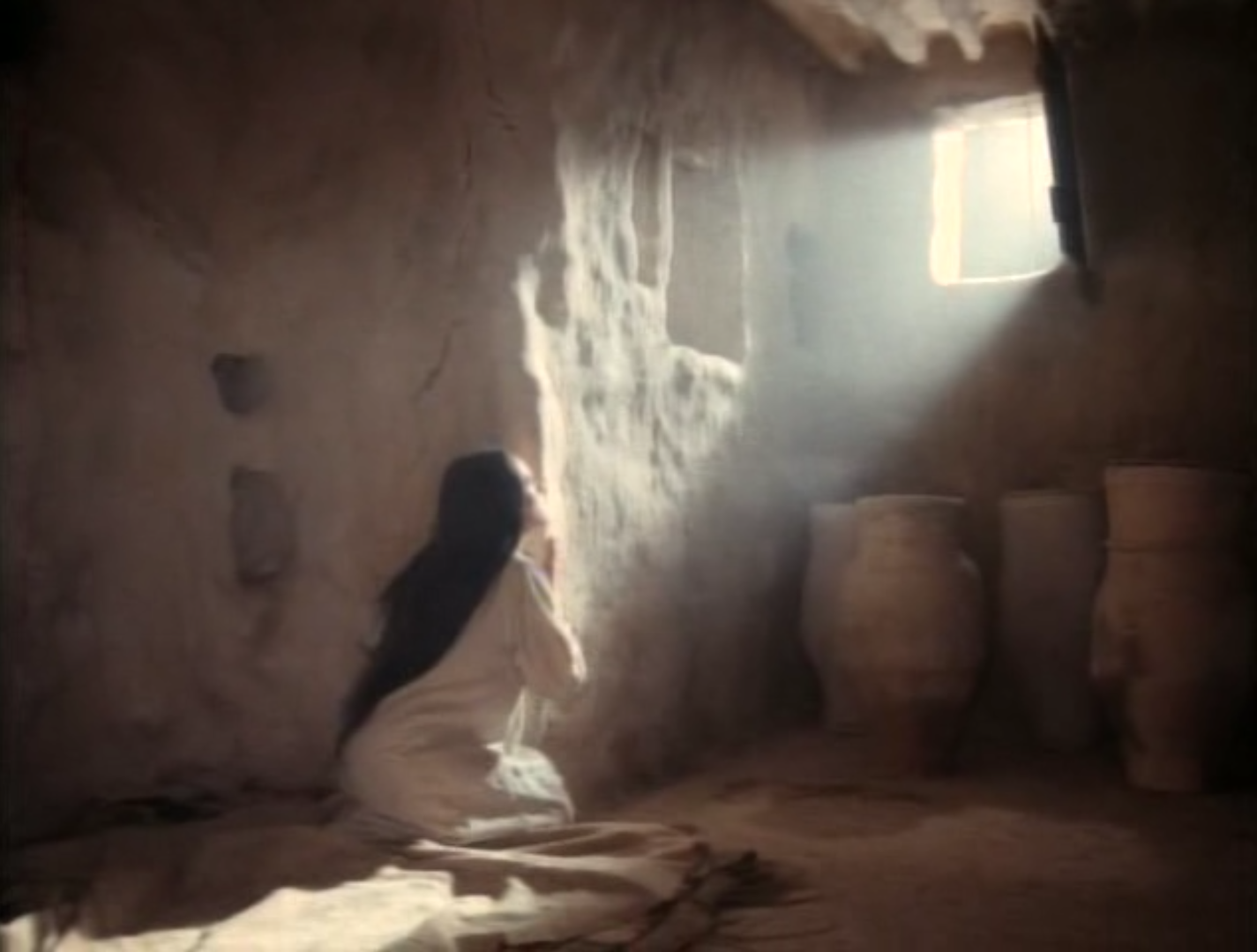
The Annunciation is one of the most visually arresting scenes in the film, not only because of Hussey's portrayal of an initially confused but ultimately devoted young woman, but also because of the striking choice not to have an actor playing the angel Gabriel.  Indeed the name "Gabriel" is not even mentioned and the viewer sees Mary as her mother Anna sees her -- it is one half of a conversation in front of light that is pouring in through the window.

Mary awakes at the sound of the window opening, and the light pouring in, and in a point-of-view shot, Mary looks up to see the window:


As she stands before the window, she converses with the angel, but the viewer, like Anna, sees only one half of the conversation:


And ultimately, Mary kneels in obedience to the angel's message in front of the window:


Here is a clip of the scene:


This motif, of light pouring through windows of a building in which a divine encounter takes place, occurs on several occasions in the film, including the raising of Jairus's daughter.  Jesus goes into the young girl's room alone (and not with Peter, James and John and the girls' parents as in Mark 5.40), and light is streaming in the window as Jesus crouches to heal the young girl.


Jesus speaks the words Talitha Cumi (Mark 5.41) and the girl rises.  The picture is beautifully composed with light coming in all three windows, and Jesus and Jairus's daughter either side of the middle window:


Incidentally, when the girl is hugged by Jesus, we have a rare shot of Robert Powell smiling with his eyes closed:


The same three-window motif occurs again when Jesus is teaching in the temple (in a scene that is only in the full, over six hour version, and not the abridged version currently found on Netflix):


Jesus is teaching in the temple while a large crowds sits, gazing in wonder, and Zerah (Ian Holm) watches from the sidelines.  The dialogue itself is taken from the Sermon on the Mount.  Here, Jesus of Nazareth, like most Jesus films breaks up the sermon, relocates it and redistributes a lot of its material.  In a tracking shot, the camera shows Jesus teaching with light streaming in three high windows.


Here is a clip of the piece:


One might also include here one of the films most iconic moments, when Pontius Pilate (Rod Steiger) sees Jesus emerging from the light in his doorway -- Ecce Homo:


Pilate is arrested by the sight of the man in the crown of thorns who has now approached him:


Wednesday, January 28, 2015

What have the Romans done for us? - Life of Brian and Jesus of Nazareth

One of the legendary scenes in Life of Brian features Judean rebels, led by Reg (John Cleese), asking, "What have the Romans done for us?"  I have been re-watching Jesus of Nazareth (dir. Franco Zeffirelli, 1977) this week and I have been struck by several Brian - Jesus of Nazareth parallels. One of these occurs at about thirty minutes into the film.

The location is Nazareth in about 4 BCE, and the Galileans Jews are discussing oppression by Rome before they are interrupted by Joseph.

"What does Rome give us?" they ask.  Here's the clip:


And in case you need a reminder, here's the famous clip from Life of Brian:


Update (Saturday 31 January): Many thanks to Matt Page who has commented over on Bible Films Blog. Among other things, he corrects my reading of the line.  It is "What does Rome give us?" and not "What do the Romans give us?"  It's interesting that I had harmonized a little to Life of Brian in my transcription, just as scribes of Mark often harmonize to the more familiar Matthean versions of Jesus' sayings!

Wednesday, March 03, 2004

Mel Gibson vs. Franco Zeffirelli

Thanks to David Mackinder for this excellent piece from Easterblogg:

Mel Gibson versus Franco Zeffirelli

A couple of excerpts:
In Jesus of Nazareth the Sanhedrin conducts a lengthy, reasoned debate about the meaning of prophecy, religious liberty, and the dangers of an uprising against Rome. Zeffirelli's debate is a little stilted, but depicts the Sanhedrin as containing men of conscience who were deeply divided about how they should treat Christ. At one point one of Zeffirelli's elders exclaims, "We are a people who love ideas and argument, then reject our prophets." Zeffirelli's Caiaphas is a doddering old man who dreads rebellion and is obsessed with fear that if Jesus really is the Messiah, then he will replace Caiaphas as leader. In sum, Zeffirelli presents the elders as real human beings, not cartoon villains.

The most telling point of difference between the films is the utter lack of joy in Gibson's telling. The Passion of the Christ is all torture, screaming, bleeding, and weeping. There's no sense that anything about Christ or his ministry is hopeful. Even in flashback scenes that precede the torture close-ups Gibson is so keen about, all is sad and depressing. We see a one-minute flashback to the Sermon on the Mount: Jesus preaches expressionless as if reading from the Federal Register, while the crowd looks about as happy as if they'd been forced there at gunpoint. There's a one-minute flashback to the Last Supper: Jesus drones in monotone while the expressions of disciples suggest they're all facing execution. This is either a total misreading of the Christian story, or reflects Gibson's desire to make that story one about misery rather than love. The Sermon on the Mount proclaimed a new hope for the human prospect; the Last Supper was a night of warm intimacy among friends. You'd never know from Gibson . . . .

. . . . . Mel Gibson appears not to like the joyful, hopeful, universalist message of Christianity. Fundamentalism of all faiths and denominations tends to be angry at the world, and Gibson's is at bottom an angry telling of the Jesus story--an argument that Christ's followers should be full of fury about their enemies and their mistreatment. Perhaps Gibson, a wealthy celebrity, sits around telling himself that he is being mistreated by enemies. Or perhaps Gibson simply longed to earn millions by being the first filmmaker to manage the race-to-the-bottom feat of presenting a gratuitous, exploitive version of the crucifixion. Take your pick of these unattractive alternatives, then stick to Franco Zeffirelli. . . . . .
Two minor quibbles. Zeffirelli is called "the previous big-name-director attempt at the Jesus story". I'd say Martin Scorsese qualifies for that. And I am not sure about the comment that "The Gospels also never say Jesus was beaten by the Temple guards who arrest him". Mark 14.65?