Monday, August 15, 2016

How to email your students

I have just come across this delightful piece of advice to students about how to email their professors (HT: Laura Lieber, with thanks!):

How to Email Your Professor (without being annoying AF)
Laura Portwood-Stacer

There is some great advice there, but I couldn't help thinking of those professors out there who do not know how to email their students. So here are some of my thoughts on this problem that occasionally rears its head:

How to Email Your Students (without being annoying)

(1) Don’t ignore your students' emails. One of the most frequent complaints that advisors hear is “The professor did not respond to my email.” This is rude and unprofessional, and you should be ashamed of yourself.

(2) Commit to responding as quickly as possible. Your students will love it if you respond in a timely fashion, and it will create a good vibe, which will improve the classroom relationship too.

(3) Actually read your students' emails. Don’t just toss off a hasty response that does not take their concern seriously. If you write a hasty, unhelpful response, you place them in the difficult situation of having to email you back again. This can make them feel awkward and embarrassed and it wastes their time and yours.

(4) Write as full a response as is necessary. Not too much; not too little. Don’t go over the top or you may come across as a wordy, head-in-the-clouds professor with no understanding of the issue at hand.

(5) Be encouraging. If the email asks a good question or makes a great point, congratulate your student on the intellectual stimulation that they have provided.

(6) Conclude the email by asking if this been helpful and if it has resolved their issue. Suggest that you would be happy to meet with them in person to discuss things further. Remember that many students are intimidated by their professors and are reticent to speak to them after class, or to come to office hours.

(7) Treat your student emails as part of an intellectual conversation. It is a wonderful privilege to be a professor in a university, and we are here to teach our students. We are engaged in an intellectual journey together in higher education. There are lots of people who would give their right arm to do what we are doing. Treat it as the privilege that it is.

(8) Try your best not to be pompous. Your students will not respond well to arrogance and condescension. You were a student once too. Try to remember what that was like!

Monday, June 20, 2016

Gospel of Jesus' Wife: Last Chapter Round-Up

Since the remarkable piece of investigative journalism from Ariel Sabar was published last Wednesday (The Unbelievable Tale of Jesus' Wife), in which the owner of the fragment, Walter Fritz, was unmasked, the discussion in the media has taken off at a pretty pace. In this post, I'd like to draw together several of the key developments. 

On Thursday, Christian Askeland filled in some further details on Walter Fritz in the Evangelical Textual Criticism blog:

More on the Gospel of Jesus Wife and Walter Fritz

And then on Friday, Owen Jarus of Live Science explained the key role he played in following leads on the text's provenance and finding his way to Fritz:

Gospel of Jesus's Wife Likely a Fake, Bizarre Backstory Suggests

Meanwhile, Karen King herself responded to Ariel Sabar's article and called him to say that she found it "fascinating" and "very helpful". In a short follow-up, Sabar explained that for Prof. King, the new information "presses in the direction of forgery":

Karen King Responds to ‘The Unbelievable Tale of Jesus’s Wife’
The Harvard scholar says papyrus is probably a forgery

These reported comments led to further media reaction as more read and digested Sabar's compelling story. One of the three original journalists to cover the story on 12 September 2012, Lisa Wangsness, author also of a fine piece entitled "Is the 'Gospel of Jesus' Wife a Revelation or a Hoax?" last November, returned again to the story in the Boston Globe:

‘Jesus’s wife’ papyrus likely fake, scholar says

Wangsness featured more comments from Karen King, as well as a tidbit from me. One of the questions in the article was whether there ought perhaps to be some kind of comment on the latest news from Harvard. A comment was soon forthcoming. Today (Monday 20th June), they added an update to the Gospel of Jesus wife website:

Update: June 20, 2016
Statement from HDS Dean David N. Hempton on the “Gospel of Jesus’ Wife”
The June 15, 2016 issue of The Atlantic Monthly published an article entitled The Unbelievable Tale of Jesus's Wife. The article called into question the provenance and authenticity of a papyrus fragment, purportedly stating "Jesus said to them, My wife" that is the subject of research by Professor Karen King of Harvard Divinity School. 
Reached for comment by The Boston Globe after publication of the Atlantic article, Professor King was quoted as stating that "It appears now that all the material [owner Walter] Fritz gave to me concerning the provenance of the papyrus ... were fabrications." 
On June 16, 2016, The Atlantic published an interview with Professor King by the same author, in which Professor King stated that the Atlantic's investigation "tips the balance towards forgery” and that the preponderance of the evidence now presses in that direction. 
The mission of Harvard Divinity School, its faculty, and higher education more generally is to pursue truth through scholarship, investigation, and vigorous debate. HDS is therefore grateful to the many scholars, scientists, technicians, and journalists who have devoted their expertise to understanding the background and meaning of the papyrus fragment. HDS welcomes these contributions and will continue to treat the questions raised by them with all the seriousness they deserve. 
David N. Hempton
Dean, Harvard Divinity School
Over the weekend and today there have been more and more articles on the story. Most of them simply repeat, summarize and comment on The Atlantic, Boston Globe and Live Science pieces, though there is a fresh piece from the Associated Press that is finding its way into several places, including The Guardian:

Jesus' Wife Papyrus Probably Fake, Say Experts
New evidence indicates the fragment in which Jesus refers to ‘my wife’ is likely to be a modern forgery

They interviewed me for this piece too, just after a Skype interview on CBN that is available here:


Debunking the Myth: Did Jesus Really Have a Wife?

Also today, the Boston Globe followed up its earlier article with a comment from Harvard Theological Review:

Harvard Theological Review won’t retract ‘Jesus’s Wife’ paper
. . . . Jon D. Levenson and Kevin J. Madigan, editors of the Harvard Theological Review, said in a statement Monday that their journal “has scrupulously and consistently avoided committing itself on the issue of the authenticity of the papyrus fragment.” 
The editors say King’s article and the articles on scientific tests King commissioned on the fragment “were represented or misrepresented in some circles as establishing the authenticity of the fragment.” . . . . 
There have also been several comments in the blogs that are worth viewing. As well as Christian Askeland and Peter Gurry on Evangelical Textual Criticism, there is interesting commentary from Roberta Mazza on Faces & Voices, Carrie Schroeder on Early Christian Monasticism in the Digital Age (Provenance, Provenance, Provenance, More on Social Networks and Provenance, and On Kindness and Critique), Jim Davila on Paleojudaica, and Malcolm Choat on Markers of Authenticity. I have certainly missed others; please let me have any links that I should add.

I don't have much fresh to add, at this point, to what I've already said. Perhaps I will say more in due course. My overwhelming feeling at this point is a profound sadness about the whole affair. Yes, it's been fantastic to see scholars like Christian Askeland and Andrew Bernhard exposing the hoax so skilfully. And it is true that the twists and turns of the story over the last four years have made fascinating reading. But at the same time it's very sad that we have all spent so much time and energy on what, in the end, is someone's attempt to dupe the academy. We are all victims of this appalling episode.


Wednesday, June 15, 2016

The Owner of the Gospel of Jesus' Wife is Unmasked

In September 2012, four journalists were granted special interviews on the Gospel of Jesus' Wife, published the day that Karen King revealed the manuscript in Rome. One of them, Lisa Wangsness, returned to the topic last November in a follow-up article in the Boston Globe. Now another of them, Ariel Sabar, who wrote a compelling and lengthy article for The Smithsonian, has also returned to the topic in a quite brilliant piece of investigative journalism, published this time in The Atlantic:

A hotly contested, supposedly ancient manuscript suggests Christ was married. But believing its origin story requires a big leap of faith.
Ariel Sabar

Karen King has always protected the anonymity of the owner of the papyrus but his identity is now no longer in doubt. Quite simply, this is a superb piece of investigative journalism. Sabar unmasks Walter Fritz in a detailed and compelling story that is the result of intelligent and detailed research. It will take you a while to read, but it will be worth it.

I could excerpt pieces of the article, but I'd rather not spoil it by doing that, especially as it is structured so beautifully. I will, however, say that I am delighted that Walter Fritz has such confidence in the scholarship of those who exposed the forgery, whom he describes as "'county level' scholars from the 'University of Eastern Pee-Pee Land'”.

Update (Thursday 16 June, 5.08pm): Christian Askeland helpfully fills in some further details on Walter Fritz in the Evangelical Textual Criticism blog:

More on the Gospel of Jesus Wife and Walter Fritz

Update (Thursday 16 June, 11.30pm): Only twenty-four hours after Sabar's article, he has this follow-up:

Karen King Responds to ‘The Unbelievable Tale of Jesus’s Wife’
The Harvard scholar says papyrus is probably a forgery

And so we have reached the final chapter of this affair, after almost four years of discussion. 

Wednesday, March 09, 2016

St Thomas Basilica

Following on from my recent posts about St Thomas Mount and Little Mount, this one explores another key Thomas location, St Thomas Basilica in Mylapore, Chennai, India. This is the place where Thomas's tomb is allegedly located and an impressive neo-Gothic cathedral is on the site.

Once again, I recorded my thoughts and edited them in the latest episode of the NT Pod:

NT Pod 79: Santhome Basilica

The magnificent white church building was built by the British in the late nineteenth century but the basilica was built by the Portuguese in the 16th century (cf. the church at Little Mount). I decided to make the journey by bus, which is something of a challenge, not least because the buses in Chennai are so unbelievably crowded. But they are also unbelievably cheap. A one-way journey lasting an hour (over about 17 km) cost me just 12 rupees (about 12p or 18c).


There is one huge advantage that this site has over the previous two that I visited -- it has a museum dedicated to the Apostle Thomas. And the museum features several items of interest. Unlike St Thomas Mount, it is not just about John 20 and "My Lord and My God". There is much more by way of the apocryphal Thomas traditions, perhaps most interestingly this relic of the lancehead that supposedly killed Thomas.
There is also a double-sided pedestal that references King Gondophores and the legend of the log on the one side (a legend also illustrated in a relief that is on the wall of the museum), and Thomas in teaching mode on the other side.

Somewhat frustratingly, a lot of the other material in the museum is labelled only in the most vague way imaginable. So there is an entire display of ancient pottery apparently discovered at the site, with dating only to "the olden days"! So too another display of bones is said to be from that same period.

The museum itself is situated above Thomas's tomb. The tomb is at the front of a chapel with pews where people pray and reflect. There is not a lot to see -- it's a colourful, relatively modern representation of Thomas in glass casing.

Although in the podcast I say that I could not take a photograph in there, I later managed to return to the site when it was empty and I took a quick pic while no one was looking.

I should also mention the large golden "pole of St Thomas" which stands tall to the side of the cathedral. It is reminiscent of the similar poll at St Thomas' Mount, although this one is taller and has a much smaller cross at the top.

Inside the cathedral itself, I should mention a nice statue of Thomas that sits to the left of the altar. Thomas is holding the legend "Deus Meus" (My God), so here, for once, we do not get the whole Johannine confession. Again, we were not supposed to be taking photographs, but my visit happened to coincide with a coachload of pilgrims from Nagaland, all of whom were snapping away with gay abandon (and rather bizarrely, they also all wanted to get pictures with me! I sat with various members of the group outside the cathedral for a good ten or fifteen photos!).

I was a touch disappointed that the promised twenty minute film about Thomas, which is very proudly advertised just outside the museum, was nowhere in evidence. At least I found it impossible to find anyone who could tell me any more about it.

Another curiosity of my visit, and this is partly reflected in the podcast, is the pursuit (one might say harassment) by several auto rickshaw drivers. One of them followed me around the entire site, usually on foot, but sometimes in his auto. At first, he made out that he was connected with the site and I foolishly engaged him in conversation. But soon it became clear that he wanted my business.

Once I'd shaken him, I got another, who even sat next to me in the cathedral. Once rid of him, and after the photographing session with the people from Nagaland, a third one began to pursue me. This one was the worst, and pursued me down the road after I left the site, even driving ahead of me, hiding behind a tree and jumping out in front of me.

Gandhi, on the beach at Mylapore, Chennai
A fourth auto driver was honest enough to tell me why they were so keen for business -- a group of four local shops selling hand-crafted goods were offering a 5kg bag of rice to any auto driver who brought them a new customer. Much later in the day, after my Veg Maharaja Mac at McDonald's, I happened to meet this guy again at the beach, where I was heading in the direction of the bus-stop for my journey back, and I rewarded his honesty by going on the little shop-tour so that he could pick up his bag of rice. But of course no good deed goes unpunished. We parted on bad terms because I would not also pay his rent for the next month.

Thursday, March 03, 2016

Little Mount

Following on from my recent post about St Thomas Mount, this one explores another key Thomas location, Little Mount (Chinnamalai), also in Chennai.

It's the place where Thomas allegedly faced his death, and the church is built over the cave where he hid from persecution.

As before, I recorded my impressions of the site as I visited it, and I have released it as an episode of the NT Pod:

NT Pod 78: Little Mount


The site itself is tucked away down a side street (the "L.D.G. Road") with no sign-posts in sight. It caused my driver some degree of stress, to the point where I eventually got out of the car and walked. I could see where it was on my Sat Nav on my phone, but he was not inclined to trust it.

"Little Mount" really is only a few steps up from the road, and is nothing like the climb up to St Thomas Mount. Although it is the large round twentieth century church that makes the big impression, it's the old chapel built by the Portuguese in 1551 that houses Thomas's cave.


The chapel is small, but pleasantly cool if you are visiting on a hot day. A few pews look up towards a shrine of the Virgin Mary, but down to the left is St Thomas's cave.

I did not try recording in the chapel or the cave, not least because a gentleman hovered around me looking anxious when I had my phone out. But I did manage to grab a couple of quick pics.

There's a nice old explanatory placard before you go down to the cave. It's just the kind of thing one wants to see on these occasions.


The old marble placard reads, as best I can decipher it, as follows:

The cave where lay hid persecuted just before being martyred by Rajah Mahadevan, king of Mylapore, A.D. 68, Thomas, one of the twelve, the great Apostle of India, the very one who put his finger into the wounds of his Lord and God. Drop your penny for this great historical and archaeological monument.


While I was there, a woman went down into the cave to do some sweeping (I have seen a lot of women sweeping in India) and to collect up the pennies that had been dropped.

The cave itself is not for the claustrophobic. It has a proper bend-down-low entrance. There is a small shrine inside the cave, and a red circle marks the spot where Thomas was allegedly martyred.

The cave is without doubt the major attraction. I wondered whether it gets horribly crowded at busy times. I was happy to have it to all to myself. There were several praying in the chapel while I was there but none went down to the cave. I think I may have been the only tourist type there. 

While I was sitting outside the chapel, by this sign pointing to "St. Thomas Cave", a gentleman approached me and pointed to "water". I thought he was worried that I was overheating, but in retrospect, I think he may have been directing my attention to the miraculous spring. 

On the way there, one sees a rocky feature that draws attention to Thomas's footprint.

Up a few steps, one enters a separate chamber that has two key features. This is one -- a fountain with water that "cures diseases". The water is now behind bars and presumably inaccessible to present-day pilgrims.

The other is also a rocky crag, and it features a cross that is cut out of the rock.


This cross is behind glass and has the header "cross made by St. Thomas". Above it is a sign that says that the cross bled for many years in the 16th and 17th centuries.

There was a lady hovering around me the whole time that I was looking at these things, and I realized after a while that she was waiting for a contribution. It was rather a formal process -- she wrote it all down in her book and handed me a receipt. But once given, she allowed me to take my pics and do my recordings without hassle.


Little Mount also has a park it labels "Holy Land", accessible through some large pink gates. The idea of the park is that it imitates Jerusalem, and features colourfully represented elements from the Passion Narrative.

The most striking of these is a trial scene featuring Jesus (with a red robe and a green crown of thorns),  a centurion and two black elephants!

Wednesday, March 02, 2016

St Thomas Mount

The NT Pod and the NT Blog go on the road! It's long been an ambition of mine to visit the sites connected with the Apostle Thomas out in Chennai (formerly Madras) in India. I decided to photograph my visit and also to record my reflections.

You can listen to my first ever "on the road" episode of the NT Pod here:

NT Pod 77: St Thomas Mount


It is about 14 minutes long. The audio quality is of course much worse than usual. I was recording on my iPhone and I am a bit breathless as I climb the steps early the episode. And the wind at the top of the mount also interferes with the recording, as do the sounds of the planes above. But I hope that you enjoy a bit of the Chennai ambience, especially all those honking cars.

I arrived at the mount by taxi after a getting stuck in a very long traffic jam. Chennai traffic can be choc-a-bloc. I must admit that there is no way that I would want to drive here. It can be pretty terrifying to see how India drivers drive, and it's amazing that there are not more accidents. It's a question of experience, I suppose.

St Thomas Mount is in Chennai and is pretty close to the airport. There's a enjoyably battered old sign that greets you on entry (right), with a "tiffin" stall just underneath.

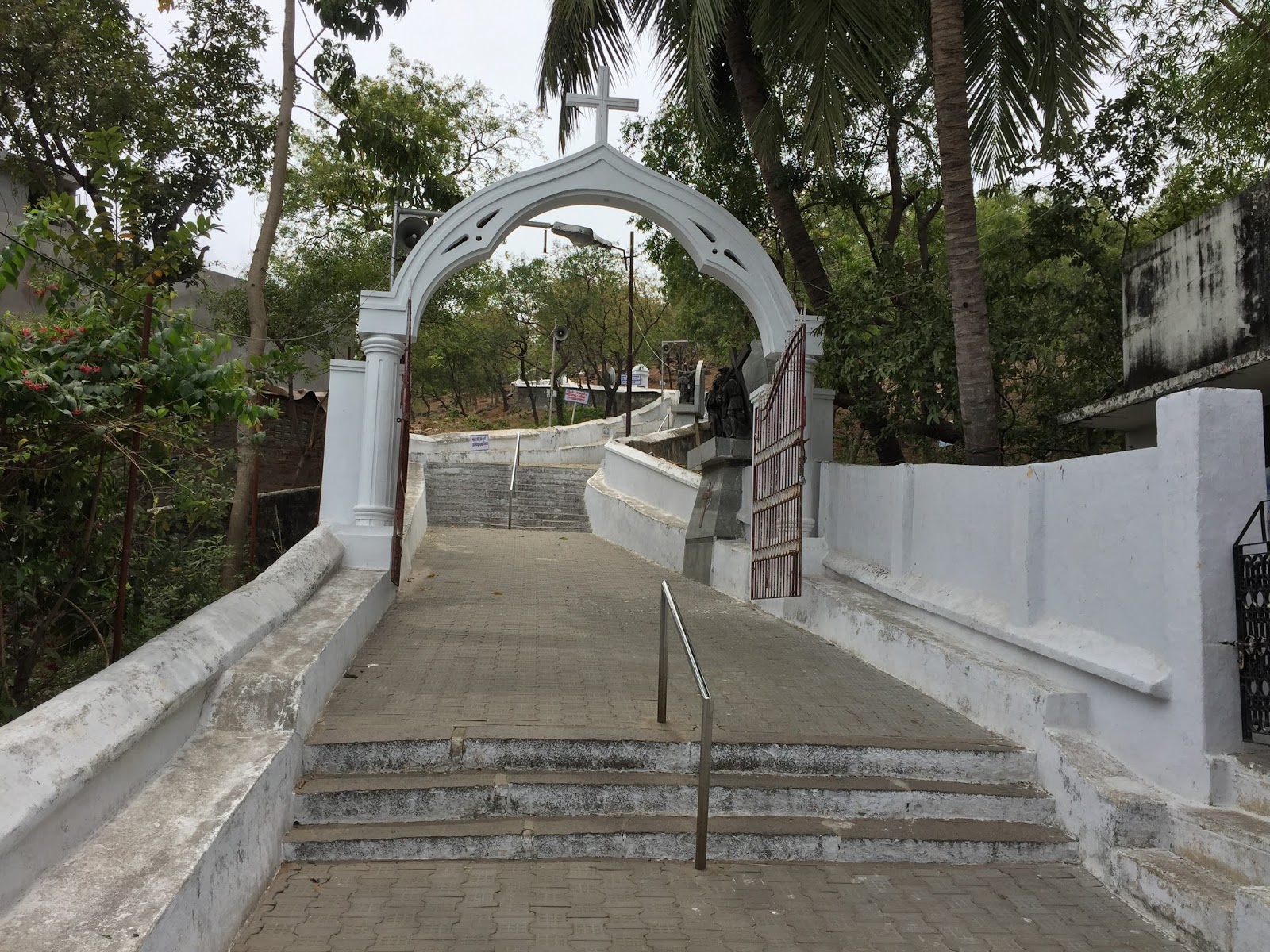
Beyond the battered old sign, to the left as we look, is the facade at the bottom of the mount that marks the beginning of the journey to the top. This nicely white-washed appearance is characteristic of the whole, including the walls either side of the steps on the way to the top, and the chapel building on top of the mount.

As one walks up the steps, the stations of the cross appear at regular intervals.

I visited the site on a Monday afternoon in February and there were only a few people around. And few of those were real tourists. The small shop selling religious artefacts was hardly doing any business at all.

Most of the visitors appeared to be there to pray. I think I saw more people inside the chapel than anywhere else.

It is striking to see how strongly the Thomas tradition has taken hold in the region. The tradition is at least as old as the Acts of Thomas which tells the story of the apostle's pilgrimage to India, at first with great reluctance.

St Thomas Mount itself offers very little by way of explanatory history. I didn't see a single placard giving anything of the apostle's story. His connection with the location is simply taken for granted.


A colourful statue of Thomas, with a gold, red and pink garment greets the pilgrim towards the top of the steps. He holds in his hand a book open to the words "My Lord, My God" (John 20.28). This is the first time we see these words, but then they appear again and again all over the shrine.

Once at the top of the mount, one of the more striking features is a tall, golden crucifix, on the far side of the mount, overlooking the city.


Just below it, as one looks down towards the city, the words "My Lord, My God" are spelled out in white stones.


The central piece is the church itself, which stands with a bronze relief of the Last Supper above its door. Once again, "My Lord, My God" are repeated here.


The chapel has an entrance called "the door of mercy", again with "My Lord and My God" over it, and a recent (2011) statue of Jesus and Thomas several feet in front of it.

Inside the chapel, there are individual pictures of the twelve apostles, right down to Thaddaeus, surely the more overlooked of the twelve!

I was perhaps a touch disappointed that the mount was so thoroughly focused on the one passage in John 20 and that there was so little influence from texts like the Acts of Thomas, and remarkably little on the apostle's connection with India.


One of the only depictions of Thomas not taken from John 20 is this scene of the apostle praying. It appears after the door of mercy on the entry into the chapel, opposite a depiction of Thomas and Jesus drawn from John 20. of the only depictions of Thomas not taken from John 20 is this scene of the apostle praying. It appears after the door of mercy on the entry into the chapel, opposite a depiction of Thomas and Jesus drawn from John 20.


There is also a convent on top of the mount. It speaks rather invitingly of "cool drinks" but nothing was on offer when I entered, and although there were several people in there, they appeared to be deep in their own conversations.

Elsewhere on the mount there is a stall that sells souvenirs but they were not really to my taste -- the kinds of garish mini-statues of Thomas and of Jesus that one would only buy to prove that one has visited the site.


There are loos just around the corner from the convent but it has to be said that they are a touch on the primitive side, perhaps dating back in time to when Thomas first visited India.


Overall, though, St Thomas Mount is well worth a visit. If you're anywhere near Chennai airport, it's a pretty short journey. Unless I missed it, disability access is poor to non-existent, so it is sadly only for those who can tackle the walk.

Although there are not that many steps, you may find yourself puffing and panting a bit (as you hear on my podcast), especially if you go along, as I did, during the heat of the day.

Tuesday, March 01, 2016

2016 Clark Lectures with Loveday Alexander

One of the great traditions at Duke is the annual series of Clark Lectures. Duke has hosted many fine scholars and some great lectures, and this year is no exception. This year's Clark Lectures feature Dr Loveday Alexander:

2016 Clark Lectures with Loveday Alexander
Duke Divinity School will hold the 2016 annual Clark Lectures with guest speaker Loveday Alexander, emeritus professor of Biblical studies at Sheffield University in England. Alexander will lecture on "Is Luke a Historian? Writing the History of the Early Church," and will give a second lecture on the topic on March 2 from 12:20 to 1:20 p.m. in 0012 Westbrook. The lectures are free and open to the public.
More at the link above.

Tuesday, January 12, 2016

John Barclay Interviewed by Eerdmans

John Barclay recently published Paul and the Gift and it is currently one of the most talked-about boos in the field. Now Eerdmans have released an interview with Prof. Barclay:


It's a lively, clear and fascinating fifteen minutes.

And from the look of those vase-shofars in the background, this was filmed in a hotel room in the Hyatt Atlanta at the recent SBL Annual Meeting.

Monday, January 11, 2016

David Bowie as Pilate in Last Temptation of Christ

The sad news today of the death of David Bowie has of course been all over the media, Facebook and Twitter. For fans of Jesus Films, Bowie gave us one of the most memorable, iconic characterisations of Pontius Pilate in Scorsese's uneven but at times inspired Last Temptation of Christ (1988). Here's the key clip:


It is a wonderfully understated, chillingly cool performance, all the better for the intimacy of the private conversation between Pilate and Jesus. There have been many outstanding and fascinating portrayals of Pilate, Rod Steiger in Jesus of Nazareth, Telly Savalas in The Greatest Story Ever Told, James Nesbitt in The Passion (BBC), but Bowie's is one of the most compelling.

(Thanks to Daniel Gullotta and Bible Films on Facebook for posting the above clip).

Sunday, December 20, 2015

NT Pod 76: This year's Christmas episode

The Christmas episode of the NT Pod has landed!

NT Pod 76: The Magi in Matthew's Gospel

This time with sleigh bells! And Johnny Cash! And Ella Fitzgerald! And me yabbering on about Matthew 2.1-12.

You can find it in the usual places -- at podacre, on iTunes, on Stitcher, on your RSS reader, and (if it ever updates) Duke's iTunes U.

Monday, December 14, 2015

I. Howard Marshall (1934-2015)

I was sorry to hear of the death of I. Howard Marshall over the weekend. He was 81. Marshall was a prolific scholar and he will be fondly remembered, especially the generations of evangelical students he trained at the University of Aberdeen.

I was lucky to get to know him a little after his retirement because he was a regular at the British New Testament Conference. He had been president of the society, and his name was on the bank account. He always showed great humour when I asked him to sign all our cheques. He said that he enjoyed spending other people's money.

Prof. Marshall was always encouraging and gracious to younger scholars. I remember in particular his kindness in providing feedback on a paper I gave on the first beatitude, which later became Chapter 7 of The Case Against Q. He was not at all convinced! Like most evangelicals of the day, including his teacher F. F. Bruce, he was wedded to Q. I have often consulted his commentary on Luke, which may be his finest and most important book.

I first saw Prof. Marshall on TV, when I was a teenager. He was interviewed for the Channel 4 programme Jesus: The Evidence, which also featured Geza Vermes, Helmut Koester, Werner Kümmel and Morton Smith. I have extracted the minute or so that features Howard Marshall and uploaded to Youtube here:


It was something of a cause célèbre at the time among evangelicals that Prof. Marshall only received a minute or so compared to the many minutes given to Geza Vermes, George Wells and others!

There is also a lecture on Youtube from Acadia University:


It is from 2002 (uploaded in 2012) and the topic is "The Interpretation of the Bible and Development of Theology." Over on Biblical Studies Online, Deane Galbraith has gathered together a series of Prof. Marshall's lectures from 1991, the Moore College Lectures on A Fresh Look at the Acts of the Apostles:

I. Howard Marshall on the Acts of the Apostles

There have been several tributes to Prof. Marshall online, including Ray Van Neste in Gospel Coalition, Darrell Bock, also on Gospel Coalition, Michael Bird on Euangelion, Stanley Porter on Domain Thirty-Three. There are comments also on Jim West's blog and James McGrath's blog. Please let me know in comments if I have missed anything.

Sunday, November 29, 2015

The Gospel of Jesus' Wife Latest: Boston Globe Update

The Boston Globe today presents a thorough, well-researched, and fair update on the saga of the Gospel of Jesus' Wife:

The Case of the Gospel of Jesus' Wife Still Isn't Closed
Lisa Wangsness

Regular readers will of course know of my own interest in this topic, and I am pleased that Lisa Wangsness has returned to the topic after over three years. It is worth bearing in mind that she is one of the three reporters given special access in the early stages back in September 2012. What is truly impressive is the research that she has put into this piece.

She has interviewed me, Karen King, Malcolm Choat, Andrew Bernhard, Christian Askeland, Tony Burke, Caroline Schroeder and several others. But more importantly, the graphics contribute really impressively to explaining the case for forgery.

Thursday, October 01, 2015

Dietmar Neufeld (1949-2015)

I was so sorry to hear of the death of Dietmar Neufeld on September 9. Dietmar Neufeld was professor in the Department of Classical, Near Eastern & Religious Studies at the University of British Columbia. Although I did not know Prof. Neufeld well, I had a high opinion of his work and I'd like to add some reflections here.

Neufeld has made important contributions to several areas of scholarship on the New Testament and Christian origins, as well as reaching out into several related areas. His reputation in the field was established through his membership of the Context Group, but he also became well known by those working on the Johannine epistles. His first authored book, Reconceiving Texts as Speech Acts: An Analysis of 1 John (Leiden: Brill, 1994) was well received. When he offered the manuscript of his second authored book, Mockery and Secretism in the Social World of Mark’s Gospel, to the Library of New Testament Studies book series (published by Bloombsbury / T & T Clark in April 2014), we enthusiastically accepted it for publication in the series.

In many respects, this is his most impressive work. In it, he tackles one of the most vexed issues in New Testament scholarship: how do we make sense of the elements of secrecy in Mark’s Gospel?  He brings his social-scientific perspective to the work and engages in a detailed study of mockery in the Graeco-Roman world, and uses these insights to reinterpret the characterization of Jesus and his disciples in Mark’s Gospel.  I thought it an original, stimulating take on the subject.  I also found  valuable his nuanced, critical discussion of recent trends in the study of orality and literacy in the ancient world, in which he resists some of the emerging over-simplifications and clichés in scholarship in this area.

One of the values of Neufeld’s work was its scope. Where so many in the field are so narrowly focused, Neufeld's interests ranged widely, covering the Synoptic Gospels (especially Mark), Paul, Revelation, the Johannine epistles, the apocryphal Life of Adam and Eve, and more. Further, Neufeld talked and wrote about issues in education, pedagogy and translation.

He will be greatly missed.

Tuesday, September 08, 2015

The End of the Gospel of Jesus’ Wife Forgery Debate

Guest post by Andrew Bernhard

[PDF of this blog post available here]

For nearly three years, there has been considerable controversy and confusion about whether a business-card sized papyrus fragment dubbed the Gospel of Jesus’ Wife is an authentic ancient artifact or not. The current scholarly consensus already holds that the fragment is forgery. In addition, a recent development has confirmed that the Gospel of Jesus’ Wife is a forgery created using a specific internet edition of the Gospel of Thomas. It seems that the Gospel of Jesus’ Wife forgery debate has finally come to an end.


The Patchwork Forgery Theory

Shortly after Professor Karen King of Harvard Divinity School unveiled the Gospel of Jesus’ Wife at an academic conference in September 2012, a scholar named Francis Watson pointed out that the text appeared to be little more than a “patchwork” of words and short phrases culled from the lone surviving manuscript of the Gospel of Thomas in Coptic (a form of the ancient Egyptian language). Building on the work of Professor Watson and other scholars (including Alin Suciu and Hugo Lundhaug), I soon suggested that the Gospel of Jesus’ Wife could have been created by someone with limited knowledge of Coptic using a specific modern edition of the Gospel of Thomas prepared by Michael W. Grondin.

As I researched the textual relationship between the Gospel of Thomas and the Gospel of Jesus’ Wife, I began to collect evidence that ultimately convinced me that the Gospel of Jesus’ Wife was indeed prepared by someone relying directly on the PDF edition of Grondin’s Interlinear Coptic/English Translation of The Gospel of Thomas posted online in November 2002. I discovered that the textual similarities between the Gospel of Jesus’ Wife and the Gospel of Thomas were overwhelming. Basically, to create the Gospel of Jesus’ Wife, all a forger would have had to do was “cut and paste” text from the Gospel of Thomas, switch a few masculine pronouns to feminine (a single letter change in Coptic), and place two key Coptic words (meaning “Mary” and “my wife”) into the “patchwork” text to create its “sensational” content. The only other change that would have been needed was the simple deletion of the two-letter Coptic word meaning “not” in line 5.

The figure below illustrates the relationship between the Gospel of Jesus’ Wife and the Gospel of Thomas. It presents the Coptic text of the Gospel of Jesus’ Wife papyrus fragment: text that appears to have been copied verbatim from the Gospel of Thomas is underlined (double underlined if it might easily have differed). Parallels to the Gospel of Thomas (with their manuscript page and line numbers in parentheses) are noted beneath the Coptic text. The Coptic pronouns that appear to have been changed from masculine to feminine are printed in green italics. The Coptic words not copied verbatim from the Gospel of Thomas that look like they have been specifically inserted into the “patchwork” text are printed in bold red: “Mary” (line 3) and “my wife” (line 4).


Every single line of the Gospel of Jesus’ Wife contains one or more snippet(s) of text found in close proximity to each other in the Gospel of Thomas; indeed, for each individual line, the relevant snippets always appear in a single screen view of the PDF of Grondin’s Interlinear at 100% size on an average-sized laptop. In addition, the Coptic text of the Gospel of Jesus’ Wife contains at least five suspicious features (denoted by superscript Latin letters in the figure above):

(a)   Line 1 of the Gospel of Jesus’ Wife unexpectedly shares a line break with the lone surviving Coptic manuscript of the Gospel of Thomas: both split the same word in the same place. This could be explained as a coincidence, or it could be attributed to a forger’s dependence on Grondin’s Interlinear. As a line-by-line edition of the lone surviving manuscript of the Gospel of Thomas in Coptic, Grondin’s Interlinear repeats all of that manuscript’s line breaks.

(b)  Line 1 and the corresponding passage in Grondin’s Interlinear both unexpectedly omit the required direct object marker (ⲙ-) before the final word visible on the line. This Coptic grammatical error might reasonably be compared to writing “She played the dog for me” rather than “She played with the dog for me.” A few other ancient manuscripts do contain an analogous mistake, but the Coptic grammatical error could also be attributed to a forger’s dependence on Grondin’s Interlinear. The 2002 PDF version of Grondin’s Interlinear omitted the direct object marker by accident as the result of a typographical error (unlike any other version of Grondin’s Interlinear).

(c)   Line 4 unexpectedly omits the Coptic word ϫⲉ (je), which would function something like a comma and an opening quotation mark in English. This omission could be explained as non-standard (if not completely unattested) Coptic grammar, or it could be attributed to a forger’s dependence on Grondin’s Interlinear. A forger might well have omitted the Coptic conjugation by accident because it is separated from the (seemingly complete) Coptic phrase meaning, “Jesus said to them” by a line break in Grondin’s Interlinear.


(d)  Line 6 presents a relative clause (ⲉⲑⲟⲟⲩ) after a non-definite noun (ⲣⲱⲙⲉ) in violation of Coptic grammar. This grammatical construction has only been explained as "a rare attestation of an as yet only partially understood phenomenon" (without any examples from ancient manuscripts provided), but it could also be attributed to a forger’s dependence on Grondin’s Interlinear. In its original context in Grondin’s Interlinear, the relative clause (ⲉⲑⲟⲟⲩ) follows the appropriate kind of noun (ⲡⲉϥⲉϩⲟ) in accordance with standard Coptic grammar.

(e)   Line 6 also contains a verb that has been conjugated twice (that is, the single verb in the line has been modified by two verbal prefixes); * as a result, the line is ungrammatical. The text could be compared to an English statement something like, “Let no wicked man does bring.” When the pertinent words from Grondin’s Interlinear are juxtaposed, the ungrammatical line of Coptic text makes perfect sense . . . in English:


The following table summarizes the different explanations that have been offered to explain the suspicious textual features of the Gospel of Jesus’ Wife:


While all five of the suspicious textual features of the Gospel of Jesus’ Wife could hypothetically be explained if the papyrus fragment were an ancient artifact, it is startling that so many suspicious textual features appear on a papyrus fragment so small that it contains just seven lines of text with more than a single word. The simplest (and most persuasive) explanation for these suspicious textual features is that they are all the result of a forger’s dependence on Grondin’s Interlinear.

[For my full analysis of the relationship between the Gospel of Jesus’ Wife and Grondin’s Interlinear, see the July 2015 issue of New Testament Studies (Cambridge University Press).]


"This" in the English translation given to Professor King

In early April 2014, Harvard Theological Review released an issue devoted primarily to the Gospel of Jesus’ Wife. Shortly after, Mark Goodacre and I were reviewing information that had been published about the Gospel of Jesus’ Wife soon after it was first unveiled in 2012. Each of us noticed the following passage in the first Gospel of Jesus’ Wife article published by Smithsonian:


[The owner] sent along an electronic file of photographs and an unsigned translation with the bombshell phrase, “Jesus said this to them: My wife…” (King would refine the translation as “Jesus said to them, ‘My wife … ’”) (emphasis added)

The appearance of the word “this” in the translation of the most notable line of the Gospel of Jesus’ Wife was odd because nothing in the Coptic text of the papyrus fragment corresponds to this word. After discussing the matter, Professor Goodacre and I realized that “this” was apparently a translation of the unexpectedly absent Coptic conjugation ϫⲉ (je) in line 4, and the word was mistranslated as “this” . . . just as in Grondin’s Interlinear.

We concluded that the “translation” of the Gospel of Jesus’ Wife that the owner of the papyrus fragment had given Professor King was almost certainly dependent on the English of Grondin’s Interlinear, just as we believed that the papyrus fragment itself was almost certainly dependent on the Coptic text of Grondin’s Interlinear. But we did not have access to the owner’s “translation” at the time, so we had no way to test our theory.

I noted our observation in a PDF on my website and commented on it again in my 2015
New Testament Studies article on the Gospel of Jesus’ Wife (
abstract; pages 347-348, 355).


Confirming Evidence of Forgery: The Release of the Owner's "Translation"

On August 27, 2015, Professor King generously released the English “translation” that the owner had provided her, and it is dependent on the English of Grondin’s Interlinear (just as we had predicted). The extensive verbal correspondence between the owner’s “translation” and the English of Grondin’s Interlinear cannot reasonably be attributed to anything but direct literary dependence.

The owner’s “translation” of the Gospel of Jesus’ Wife displays evidence of dependence on Grondin’s Interlinear in every line with more than one word. It includes repeated English “translations” of Coptic words not even present on the papyrus fragment itself, incorrect translations of Coptic text, and distinctive translations as well – all of which can be traced back to Grondin’s Interlinear.

For example, compare the pertinent passages in Grondin’s Interlinear with the transcription of the first line of the owner’s “translation” of the Gospel of Thomas:


The English words and word order in both Grondin’s Interlinear and the first line of the owner’s “translation” are identical, but they should not be. The word that means “for” appears in the Coptic text of Grondin’s Interlinear, but it does not appear in the owner’s Coptic transcription of line 1 (or on the Gospel of Jesus’ Wife papyrus fragment). Grondin has placed “ - - - ” beneath the word ⲅⲁⲣ (gar: “for”) and inserted the English word “for” in parentheses before “my mother” in his translation, presumably because he preferred to use English (rather than Coptic) word order. The person responsible for the owner’s “translation” has obviously not translated a Coptic word meaning for from the Gospel of Jesus’ Wife because no such Coptic equivalent is present. Obviously, the word “for” has been copied directly from the English of Grondin’s Interlinear.

This observation and many others like it demonstrate that the owner’s “translation” of the Gospel of Jesus’ Wife is not an actual translation of the Coptic text of the Gospel of Jesus’ Wife papyrus fragment; it was prepared by someone incapable of translating Coptic who borrowed straight from the English of Grondin’s Interlinear

[For a more detailed discussion of the evidence that the owner’s “translation” borrowed directly from the English of Grondin’s Interlinear, see my recent blog posts here and here.]


Conclusion

We can now be confident not only about the modern origin of the Gospel of Jesus’ Wife but also about how the text itself was prepared. The Gospel of Jesus’ Wife was created simply by “cutting and pasting” text from the Gospel of Thomas, switching a few pronouns, and inserting the key Coptic words meaning “Mary” and “my wife” into the “patchwork” text. In addition, the modern forger has left many “fingerprints” on this purportedly ancient text: detailed analysis of the Gospel of Jesus’ Wife has revealed that it contains at least five suspicious textual features that are most persuasively explained by a forger’s dependence on the Coptic of Grondin’s Interlinear.

On the basis of the theory that the Gospel of Jesus’ Wife papyrus fragment was prepared by someone using Grondin’s Interlinear (and the presence of the single word “this” in a seven word excerpt from the owner’s “translation”), we were able to predict that this “translation” would show direct dependence on the English of Grondin’s Interlinear. Our prediction has now been confirmed by the recent release of the owner’s “translation.”

It is not plausible that the Gospel of Jesus’ Wife papyrus fragment was created independently of the owner’s “translation.” Both must have been prepared after 1997, when Grondin’s Interlinear was first posted online (two years before archive.org recorded its existence). I suspect that they were prepared using the PDF version of Grondin’s Interlinear posted online on November 22, 2002. The first line of the papyrus fragment appears to repeat a typographical error found only in this version of Grondin’s Interlinear; also, using either of the graphical versions (page-by-page or saying-by-saying) would have required flipping back and forth between graphics online in a manner that would have made the forgery more difficult.

I think it is now safe to assert that the legitimate Gospel of Jesus’ Wife forgery debate has come to an end. Ideally, any ongoing research efforts related to the Gospel of Jesus’ Wife will be focused on identifying the person(s) responsible for the forgery. The still-unidentified individual who brought the Gospel of Jesus’ Wife to Professor King also provided her with at least two more documents suggesting that the Gospel of Jesus’ Wife was examined by a pair of German scholars in Berlin in 1982 (fifteen years before it could have been created), as well as an obviously forged Coptic papyrus fragment containing a part of the Gospel of John. I hope that scholars can work together to prevent the dissemination of additional forged papyrus fragments that could disrupt historical research.


* In technical terminology, the single infinitive in the line has been modified by two conjugation bases.