The new Biblioblog Top 50 is now available:
Biblioblog Top 50: April 2009
As usual, a huge amount of work has gone into it. If the author would step out of the shadows, I would enjoy thanking him personally (the author is, of course, male and goy).
I had not realized that Andrew Bernhard had begun a blog at his gospels.net site, and it's good to see it doing well. I am also pleased to see the NT Blog doing OK too.
A bigger surprise is to see my experimental podcast featuring among the list of new blogs. I will blog about this in due course but since it gets a mention and a link, let me fill in some background. I am planning to release a proper public podcast in the coming weeks but decided to experiment first by recording short podcasts for students on my Historical Jesus course, in order to get on top of the technology and to experiment with the format. It has been an enjoyable experience and the students have reacted well to it. Indeed, I am inclined to make this a more regular feature of my teaching. I think I am now ready to move on to a podcast aimed at a broader audience, but I should stress that what you see (hear) on the site mentioned above has the word "experimental" stamped on it.
Thursday, April 30, 2009

Archaeology, Politics and Media Symposium Write-up
I attended the Archaeology, Politics and Media Symposium at Duke last week and Bob Cargill has helpfully written up a running commentary on the symposium in his blog:
Duke Conference on Archaeology, Politics and the Media: Day 1
Duke Conference on Archaeology, Politics and the Media: Day 2
Duke Conference on Archaeology, Politics and the Media: Day 1
Duke Conference on Archaeology, Politics and the Media: Day 2
Wednesday, April 29, 2009
The Historical Jesus: What if key pieces are missing?
 When preparing to teach the Historical Jesus last year, I asked the question Why is the Historical Jesus Quest so difficult? The first difficulty, I suggested, is that so much evidence is missing. Having just come to the end of another enjoyable Historical Jesus course here at Duke, I find that this is something that continues to haunt me, in spite of the fact that it seems not to trouble others engaging in the quest so much. So I would like to develop my concerns here by asking: What if key pieces are missing?
There is an assumption at work in a lot of historical Jesus research that all the relevant and necessary materials for a reasonably complete picture of Jesus are available. They are available somewhere and we can get at them somehow. We just have to work hard to get to them. We spend many painful hours sifting and honing criteria because we feel that the literary deposit is somewhere bound to contain all the material of real importance. We speak of what we can say about the historical Jesus "with confidence" because we are sure that the really key data has to be present. Only matters peripheral to the task of reconstructing the key elements in his life has disappeared.
The assumption develops out of an unrealistic perspective on the task. We proceed as if we are doing the work of restoration, clearing the dirt, the damage, the rust in order to unveil the real Jesus. But the quest is not about restoration. It is about ancient history and when understood as ancient history, discussion about the historical Jesus should constantly involve the reminder that massive amounts of key data must be missing.
It may be that we seldom reflect on this fact because the ideological stakes in so major a figure inevitably interact with historical research on him. Those ideological interests are, of course, many and varied, but the same kind of optimistic assumptions about the data set are shared by those from different ends of the spectrum, from those whose faith commitment compels them to regard the scriptural deposit as definitive, to those who look to a range of materials and methods in a bid to reconstruct a Jesus who is uncongenial to later Christian orthodoxy.
Let me illustrate the kind of thing I am talking about. According to almost everyone, one of the most certain things that we can know about the historical Jesus is that he was a disciple of John the Baptist. This is bedrock stuff and anyone familiar with Jesus research will know all about why. As it happens, I am inclined to agree with this; I suspect that Jesus did indeed have an association with John the Baptist and that it was important, in some way, in his development. But how important was John the Baptist, as an influence on Jesus, in comparison to other people? We know about the link between the two men because John the Baptist was himself famous -- Josephus devotes more time to him than he does to Jesus. So the tradition remembers and underlines the association between the two men. But our influences are seldom solely other famous people. Perhaps the major influence on Jesus was his grandfather, whose fascination with Daniel 7 informed Jesus' apocalyptic mindset. Or perhaps it was Rabbi Matia in Capernaum who used to enjoy telling parables drawn from local agriculture. Or perhaps it was that crazy wandering Galilean exorcist Lebbaeus who used to talk about casting out demons by the Spirit of God. The fact is that we just don't know. We can't know. Our knowledge about the historical Jesus is always and inevitably partial. If we take the quest of the historical Jesus seriously as an aspect of ancient history, we have to admit that many of the key pieces must be missing, don't we?
Monday, April 27, 2009
Stephen Carlson on Origen's Use of Thomas
From time to time there has been discussion on the blogs about the e-lists (e.g. here, Are e-lists dying?). One of the e-lists that has maintained its vitality, with a programme of regular contributors discussing specially themed material, is the Gospel of Thomas list, now ten years old (and congratulations to Mike Grondin for being at the helm all that time). One of the latest of these discussions will be led by Stephen Carlson, who is posting for discussion his forthcoming SBL paper on Origen's Use of the Gospel of Thomas (abstract). The paper emerged out of the graduate program here at Duke, so I can vouch for its quality! If you are not already a member of the Gospel of Thomas e-list, follow this link to join:
Gospel of Thomas Discussion Group
Gospel of Thomas Discussion Group
Thursday, April 23, 2009
Archaeology, Politics and the Media Symposium at Duke today
I will be at the Duke Symposium on Archaeology, Politics and the Media today, details here:
Flyer here. I'll be giving a presentation at the symposium on "The 'Jesus Family Tomb' and the Bloggers"; I have outlined my presentation here in three parts (Part 1, Part 2 and Part 3). AKMA is responding, and he will be wearing a tie.
I will, of course, be twittering during the symposium (follow me on twitter).
Flyer here. I'll be giving a presentation at the symposium on "The 'Jesus Family Tomb' and the Bloggers"; I have outlined my presentation here in three parts (Part 1, Part 2 and Part 3). AKMA is responding, and he will be wearing a tie.
I will, of course, be twittering during the symposium (follow me on twitter).
Monday, April 20, 2009
The Talpiot Tomb and the Bloggers III: When bloggers apparently fail to make an impact
In the previous two posts on this topic, I have celebrated some of the blogging successes in their critiques of the Discovery Channel documentary, The Lost Tomb of Jesus. This was an occasion when several expert voices spoke up quickly and accurately and created a strong wall of opinion that had the effect of seriously undermining the claims made by the film makers. But it is not always so straightforward. Indeed, the kind of successes on this occasion are the exception rather than the rule. It is much more common for academic bloggers to be ignored by the media, even when they are pointing out errors and inaccuracies that are actually embarrassing those making the claims. A clear example of the kind of thing I am talking about was the following post which I will be discussing in this third and final post on The Talpiot Tomb and the bloggers:
I published the post on 11 March 2007, a week after the documentary aired. It took me ages to write. It was one of those posts with which other bloggers will be familiar, the post that keeps on expanding, requiring lots of research, and which makes you ask repeatedly, "Is this really worth the effort?". It relates to the "official" website on the "The Lost Tomb of Jesus" at www.jesusfamilytomb.com. That website, more slick, more snazzy, more detailed than Discovery's site, had gone online at the same time, the end of February, but unlike that site, it was riddled with errors and inaccuracies.
Some of the errors were simply careless, sloppy mistakes, the Acts of Philip for the Gospel of Philip, AC for AD, Jesus 13 with Galilean rabbis rather than 12 at the Jerusalem temple, and so on. Others, though, were more substantial. Several claims about the Talpiot Tomb discoveries were so badly stated that they amounted to misleading information, like the claim that one of the ossuaries actually read "Mary Magdalene", alongside other familiar difficulties like the misreading of Francois Bovon's analysis of Mary in the Acts of Philip.
The most remarkable elements on this site, though, were not so much statements that were misguided or inaccurate, but entire sections that were nonsense, the Gospel of Thomas as "suppressed by Christian authorities due to the status allotted to Mary of Magadala (sic) as master", or "the Essene Gospel of Peace" as "one ancient manuscript discovered in the Secret Archives of the Vatican" or the following page on "The Gospels Nazarene: The Gospel of the Holy Twelve", which is nonsense from beginning to end:
The Gospel of the Nazarenes or the Gospel of the Holy Twelve is considered to be the original Gospel or one of the first complete written manuscripts of the original word of Jesus.There is, of course, no reliable historical information contained on this page.
The term "Nazarene" is used by some to refer to early Jewish followers of Christianity in connection with the ancient Essene sect of Judaism which Jesus is often associated with. The original Gospels of Nazarene are said to have been written by St. John, who passed the manuscript along to a trusted friend in 70 AD following his arrest.
In the nineteenth century, the Gospel of the Holy Twelve was rediscovered by a friar. However, since its exposure to Church Authorities in Rome, it has remained hidden in the Vatican archive, which some say is due to newly discovered content that would discredit the Church and the Council of Nicea.
So what happened next? I documented each of the errors and inaccuracies that I could find, while suspecting that a still more careful reading would reveal many more, and I hoped that the authors of the site would take the list seriously and amend their site accordingly. Each one still remains on the site to this day.
To his credit, James Tabor told me that he had reported this list to those responsible for the site but no adjustments were made, either then or in the subsequent two years.
What does this example teach us? Well, if I were feeling cynical, I would say that it has taught me to waste less time on sites that are driven by commercial concerns and which are uninterested in honest intellectual concerns. I would note that I am inclined to fall into that naïve academic belief that people will want to set the record straight, that they will want to eliminate disreputable and ignorant statements, and that accuracy, precision and nuance matter. One of my favourite comments on the post here discussed remarked that while the link to the Gospel of Philip was inaccurate, the links to "Buy the DVD" and "Buy the book" worked fine.
If I were feeling less cynical, though, I would note that even where a glitzy site like this retains misinformation on a large scale, there is value in the academic bloggers publicly setting out the errors and inaccuracies involved. If googleization democratize the process of attaining knowledge, one of the values of that process is that any researcher looking for material on "the Jesus family tomb" will quickly come into contact not only with the glitzy, commercial, error-ridden official site but also the mundane, non-commercial, accurate academic blogs.
As in other areas, politics, religion, journalism, the blogs have empowered experts who have something intelligent, well researched and cogent to say. When we are using the medium thoughtfully, they can place us in a surprisingly influential position, even when those with the money, the staff, the time and the publicity might at first appear seem like formidable opponents. In spite of our failures, it is a responsibility worth taking seriously.
The Talpiot Tomb and the Bloggers II: A Change in Tone
In my previous post, I looked at a success story in the blogging of the Talpiot "Jesus family tomb" affair, where accurate and knowledgeable blogging led to changes in several of the claims made on the Discovery Channel website. It could be argued that that early success was symptomatic of a larger trend according to which the early, bold and far-reaching statements gave way to something much more cautious. Many of us felt that we could see Discovery progressively distancing themselves from claims that at first they had embraced. To go back now and to watch the Press Conference on Monday 26 February 2009 (still available online at the Discovery Jesus Tomb website, direct link here), at which the case was first made, is to see a remarkable degree of confidence in the importance of the alleged discovery, as the president and general manager of the Discovery Channel begins:
You are joining us here for what might be one of the most important archaeological finds in human history. In the hills of Jerusalem, archaeologists have discovered a tomb, a two thousand year old tomb, which contains significant forensic evidence, and some potentially historic consequences . . . . I would like to briefly discuss how this momentous find came about and how it comes to be before you today.And James Cameron, who comes to the microphone next, tells the story of his involvement with the documentary, which he went on to produce, and speaks of it as "literally this is the biggest archaeology story of the century". And so it goes on. But this robust beginning gave way, quite quickly, to a more cautious tone.
The reaction in the blogosphere, as well as in other media outlets, demonstrated very quickly that the vast majority of scholars assessing the case were not finding it convincing. Unilke Cameron, who said that as a layman he had found the case "pretty darn compelling", the experts were finding the case unpersuasive. The statistical case began to crumble as experts cast doubt on elements in the identification of the ossuary inscriptions, and especially its "Ringo Starr", the supposed presence of Mary Magdalene. The claim that "Mariamenenou Mara" was a unique way of identifying Mary Magdalene appeared to be based on a misreading of Francois Bovon's analysis of the Acts of Philip. I called attention to this before the documentary aired (with a follow up on 11 March), and others made similar points, including Tony Chartrand Burke and Richard Bauckham. Now Bauckham himself is not himself a blogger, but was guesting on his St Andrews' colleague Jim Davila's Paleojudaica blog before producing a revised version of his thoughts also on Paleojudaica. Once again the bloggers were adding guest posts from experts to enhance their own efforts, and the effect was pretty dramatic.
When the documentary aired on Sunday 4 March, Discovery added an extra programme that followed on immediately afterwards -- a studio discussion, hosted by Ted Koppel, The Lost Tomb of Jesus -- A Critical Look. It was this programme that launched Jonathan Reed's now famous charge of "archaeoporn". Some at the time saw the scheduling of this programme as an opportunity for Discovery to imply some critical distancing from the claims made in the documentary, claims that they had been heartily endorsing only a week earlier. When the first repeat of The Lost Tomb of Jesus was dropped from Discovery's schedules, it began to look like they were indeed feeling less confident about the documentary than they had at first.
I should add that it was not only the bloggers who played a role in holding the programme makers to account. One key event was the appearance of Eric Meyers with Simcha Jacobovici on the Diane Rehm show on 5 March, the morning after the documentary aired. But in only the recent past, radio appearances and newspaper op-eds would have been the only major public venues for providing critiques of programmes like this. Now the blogging revolution had changed all that and the reactions were thorough, detailed, varied and fast.
The Talpiot Tomb provided the first major test for the bloggers in our area, and it is a test that they passed with flying colours. The contrast with the earlier and similar story, the James Ossuary, only a few years earlier, in 2002, is significant. Then blogging was only in its infancy, and in our area it was non-existent. (Jim Davila's Paleojudaica, the pioneer, began in March 2003; this blog began six months later in September 2003). The James Ossuary story took some time to unravel and although furiously debated on the then more popular e-lists, the latter did not attract the same degree of expertise or the same degree of publicity now reached by the blogs. Indeed, two occasional bloggers were themselves involved directly with the project, Darrell Bock, who was highly critical of the the documentary's claims, and James Tabor, who remained sympathetic, and provided a sane if lonely voice speaking up for Jacobovici.
At this point, perhaps you will be thinking that there is far too much by way of celebrating blogging success, so in the next part I will look at an example of a complete failure to achieve any change at all, and the failure was mine.
Sunday, April 19, 2009
The Talpiot Tomb and the Bloggers I: An Early Success
On Thursday this week I am giving a short presentation at the Duke Symposium on Archaeology, Politics and the Media: Re-Visioning the Middle East (Flyer). My topic is "The Talpiot Tomb and the Bloggers". Naturally, I will be outlining my presentation here, with some hyperlinks to the relevant material. In this first post, I would like to begin with an example of how blogging successfully held the programme makers to account and resulted in changes to the claims made. Most of the links below are to the NT Blog where you can find further links to the relevant information, and you can get a feel for the original timeline, which on this occasion is important.
The Lost Tomb of Jesus was first broadcast across a two hour slot on Discovery Channel at 9pm on March 4 2007. Several of us live blogged the event. But by this point, Discovery's publicity machine had been in full force for several days; there was a press conference, a snazzy "official" website and Discovery's own website. The bloggers got to work on this informtion straight away and by the time the documentary had aired, there were already major question marks against the claims being made by Simcha Jacobovici and the other programme makers.
The discussion of the statistics continued for some weeks and months after this initial flurry of emails and posts, and I should make special mention of the work of Randy Ingermanson, who was involved in the discussions right from the beginning and went on to write what I think of as the definitive piece on the subject, Analysis of Andrey Feuerverger's Article on the Jesus Family Tomb. But I have homed in in this post on the early contributions of Joe D'Mello, and the discussions of the statistics in this blog, because it illustrates one of the upsides of the blogs. By providing informed comment in an up-to-the-minute way, the blogs can, on occasions like this, hold the media to account, exposing problematic claims and faulty logic. It was, I think, the combination between speed and accuracy that made the impact. The reactions were speedy, at the very time that the eye of the media was upon us, and when Discovery wanted to avoid criticism. The reactions were informed and accurate, the blogging revolution allowing connections to be made between Biblical scholars and statisticians.
In the next part, I will turn to the broader picture of the blogging of the Talpiot Tomb, and how it had success in changing the scene.
The Lost Tomb of Jesus was first broadcast across a two hour slot on Discovery Channel at 9pm on March 4 2007. Several of us live blogged the event. But by this point, Discovery's publicity machine had been in full force for several days; there was a press conference, a snazzy "official" website and Discovery's own website. The bloggers got to work on this informtion straight away and by the time the documentary had aired, there were already major question marks against the claims being made by Simcha Jacobovici and the other programme makers.
The case for the identification between the Talpiot Tomb and Jesus of Nazareth is based largely on statistics. The cluster of names found in this tomb is said to correspond to a remarkable degree with the names of Jesus and his family. Before the documentary had aired, I was highly sceptical of the statistical case, not least because it appeared to rely on a dubious identification between Mariamene and Mary Magdalene while at the same time failing to take seriously important contrary evidence, Judas son of Jesus, and ignoring the non-match Matia.
Simcha Jacobovici had hired a top statistician, though, and surely, he argued, his expertise should be taken seriously. The statistician in question was Dr Andrey Feuerverger, Professor of Mathematics and Statistics at the University of Toronto. I wrote the following:
Simcha Jacobovici had hired a top statistician, though, and surely, he argued, his expertise should be taken seriously. The statistician in question was Dr Andrey Feuerverger, Professor of Mathematics and Statistics at the University of Toronto. I wrote the following:
Clearly he knows a lot more about statistics than most of us, and I would not dream of trying to second guess him. But he revealed a very important piece of information at the press conference, that he is not an expert on the New Testament or archaeological data, so he was working with the data given to him by the programme makers. The relevance of this is that a significant and fatal bias was introduced into the analysis before it had even begun.In an attempt to make the point by extending and reapplying an analogy that Simcha Jacobovici was fond of, I continued:
One can view the data that was given to Feuerverger on the Discovery website, in the PDF packet of documentation, where the grounds for the statistical analysis are given. It is clear from this that the task he was given was to work out the probability of a certain cluster of names occurring, where in each case all known examples of the given name in the given period were divided into all known naming possibilities in the given period. And the names he worked with were Jesus son of Joseph, Mariamne, Maria and Joseph. The name Matia was initially factored in too, and then removed "since he is not explicatively [sic] mentioned in the Gospels". But the problem is not just that Matia is not mentioned as a family member in the Gospels, it is that the greater the number of non-matches, the less impressive the cluster becomes. Or, to put it another way, it stops being a cluster of striking names when the cluster is diluted with non-matches. Mariamne needs to be taken out of the positive calculation and instead treated as a non-match; Matia needs to be treated as a second non-match; Judas son of Jesus needs to be treated as contradictory evidence. These three pieces of data together detract radically from the impressiveness of the given cluster.
At the risk of labouring the point, let me attempt to explain my concerns by using the analogy of which the film-makers are so fond, the Beatles analogy. This analogy works by saying that if in 2,000 years a tomb was discovered in Liverpool that featured the names John, Paul and George, we would not immediately conclude that we had found the tomb of the Beatles. But if we also found so distinctive a name as Ringo, then we would be interested. Jacobovici claims that the "Ringo" in this tomb is Mariamene, whom he interprets as Mary Magdalene and as Jesus's wife, which is problematic (see Mariamne and the "Jesus Family Tomb" and below). What we actually have is the equivalent of a tomb with the names John, Paul, George, Martin, Alan and Ziggy. We might well say, "Perhaps the 'Martin' is George Martin, and so this is a match!" or "Perhaps John Lennon had a son called Ziggy we have not previously heard about" but this would be special pleading and we would rightly reject such claims. A cluster of names is only impressive when it is a cluster that is uncontaminated by non-matches and contradictory evidence.That post appeared on Thursday 1 March. (Actually I remember being up late that night to write it, and the time stamp of 1.45am confirms that memory). Within 24 hours, I was able to publish a follow-up based on a helpful but technical email from Joe D'Mello who was concerned about some of the claims being made on the Discovery Channel website. D'Mello was able to go much further than I, and others like me, were able to go. We were largely questioning the data that had been fed to Feuerverger, but D'Mello could see that there were problems also in the interpretation of the statistical calculations. D'Mello was disputing the following claim that appeared prominently on the Discovery Website:
In short, including Mariamne and leaving out Matia and Judas son of Jesus is problematic for any claim to be made about the remaining cluster. All data must be included. You cannot cherry pick or manipulate your data before doing your statistical analysis.
A statistical study commissioned by the broadcasters (Discovery Channel/Vision Canada/C4 UK) concludes that the probability factor is 600 to 1 in favor of this tomb being the tomb of Jesus of Nazareth and his family.D'Mello was clear that this conclusion was not justified by the data. I invited him to write a guest post for me; and he wrote to Feuerverger and Discovery. Within two days, now the day of the broadcast itself, D'Mello had secured important corrections from Feuerverger, including the following:
In this respect I now believe that I should not assert any conclusions connecting this tomb with any hypothetical one of the NT family. The interpretation of the computation should be that it is estimating the probability of there having been another family at the time whose tomb this might be, under certain specified assumptions.Again, I published the material here and again it was not the end of the story. By March 10, D'Mello had secured an agreement that there should be an adjustment on the Discovery website itself, a correction that duly appeared three days later, on 13 March, and then throughout the site by the end of the week, on 16 March. Perhaps the most significant of the changes was this one:
Dr. Andrey Feuerverger, professor of statistics & mathematics at the University of Toronto, has concluded a high statistical probability that the Talpiot tomb is the JESUS FAMILY TOMB.It is easy to see that the second statement is significantly weaker than the first.
changed to
Dr. Andrey Feuerverger, professor of statistics at the University of Toronto, has concluded (subject to the stated historical assumptions) that it is unlikely that an equally "surprising” cluster of names would have arisen by chance under purely random sampling.
The discussion of the statistics continued for some weeks and months after this initial flurry of emails and posts, and I should make special mention of the work of Randy Ingermanson, who was involved in the discussions right from the beginning and went on to write what I think of as the definitive piece on the subject, Analysis of Andrey Feuerverger's Article on the Jesus Family Tomb. But I have homed in in this post on the early contributions of Joe D'Mello, and the discussions of the statistics in this blog, because it illustrates one of the upsides of the blogs. By providing informed comment in an up-to-the-minute way, the blogs can, on occasions like this, hold the media to account, exposing problematic claims and faulty logic. It was, I think, the combination between speed and accuracy that made the impact. The reactions were speedy, at the very time that the eye of the media was upon us, and when Discovery wanted to avoid criticism. The reactions were informed and accurate, the blogging revolution allowing connections to be made between Biblical scholars and statisticians.
In the next part, I will turn to the broader picture of the blogging of the Talpiot Tomb, and how it had success in changing the scene.
Wednesday, April 15, 2009
The Centurion's Sarcastic Cry in Mark 15.39
The centurion's cry in Mark 15.39, "Truly this was the son of God", is often described as a "confession". It is the moment in Mark's Gospel when Jesus is finally acknowledged as God's son, by a Gentile centurion, forming a nice inclusio with God's announcement of Jesus as his son in Mark 1.11 (cf. 9.7, 12.6). But are we supposed to read centurion's statement as a positive confession, or is it a sarcastic comment, "Huh, truly this fellow as a son of god!"? I first heard the latter interpretation as a first year student in Oxford in the mid 80s, from Canon John Fenton. I would like to underline the merits of this reading in the current blog post, and then I will conclude by asking where the reading originates.
Since hearing John Fenton expound this reading, I have often taught it myself. Usually people are somewhat shocked at first, but as time goes on the reading becomes more appealing and, ultimately, quite persuasive. If the cry is sarcastic, it makes sense in its narrative context. Take another look:
To read the text in this way coheres with the rest of Mark's Passion Narrative, which is commonly regarded as rich in irony. Jesus is repeatedly mocked as a king (15.9, 12, 18, 26, 32) with purple cloak, crown of thorns and mock homage (15.17-20), but the reader knows that he really is a king. He is mocked as a prophet (14.65) while his very prophecies are being enacted all around him (the mockery itself, fulfilling his Passion predictions, and Peter's denial, fulfilling Jesus' Last Supper prophecies). Given this context, it is difficult to think that the centurion's remark can be intended as a "confession" of faith in Jesus. Reading the remark as the crowning element in the dramatic irony of Mark's Passion Narrative makes good narrative sense.
Now, the first time I heard the suggestion that we read the centurion's cry as ironic was from my tutor John Fenton. A friend tells me that he thinks Fenton got this interpretation from Austin Farrer. This is plausible because Fenton was an admirer of Farrer, but I don't remember that from what Fenton himself said -- and he was inclined to attribute ideas that were not original. I have cast around the literature too to see if anyone else has read the text in this way, and I am surprised to be struggling to find examples of this interpretation. I had thought that perhaps Donald Juel mentioned it, but again I can't find it. Fenton himself mentions it in written work once, as far as I am aware, as follows, with some helpful additional context connecting the saying to the Elijah on Horeb narrative:
Since hearing John Fenton expound this reading, I have often taught it myself. Usually people are somewhat shocked at first, but as time goes on the reading becomes more appealing and, ultimately, quite persuasive. If the cry is sarcastic, it makes sense in its narrative context. Take another look:
Mark 15.37: ὁ δὲ Ἰησοῦς ἀφεὶς φωνὴν μεγάλην ἐξέπνευσεν. 38. Καὶ τὸ καταπέτασμα τοῦ ναοῦ ἐσχίσθη εἰς δύο ἀπ' ἄνωθεν ἕως κάτω. 39 Ἰδὼν δὲ ὁ κεντυρίων ὁ παρεστηκὼς ἐξ ἐναντίας αὐτοῦ ὅτι οὕτως ἐξέπνευσεν εἶπεν, Ἀληθῶς οὗτος ὁ ἄνθρωπος υἱὸς θεοῦ ἦν.There is nothing that the centurion has seen that suggests that we should read the text as implying his admiration for Jesus. He makes his comment when he saw how Jesus died (ὅτι οὕτως ἐξέπνευσεν εἶπεν), that is, in despair (15.34), apparently unable to call down Elijah to deliver him (15.35-6). The reader, on the other hand, is given some privileged information, that the veil of the temple was torn in two, from top to bottom. This is classic dramatic irony: the reader knows what the actors in the drama do not know, and the actors do not realize the truth of the words that they are speaking in mockery.
Mark 15.37: And Jesus gave a loud cry and breathed his last. 38. And the veil of the temple was torn in two, from top to bottom. And when the centurion, who was standing facing him, saw how he died, he said, "Truly this was a son of god".
To read the text in this way coheres with the rest of Mark's Passion Narrative, which is commonly regarded as rich in irony. Jesus is repeatedly mocked as a king (15.9, 12, 18, 26, 32) with purple cloak, crown of thorns and mock homage (15.17-20), but the reader knows that he really is a king. He is mocked as a prophet (14.65) while his very prophecies are being enacted all around him (the mockery itself, fulfilling his Passion predictions, and Peter's denial, fulfilling Jesus' Last Supper prophecies). Given this context, it is difficult to think that the centurion's remark can be intended as a "confession" of faith in Jesus. Reading the remark as the crowning element in the dramatic irony of Mark's Passion Narrative makes good narrative sense.
Now, the first time I heard the suggestion that we read the centurion's cry as ironic was from my tutor John Fenton. A friend tells me that he thinks Fenton got this interpretation from Austin Farrer. This is plausible because Fenton was an admirer of Farrer, but I don't remember that from what Fenton himself said -- and he was inclined to attribute ideas that were not original. I have cast around the literature too to see if anyone else has read the text in this way, and I am surprised to be struggling to find examples of this interpretation. I had thought that perhaps Donald Juel mentioned it, but again I can't find it. Fenton himself mentions it in written work once, as far as I am aware, as follows, with some helpful additional context connecting the saying to the Elijah on Horeb narrative:
Elijah had, it was believed, set up an experiment to prove that the Lord was God, not Baal (1 Kings 18). Someone now tries to repeat the experiment on Jesus: he is given the drink, and they say, Let us see if Elijah will come to take him down from the cross. If Elijah comes, Jesus is who he says he is; if Elijah does not come, he is not. Jesus dies, without the intervention of Elijah, thus proving to those who think in this way that he was not the Messiah, the king of Israel. (It is possible that the centurion's words should be taken in this sense: He really was God's son! Of course not! There is a parallel in the Greek between what the people said on Mount Horeb after Elijah's miracle: Truly the Lord is God; and what is said here, Truly this man was the Son of God. There is also the possibility that 'this man' should be translated 'this fellow', disparagingly, as in Acts 6.13.), John Fenton, Finding the Way Through Mark (London: Mowbray, 1995), 111.If anyone has any more from the literature on this theme, I would be interested to hear it.
Thursday, April 09, 2009
The Horrors of Crucifixion and Amnesty International
 This week in my Historical Jesus class we came to one of the topics that I never particularly enjoy teaching, not because it is lacking in interest but because it is such a profoundly disturbing topic. If there is one thing that we know about the Historical Jesus with a degree of certainty, it is that he died by crucifixion. If we don't know that, we really don't know anything. But if we do know that, what are the details of what we know about crucifixion in general?
When discussing Jesus' crucifixion, I like to explore the archaeological and the literary evidence for ancient crucifixion. That means drawing attention to the blood-curdling accounts from Seneca, Cicero and Josephus, among others, with help from Martin Hengel's little book, and adding to those Joe Zias's work on Crucifixion in Antiquity. When I showed the students a picture of the heel bone of Jehohanan, the sole archaeological evidence of a crucifixion victim, with the nail still embedded, there was an audible sense of horror at what must have been involved in that crucifixion. It brings home to students the unspeakably cruel nature of the punishment.
If, like me, you are a sensitive person, discussing forms of ancient torture with some degree of detail is not a pleasant experience. There is an anxiety in drawing attention to something so horrible from the past. When I was teaching this a few years ago, I found myself making some kind of remark about the cruelty, the sadism of the ancient figures we were discussing. And then I paused for a moment. The conceit of the academic who studies antiquity allows the indulgence of separating oneself from the past. The distancing is, of course, necessary and often desirable if one is to understand the past. But appreciation of the horrors of antiquity can at the same time awaken us to similar horrors in the contemporary world. And here there is something we can do about it. Why not use the reminder of evil in antiquity to stimulate us to action about the evil in the contemporary world?
Like 2.2 million others, I am a member of Amnesty International and I attempt, often inadequately, to make my small contribution to ending human rights abuses around the world.
I don't often discuss politics on this blog. It's not the blog's topic, and I am not expert enough to provide incisive political comment. I leave that to those who are more skilled and knowledgeable than I. But on occasions like this, with the reminder of such inspeakable human cruelty, I break with protocol, as I do in the classroom too, and share my own commitment to joining those who campaign for internationally recognised human rights for all.
Tuesday, April 07, 2009
BBC Passion repeated on BBC4 tomorrow
The Passion gets a repeat showing on BBC4 tomorrow, Wednesday 8 April, at 7.30pm. They are showing all four episodes in an omnibus version. If you did not catch it last year, I strongly recommend it. No news yet on its first airing in the US, but it now looks unlikely to air here this year. Previous discussion of The Passion on this blog here.
Monday, April 06, 2009
Syneidon Podcast: Exploring the Gospel of Mark
Regular readers will know if my enthusiasm for the University of Birmingham's Syneidon Project, which is run by Richard Goode and Helen Ingram. Helen is already known to many of you through her blog The Omega Course, recently mentioned at the Biblioblog T0p 50 website, and to others she is famous for her church organ renditions of rock classics. Both Richard and Helen are University of Birmingham PhDs in New Testament and it is excellent news that Syneidon now have their own podcast:
Syneidon Podcast
The first episode is entitled Exploring the Gospel of Mark - 1. Richard is the compère and has a fine voice for radio. He is joined by another Birmingham graduate, from the Queen's Foundation, Robert Foster (who was in my first ever Greek class in Birmingham some years back!). And there is an interview with David Parker. Helen supplies the music, her own composition and not Metallica.
I hope to add a page to the NT Gateway soon on Podcasts, encouraged by the fact that I hope to have my own podcast available soon. I will have details there and here when it is available.
Syneidon Podcast
The first episode is entitled Exploring the Gospel of Mark - 1. Richard is the compère and has a fine voice for radio. He is joined by another Birmingham graduate, from the Queen's Foundation, Robert Foster (who was in my first ever Greek class in Birmingham some years back!). And there is an interview with David Parker. Helen supplies the music, her own composition and not Metallica.
I hope to add a page to the NT Gateway soon on Podcasts, encouraged by the fact that I hope to have my own podcast available soon. I will have details there and here when it is available.
Friday, April 03, 2009
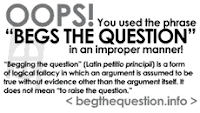
Beg the question alert: Crossley
 From James Crossley's Jesus in An Age of Terror, 36:
"Note throughout that Ristau did not really condemn those involved -- at best the odd human error here and there -- and he apparently still believes that western powers are acting with only kindness in their hearts. But with the propaganda model in mind, this begs the question, if he concedes wrongdoings then why can he not bring himself to condemn the wrongdoers or post comments on his blog, especially as he is arguably the most explicitly political biblioblogger?
Thursday, April 02, 2009
The Dilettante Hobby Horse Bibliobloggger's Behaviour
In an earlier post, I drew attention to the uncanny similarities between the style of Jim West and the style of the anonymous author of the Dilettante Hobby Horse blog. The latest post on the site continues the trend, with another West-style neologism ("horsistary"), and characteristic usages like "'em" phrases ("tell 'em", "show 'em", etc.). But what makes the new post striking is that the anonymous author is now not only imitating Jim's style but also using materials sent to him by Jim without the proper attribution.
The sequence of events appears to go something like this. Chris Tilling posted on Negotiating Tensions in the Bible. A character called "sickrandir" adds a comment and then Jim comments, "i'm going to copy his comment and send them over to the dilettante hobby horse!" The comments in question then appear on the Dilettante Hobby Horse very shortly afterwards, but without the requisite "hat tip" to Jim. Now we all know how Jim feels about using material without a hat-tip (e.g. with reference to BAR). So it seems likely that the Dilettante Hobby Horse is going to be in for Jim's wrath pretty soon. As well as blogging anonymously, he fails to attribute his sources, and he has the affrontery to do all of this using Jim's own writing style. Time to take action, Jim!
The sequence of events appears to go something like this. Chris Tilling posted on Negotiating Tensions in the Bible. A character called "sickrandir" adds a comment and then Jim comments, "i'm going to copy his comment and send them over to the dilettante hobby horse!" The comments in question then appear on the Dilettante Hobby Horse very shortly afterwards, but without the requisite "hat tip" to Jim. Now we all know how Jim feels about using material without a hat-tip (e.g. with reference to BAR). So it seems likely that the Dilettante Hobby Horse is going to be in for Jim's wrath pretty soon. As well as blogging anonymously, he fails to attribute his sources, and he has the affrontery to do all of this using Jim's own writing style. Time to take action, Jim!
Hyperlinking endnotes: a suggestion for James Crossley
I am currently enjoying James Crossley's Jesus in An Age of Terror and hope to comment here in due course. One quick suggestion comes to mind as I read the piece that is going to be of the most interest to those of us here, Chapter 2, "The Politics of the Bibliobloggers". There are 94 endnotes to this chapter, most of them with one or more URLs pointing to a particular blog post. Now, few of us are going to go to our machines and type these in, letter by letter, so the ideal would be to have an online version of the endnotes in which each URL is hyperlinked. It's an excellent time-saving device and it helps readers to investigate the claims made here for themselves. Moreover, because of link-rot, dozens of these URLs are already defunct, and the presence of even the defunct URL would allow a quick copy and paste to archive.org.
Just in case you think this sounds terribly theoretical, I have a model for this kind of thing which I created back in 2004 when I was invited by Robert Webb and Kathleen Corely to contribute to a book on The Passion of the Christ. The book has its own page at Jesus and Mel Gibson's Passion of the Christ, with its full hyperlinked footnotes page here.
Just in case you think this sounds terribly theoretical, I have a model for this kind of thing which I created back in 2004 when I was invited by Robert Webb and Kathleen Corely to contribute to a book on The Passion of the Christ. The book has its own page at Jesus and Mel Gibson's Passion of the Christ, with its full hyperlinked footnotes page here.
Wednesday, April 01, 2009
Moratorium on Biblioblogging April Fool's Jokes
It's April 1 and once again we have a selection of April Fool's jokes on the biblioblogs. As usual, there are varying degrees of skill, wit and humour to be found. I don't know whether I am speaking just for myself here, but frankly I am finding it all a bit tiring. One or two of them raised a bit of a smile, but all of them induced that dull, "Here we go again" kind of tedium. The difficulty is not just that they are getting tired but that they detract from the scholarly nature and academic reputation of the biblioblogs. If we wish to be taken seriously by the guild, I think it's time to behave with a bit more decorum. I suspect that what we are seeing here is a symptom of a larger problem about the decline in the academic quality of the biblioblogs. I think I am inclined to use an American expression and say "Enough already!"
Subscribe to:
Posts (Atom)