I am grateful to Simcha Jacobovici for taking the time to respond to my blog post A Tale of Two Replicas in which I detailed the differences between the two replicas of Ossuary 6 from Talpiot Tomb B and asked some questions about them. I have been blogging and writing about the Talpiot Tombs for several years now and although I have sometimes received indirect responses from members of his production team, this is the first time that Jacobovici has responded himself. I had always assumed that he did not read my blog, especially as I have often engaged with his theories about the tombs, so it was a honour to receive a public response to my most recent post.
Jacobovici's post is entitled Pants on Fire. Although the primary reference is presumably to the rhyme, "Liar, liar, pants on fire", from the school playground, it is also a clever and amusing allusion to Jacobovici's characterization of his critics as underwear bloggers, and I am apparently a member of this group.
Most of Jacobovici's post is general abuse, some of it quite funny, some of it puzzling, most of it presumably intended to provoke a reaction. I am grouped together with others like Prof. Robert Cargill and we are regarded as "personal and hysterical", "masquerading as scholars", "enforcers of Pauline theology" (?) who make "libelous statements". It is "pseudo-scholarship" that aims "to rewrite history in Orwellian fashion". Jacobovici ends the post by planning to take a shower "because I feel slimed by these guys".
Although most of the post is in that vein and so of limited use in the actual discussion, there is some content. I am pleased to see my basic contention verified, that there were indeed two separate replicas made of the ossuary in question, and that there were significant differences between them. Replica 1 was produced first and Replica 2 later, in April 2012. Prof. James Tabor kindly clarifies the matter further in a useful comment to my post, and he expresses some surprise that I had not realized that there were two different replicas.
I suppose that I in turn should express some surprise at Tabor's and Jacobovici's surprise. They have consistently talked about the museum quality replica as if there were only one and before posting on the topic, I reviewed everything that I could find. I could not find any statement anywhere about the production of a second replica, in the media, in the blogs, in correspondence, in the official website. They repeatedly and consistently talk about just the one replica. And from the reactions more broadly to my post, I can tell that no one else seemed to realize that there was more than one replica.
However, it turns out that I had in fact missed something, and for this I apologize. About half-way through a lengthy post on another subject on 4 January 2013, nine months after Replica 2 was produced, James Tabor mentions the two replicas, and provides a picture of each, with a view to making some insinuations about Amos Kloner. I had missed that paragraph in my research. Mea culpa. And it turns out that while Jacobovici himself had not talked about the two replicas (again, subject to correction, as always), he did re-blog Tabor's blog post in which that paragraph appeared, at the same time, ninth months after its production.
The point of my post, though, was to draw attention to differences between the two replicas and to ask some questions about them. Tabor confirms my point that the "fish in the margins" were adjusted between the production of the two replicas, apparently in response to scholarly critique of the way that they had been represented (the critique was by Robert Cargill, though neither Tabor nor Jacobovici mention this), and it is useful to know that.
My key question related to the replica shown to Prof. Émile Puech. Since it is on video, there is no doubt at all that the replica is informing the discussion. It is clearly Replica 2, the replica that features an apparent attempt to spell out "YWNH" (Jonah), in contrast to Replica 1, which does not have it, and which was produced before the "YWNH" inscription theory had emerged. Jacobovici does not comment on this issue, the relationship between Puech's statement and Replica 2.
A further issue does arise from this about how accurate the "museum quality replicas" really are, but that's a blog post for another day.
Showing posts with label James Tabor. Show all posts
Showing posts with label James Tabor. Show all posts
Wednesday, September 18, 2013

Monday, September 16, 2013
A Tale of Two Replicas
The recent renewed discussion of the Talpiot Tombs, brought about by Simcha Jacobovici's post featuring an interview with Professor Émile Puech of the École Biblique in Jerusalem (See Simcha Jacobovici and the Talpiot Tomb again), and followed up by Prof. Puech's own statement on the affair , has sent me back once again to the photographs, the blog posts, the media reports and the articles that I have in the past spent such a long time looking at. But this time I spotted something new, what I am calling "A Tale of Two Replicas".
Throughout the discussions of the Talpiot Tomb, right from the first, Simcha Jacobovici, James Tabor and others involved with the "Jesus Discovery" project (website here) have talked about and publicized what they call "the museum quality replica" of ossuary 6 from Talpiot tomb B. But here's the curious thing. It's not one replica. There are two different replicas. As far as I am aware -- and I think I have read everything -- they have never admitted that they produced a second replica to replace the first. (Please correct me if I am wrong). And when one notices what changes between the two replicas, there is some cause for concern.
Here is the first replica. This one was on the first version of the Jesus Discovery website and dates back to when the site was first published in February 2012, as you can see from the archive.org capture.
Here is the second replica, which dates back, as far as I can tell, to April 2012, and which replaced the first on the Jesus Discovery website. This is the one you see there now.
One can see the whole of Replica 2 in high definition here, if you want to take a closer look. Notice also that there are no extraneous lines here. Everything appears to be doing service in the representation of "YWNH". Here's the tracing of the letters as it appeared on James Tabor's blog:
In each, the "yod" has a loop, the "nun" is unbroken and the top line of the "he" does not extend all the way to the border.
I don't know what to make of all this, but I thought in the interests of analyzing Talpiot Tomb B, and the claims made by those involved with the "Jesus Discovery" project, it would be useful to lay out what I have found by analyzing the two contrasting replicas, and to see if others also see what I am seeing. Why is it that the "fish in the margins" are recrafted in between Replicas 1 and 2? Why is it that the "YWNH" inscription suddenly becomes clear only in Replica 2?
It may be worth adding that the replica shown to Prof. Puech in the video released last week is clearly Replica 2, which has a version of the "YWNH" inscription that we see above, and not the ambiguous representation of Replica 1:
As we have seen above, it is only Replica 2 that has a representation of the "YWNH" inscription that conforms with the interpretation of those involved in the project. Did the representation of "YWNH" on Replica 2 influence Prof. Puech's reading?
Throughout the discussions of the Talpiot Tomb, right from the first, Simcha Jacobovici, James Tabor and others involved with the "Jesus Discovery" project (website here) have talked about and publicized what they call "the museum quality replica" of ossuary 6 from Talpiot tomb B. But here's the curious thing. It's not one replica. There are two different replicas. As far as I am aware -- and I think I have read everything -- they have never admitted that they produced a second replica to replace the first. (Please correct me if I am wrong). And when one notices what changes between the two replicas, there is some cause for concern.
Here is the first replica. This one was on the first version of the Jesus Discovery website and dates back to when the site was first published in February 2012, as you can see from the archive.org capture.
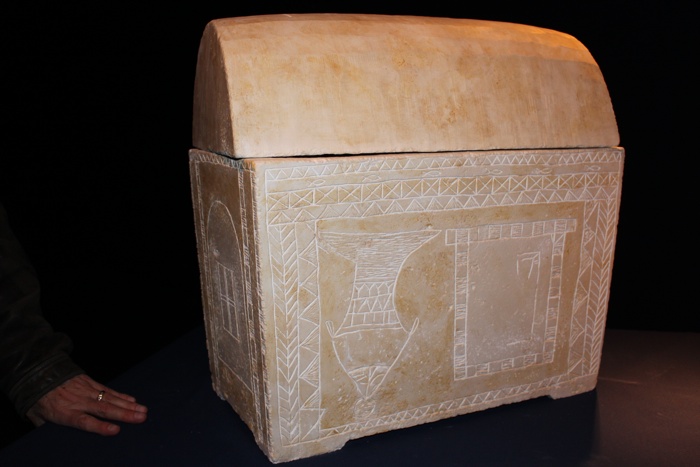 |
| Replica 1 (February 2012) |
 |
| Replica 2 (April 2012) |
If you think they look pretty similar, you would be right. But there are some telling signs that illustrate beyond doubt that these replicas are different. Let's take a look at them side by side:
 |
| Replica 1 (left) and Replica 2 (right) |
There are several tell-tale signs. Notice how in Replica 1, there are some lines drawn inside the square shaped object to the right of the vessel / fish, whereas in Replica 2, these lines are completely absent:
Notice also how the top left tip of the vessel / fish is next to the pointed part of a triangle in Replica 1 but next to the flat part of a triangle in Replica 2:
Similarly, notice how at the bottom left of Replica 1, the triangular shape protrudes across the border whereas in Replica 2, the triangle is neatly inside of its border:
Similar observations could be repeated for other elements in the two replicas, but I am sure that you get the basic point. Now one of the reasons that this is worthy of comment is that the replica (singular) has always been called "museum quality" and its accuracy has been praised. Yet, far from this being one, accurate "museum quality" replica, it is two contrasting replicas, in which attention to detail is far from the order of the day.
It is not just the question of accuracy and representation that is at issue here, or the apparent failure to flag up the differences between the two replicas. It is that Replica 2 makes several changes that may be the result of engaging with criticisms of the project. Let me attempt to explain what I am getting at.
Replica 1 appears in all the publicity for the documentary, book and website from February to March 2012. Replica 2 first appears, again as far as I can work out, and subject to correction, on April 3 or 4 2012, in Jerusalem:
In between the release of Replica 1 and Replica 2, there had been a lot of criticism about the project's claims including, among other things, the idea that there are drawings of little "fish in the margins". Robert Cargill demonstrated that the little oval shapes had been "inked in" so as to make them appear like fish. Now notice how the "fish in the margins" changed between the two replicas. In Replica 1, before the criticism had appeared, they were presented as fish, with very clear, long tails:
In Replica 2, which appeared after the criticism had been made, these shapes resemble more closely the actual shapes on the ossuary. The tails have gone:
Now, since Replica 2 appeared some time after Replica 1, I began to wonder whether there were also any changes in the way that the alleged YWNH ("Jonah") inscription appeared. Does the alleged inscription differ at all between Replicas 1 and 2? There is, indeed, a major difference in the way this appears between Replicas 1 and 2. Here it is in Replica 1:
This replica appears to have been produced before the "YWNH" inscription theory had emerged. The lines really look like random lines. Notice in particular what would become the letter "nun" -- it is here completely broken, just as it was in the CGI composite photograph and all the pictures up to this point (Do the lines in the "fish" head spell out Jonah?). No one looking at this picture would for a moment think it was spelling out "Jonah".
However, in Replica 2, the transformation of these lines is remarkable. Now the inscription could indeed be taken to spell out "Jonah". Notice how the "nun" is now one single, connected line. It is no longer broken. The "he" is given the appearance of stopping with one thick line forming the top of the letter, and only a thin line going on to the border. And the "yod" has a little loop on it just as it does in the "tracing" of the letters that appeared when the alleged inscription first came to light. Here's a close-up:
 |
| Replica 1 has a drawing inside the square which Replica 2 lacks |
Notice also how the top left tip of the vessel / fish is next to the pointed part of a triangle in Replica 1 but next to the flat part of a triangle in Replica 2:
 |
| Triangle border differs next to top left of vessel / fish |
 |
| Replica 1: triangle protrudes across the border in contrast to Replica 2 |
Similar observations could be repeated for other elements in the two replicas, but I am sure that you get the basic point. Now one of the reasons that this is worthy of comment is that the replica (singular) has always been called "museum quality" and its accuracy has been praised. Yet, far from this being one, accurate "museum quality" replica, it is two contrasting replicas, in which attention to detail is far from the order of the day.
It is not just the question of accuracy and representation that is at issue here, or the apparent failure to flag up the differences between the two replicas. It is that Replica 2 makes several changes that may be the result of engaging with criticisms of the project. Let me attempt to explain what I am getting at.
Replica 1 appears in all the publicity for the documentary, book and website from February to March 2012. Replica 2 first appears, again as far as I can work out, and subject to correction, on April 3 or 4 2012, in Jerusalem:
 |
| Simcha Jacobovici shows off Replica 2 in Jerusalem, 3/4 April 2012 |
 |
| Replica 1: "fish in the margins close up" (screengrab from Steve Caruso) |
 |
| Replica 2: "fish in the margins" now appear more like ovals |
Now, since Replica 2 appeared some time after Replica 1, I began to wonder whether there were also any changes in the way that the alleged YWNH ("Jonah") inscription appeared. Does the alleged inscription differ at all between Replicas 1 and 2? There is, indeed, a major difference in the way this appears between Replicas 1 and 2. Here it is in Replica 1:
 |
| Close up of alleged "Jonah" inscription on Replica 1 |
However, in Replica 2, the transformation of these lines is remarkable. Now the inscription could indeed be taken to spell out "Jonah". Notice how the "nun" is now one single, connected line. It is no longer broken. The "he" is given the appearance of stopping with one thick line forming the top of the letter, and only a thin line going on to the border. And the "yod" has a little loop on it just as it does in the "tracing" of the letters that appeared when the alleged inscription first came to light. Here's a close-up:
 |
| Close up of Replica 2, showing YWNH lettering clearly marked |

 |
| Yellow tracing of the alleged letters, James Tabor's blog, April 2012 |
I don't know what to make of all this, but I thought in the interests of analyzing Talpiot Tomb B, and the claims made by those involved with the "Jesus Discovery" project, it would be useful to lay out what I have found by analyzing the two contrasting replicas, and to see if others also see what I am seeing. Why is it that the "fish in the margins" are recrafted in between Replicas 1 and 2? Why is it that the "YWNH" inscription suddenly becomes clear only in Replica 2?
It may be worth adding that the replica shown to Prof. Puech in the video released last week is clearly Replica 2, which has a version of the "YWNH" inscription that we see above, and not the ambiguous representation of Replica 1:
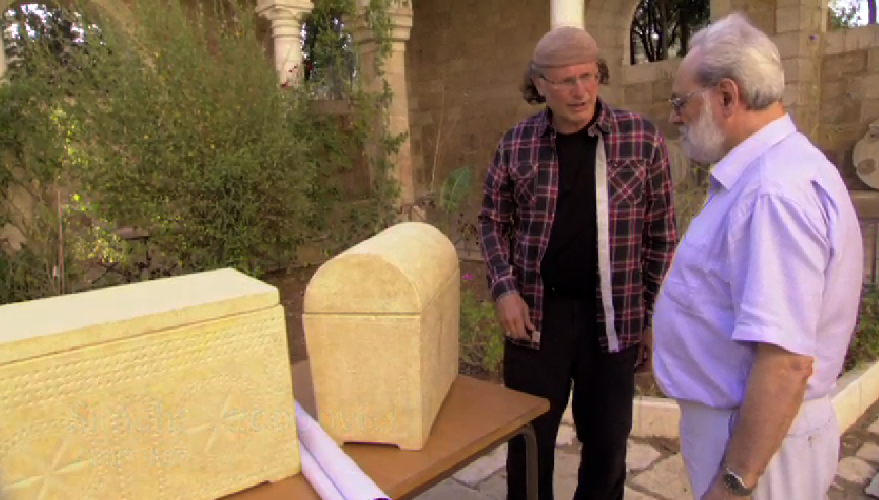 |
| Simcha Jacobovici shows Émile Puech Replica 2 |
Émile Puech's Statement on the Talpiot Tomb Images
I expressed some surprise over Prof. Émile Puech's apparent endorsement of Simcha Jacobovici's claims about the Talpiot Tombs on Thursday in a post headed Simcha Jacobovici and the Talpiot Tomb Again.
It now appears that Prof. Puech is very unhappy with the way that he was treated by Jacobovici and he has spoken out about this, first in en email reproduced on Jim West's blog, and subsequently in emails to several scholars including James Tabor, who publishes the email in a blog posted headed Emile Peuch’s [sic] Position on the “Jesus Discovery” and “Lost Tomb of Jesus” Films.
I am grateful to Prof. Tabor for publishing Prof. Puech's comments, and I think it is greatly to his credit that he has done so.
I hope that Simcha Jacobovici will be issuing a public apology to Prof. Puech as soon as possible.
It now appears that Prof. Puech is very unhappy with the way that he was treated by Jacobovici and he has spoken out about this, first in en email reproduced on Jim West's blog, and subsequently in emails to several scholars including James Tabor, who publishes the email in a blog posted headed Emile Peuch’s [sic] Position on the “Jesus Discovery” and “Lost Tomb of Jesus” Films.
I am grateful to Prof. Tabor for publishing Prof. Puech's comments, and I think it is greatly to his credit that he has done so.
I hope that Simcha Jacobovici will be issuing a public apology to Prof. Puech as soon as possible.
Friday, April 26, 2013
The Jesus Discovery? A Sceptic's Perspective
The third in the series of papers on the claims made by James Tabor and Simcha Jacobovici on the Talpiot Tomb is now up on the Bible and Interpretation website. All three papers are revised versions of presentations given at the SECSOR meeting in Greenville, SC, on March 16 this year:
Mark Goodacre
My paper gathers together my thinking about Talpiot Tombs A and B as they have emerged here on the NT Blog over the last five years. The primary focus is the more recent claims about Talpiot Tomb B (Is it is fish? Is it a vase? Is it a stick man with seaweed wrapped around his head? Are those scales of a fish or patterns on a vessel? Are those fins or handles?) but there is some discussion also of Talpiot Tomb A, and I am afraid that I could not resist the temptation to bring out John, Paul, George, Alan, Martin and Ziggy for a reunion concert.
Renewed thanks to Ralph Hawkins for the invitation to speak last month at SECSOR, to Mark Elliott for inviting us to publish our papers on Bible and Interpretation, and to James Tabor and Christopher Rollston for stimulating exchanges.
Thursday, April 25, 2013
Revisiting the Talpiot Tomb
Back in March, James Tabor, Christopher Rollston and I spoke at the SECSOR (Southeastern Commission for the Study of Religion) meeting in Greenville, SC, on the topic of The Jesus Discovery: The New Archaeological Find that Reveals the Birth of Christianity by Simcha Jacobovici and James Tabor. Bible and Interpretation is now publishing, over the next several days, our papers from that session, beginning today with the following:
James Tabor
Christopher Rollston's and my papers are to follow over the next couple of days.
Monday, June 11, 2012
James Charlesworth on Talpiot Tomb B (Revised and Updated)
This is a fully revised and updated version of my earlier post James Charlesworth on Talpiot Tomb B which commented on an earlier version of an article by James Charlesworth on Talpiot Tomb B that was subsequently removed. This post revises that one so that it responds to the new version of the article.
--
Those with an interest in the claims made by Simcha Jacobovici and James Tabor on Talpiot Tomb B, "the Patio Tomb", have been looking forward to hearing more about the views of Prof. James Charlesworth of Princeton Theological Seminary who acted as the "primary academic consultant" on the project (Tabor, Preliminary Report, 1, n. 2) and who appears in the documentary labelled The Resurrection Tomb Mystery (USA) / The Jesus Discovery (Canada). His report is now available, as a PDF on the Bible and Interpretation website:
What is the Message of the "Patio Tomb" in Talpiot, Jerusalem?
James Hamilton Charlesworth, Princeton, June 2012
The article provides a useful summary of the issues raised by the documentary and the related book (but not the Jesus Discovery website or the Preliminary Report, neither of which is mentioned). Charlesworth is broadly supportive of Tabor's and Jacobovici's claims, but he is cautious and sceptical at several points. Charlesworth discusses the different possibilities for the interpretation of the image on ossuary 6 (nefesh, amphora or fish?) and he defends his reading of YONAH at the bottom of that image. He asks lots of questions and encourages continued debate.
The piece is aimed at a non-scholarly audience for whom Charlesworth explains terms like "ossuary" and "nefesh"; he explains what happened in 66CE (2); he notes the correspondences between Hebrew and English letters (9) and explains that "Hebrew is written right to left" (9).
In spite of that target audience, I will admit to some disappointment that Charlesworth does not engage directly with any of the scholars' critiques of the project, whether here, on the ASOR blog, on Bible and Interpretation, on Robert Cargill's blog, on Christopher Rollston's blog or elsewhere. He does mention "scholars and non-scholars" who "have been reporting and blogging" and he speaks about his dismay over "occasional ad hominem comments" (1). As one who has experienced some unpleasant remarks, including from those involved in the making of the documentary, I very much share Charlesworth's concern on that front. Nevertheless, I think there is a danger in only mentioning blogging in the context of complaining about those who abuse the medium because it can all too easily be taken as a reason not to engage with serious scholarly criticism of the claims.
In relation to this, it is disappointing that Charlesworth simply repeats the sight reading of the inscription on Ossuary 5, "Divine [YHWH], who lifts up (or raised up), from (the tomb or death?)" (6), which is seen in the documentary. With the exception of a brief footnoted reference to Bauckham (15, n. 10), he does not engage with the careful analysis and criticism of this claim, with alternative readings, offered by Richard Bauckham, Christopher Rollston and others (see also Rollston's review here; see further links in those posts). The difficulty with not engaging with the critics is that it can give the impression that the reading in question is uncontested and somehow self-evident. It is not. It is controversial and unclear.
By contrast, there is some exposition of the alleged YONAH inscription that appears at the bottom of the image on Ossuary 6 (6-11). It is useful to have this exposition given that previously Charlesworth's views were only known through reports (See most fully Taborblog). Charlesworth is actually quite guarded about his suggestion and only puts forward the reading quite tentatively. Of the four alleged letters, he regards only the he as "unmistakable" (9). The yod may be a zayin; "some imagination is required" for the reading of the waw (9) and the nun "is not prima facie obvious" -- it may be a lamed (9).
Having read Charlesworth's own defence of this claim, I admit to being no more convinced than I was before, and pleased to see the way in which he makes the suggestion only tentatively. One of the reasons for my own scepticism has been the confusing nature of the case. With so much going on in the head of the fish / base of the vessel -- arms and legs of a stick man, a mouth and an eye of a fish, Hebrew letters that extend unusually and further lines that are unaccounted for -- it is doubtful that YONAH is there (see further The Texas Sharpshooter Fallacy and the Talpiot Tomb).
Like Tabor and Jacobovici, Charlesworth is inclined to see a stick man here too (5, 9-10 and especially 11), though he does not explain which lines belong to the stick man, and whether any of the lines that form the stick man do double duty as parts of the alleged YONAH inscription (see further my Changing Body of the Stick Man and links there). I suspect that most scholars will remain sceptical about the presence of a stick man given the lack of clarity about which lines represent his arms and legs.
Charlesworth does, however, add a new element to the discussion of the stick man with an interesting speculation about the size of his head:
Moreover, one of the issues mentioned by Charlesworth does have a straightforward explanation. He asks:

But what of the image itself? According to Jacobovici and Tabor's Jesus Discovery, at the time of viewing, Charlesworth "offered without hesitation the same interpretation of the fish" (loc. 1041). In the new article, he is still inclined towards the "fish" interpretation, but he suggests that there are merits also in the ideas that it is a nefesh monument or an amphora. Indeed he wonders whether the artist was being deliberately ambiguous, perhaps attempting to depict all three. He suggests, for example, that:
Charlesworth's concern with the amphora theory relates to the handles:

Moreover, since he does not mention it in the article, Charlesworth may be unaware that in May 1981, Zvi Ilan reported that the first excavators of the tomb, who actually saw the ossuary, interpreted the image in question as an amphora (ASOR blog). Furthermore, Charlesworth does not mention the image on the side of ossuary, the image that Tabor and Jacobovici had interpreted as a "half-fish" but which clearly appears to have handles on either side, as I have often mentioned here (see How the half-fish became a vase and why it matters and links there):

The key point about this image, which Tabor and Jacobovici concede may have been interpreted as a vase in 1981, is that it provides the all-important contextual information about the image on the façade. Vase on the side; vase on the front.
Charlesworth's post concludes with reflections on the meaning of the image, and although he suggests that "meaning resides in ambiguity and all symbols are multvalent" (11), he focuses on the idea of Jonah and the fish, linking this first with repentance and then with resurrection. He draws attention to the repentance theme in Luke 11.29-32 and adds that
Charlesworth goes on to mention the connection between the resurrection and the sign of Jonah in Matt. 12.38-41, the text that is key in Tabor's and Jacobovici's case (See my The Talpiot Tomb, Jonah and Q). The big question here relates to dating. Most scholars (me included) date Matthew after 70CE, after the dates of the ossuaries in this early Roman period tomb, which places a question mark against Tabor's and Jacobovici's case. Charlesworth's comment is:
Before concluding this post, I would like to comment on three other things of interest. The first is the mention of a "rubbing of that image" (Q & A with Ben Witherington, footnote 1), i.e. the image of the fish / vessel on ossuary 6. I had not heard about this before and so asked Prof. Charlesworth for clarification. He responded by saying emphatically that "there was no rubbing" and in the revised article, the reference has been changed to "a CGI generated image created from a composite of several photographs from different angles and in different lighting" (14, n. 2).
Second, I was interested to see measurements for the fish/vessel image (23 x 15 x 9 x 3) for the first time (4). This is helpful information, but I am curious about how the image was measured.
Third, it is helpful to have some clarifications of the dates in this article. Charlesworth here dates his involvement to June 2010, which coheres with the dating in The Jesus Discovery and corrects his earlier dating of June 2011.
In summary, after having read Charlesworth's article carefully, I am sorry to say that I remain completely unpersuaded by the claims made in the documentary, the book, the website, and the preliminary report.
----------------------
Appended Note 1: Two of Richard Bauckham's comments to the earlier version of this post remain relevant to this revised version, so I will quote them again here:

--
Those with an interest in the claims made by Simcha Jacobovici and James Tabor on Talpiot Tomb B, "the Patio Tomb", have been looking forward to hearing more about the views of Prof. James Charlesworth of Princeton Theological Seminary who acted as the "primary academic consultant" on the project (Tabor, Preliminary Report, 1, n. 2) and who appears in the documentary labelled The Resurrection Tomb Mystery (USA) / The Jesus Discovery (Canada). His report is now available, as a PDF on the Bible and Interpretation website:
What is the Message of the "Patio Tomb" in Talpiot, Jerusalem?
James Hamilton Charlesworth, Princeton, June 2012
The article provides a useful summary of the issues raised by the documentary and the related book (but not the Jesus Discovery website or the Preliminary Report, neither of which is mentioned). Charlesworth is broadly supportive of Tabor's and Jacobovici's claims, but he is cautious and sceptical at several points. Charlesworth discusses the different possibilities for the interpretation of the image on ossuary 6 (nefesh, amphora or fish?) and he defends his reading of YONAH at the bottom of that image. He asks lots of questions and encourages continued debate.
The piece is aimed at a non-scholarly audience for whom Charlesworth explains terms like "ossuary" and "nefesh"; he explains what happened in 66CE (2); he notes the correspondences between Hebrew and English letters (9) and explains that "Hebrew is written right to left" (9).
In spite of that target audience, I will admit to some disappointment that Charlesworth does not engage directly with any of the scholars' critiques of the project, whether here, on the ASOR blog, on Bible and Interpretation, on Robert Cargill's blog, on Christopher Rollston's blog or elsewhere. He does mention "scholars and non-scholars" who "have been reporting and blogging" and he speaks about his dismay over "occasional ad hominem comments" (1). As one who has experienced some unpleasant remarks, including from those involved in the making of the documentary, I very much share Charlesworth's concern on that front. Nevertheless, I think there is a danger in only mentioning blogging in the context of complaining about those who abuse the medium because it can all too easily be taken as a reason not to engage with serious scholarly criticism of the claims.
In relation to this, it is disappointing that Charlesworth simply repeats the sight reading of the inscription on Ossuary 5, "Divine [YHWH], who lifts up (or raised up), from (the tomb or death?)" (6), which is seen in the documentary. With the exception of a brief footnoted reference to Bauckham (15, n. 10), he does not engage with the careful analysis and criticism of this claim, with alternative readings, offered by Richard Bauckham, Christopher Rollston and others (see also Rollston's review here; see further links in those posts). The difficulty with not engaging with the critics is that it can give the impression that the reading in question is uncontested and somehow self-evident. It is not. It is controversial and unclear.
By contrast, there is some exposition of the alleged YONAH inscription that appears at the bottom of the image on Ossuary 6 (6-11). It is useful to have this exposition given that previously Charlesworth's views were only known through reports (See most fully Taborblog). Charlesworth is actually quite guarded about his suggestion and only puts forward the reading quite tentatively. Of the four alleged letters, he regards only the he as "unmistakable" (9). The yod may be a zayin; "some imagination is required" for the reading of the waw (9) and the nun "is not prima facie obvious" -- it may be a lamed (9).
Having read Charlesworth's own defence of this claim, I admit to being no more convinced than I was before, and pleased to see the way in which he makes the suggestion only tentatively. One of the reasons for my own scepticism has been the confusing nature of the case. With so much going on in the head of the fish / base of the vessel -- arms and legs of a stick man, a mouth and an eye of a fish, Hebrew letters that extend unusually and further lines that are unaccounted for -- it is doubtful that YONAH is there (see further The Texas Sharpshooter Fallacy and the Talpiot Tomb).
Like Tabor and Jacobovici, Charlesworth is inclined to see a stick man here too (5, 9-10 and especially 11), though he does not explain which lines belong to the stick man, and whether any of the lines that form the stick man do double duty as parts of the alleged YONAH inscription (see further my Changing Body of the Stick Man and links there). I suspect that most scholars will remain sceptical about the presence of a stick man given the lack of clarity about which lines represent his arms and legs.
Charlesworth does, however, add a new element to the discussion of the stick man with an interesting speculation about the size of his head:
If this is a large fish and Jonah is intended, then it is possible to image [sic, imagine?] a stick figure inside the fish. If so, the head is absurdly large. Why? Obviously, some Jews imagined the resurrection body to be similar to but different from the fleshy body. Would some early Jews have imagined a resurrected body would have a large head? Is that the ideal body? We simply need to raise questions and be open to dialogue. (5).I would be interested to hear if there is any analogy for the idea of the resurrection body having a massive head. I would doubt it, but I will listen with interest. But in any case, the key question presumably would relate not to the resurrection body but to the book of Jonah, where there is no hint that the character has a massive head, either before or after being swallowed by the fish.
Moreover, one of the issues mentioned by Charlesworth does have a straightforward explanation. He asks:
Why has the engraver spent so much time on the lines within the spherical "bottom"? One can count at least 14 strokes. Why? What was imagined? (5).As Juan V. Fernández de la Gala has helpfully illustrated (ASOR Blog), those lines are the way that the artist shades in the vessel, seen also at the top of the vessel (the "fish tail") and the vessel decorations (the "scales"):

But what of the image itself? According to Jacobovici and Tabor's Jesus Discovery, at the time of viewing, Charlesworth "offered without hesitation the same interpretation of the fish" (loc. 1041). In the new article, he is still inclined towards the "fish" interpretation, but he suggests that there are merits also in the ideas that it is a nefesh monument or an amphora. Indeed he wonders whether the artist was being deliberately ambiguous, perhaps attempting to depict all three. He suggests, for example, that:
A symbol must be interpreted and usually has many meanings. Symbols appear in a world of ambiguity and bring with them more than one meaning (4).Charlesworth adds:
But, something is intended. We should move beyond what it could possibly be and ask what is the intentionality that created this image (5).I must admit to struggling with this. It is difficult to ask about the "intentionality" of the artist without having a clear handle on "what it could possibly be". Perhaps my fondness for Occam's Razor is the problem. Where Charlesworth wonders about the decorative squares inside the image --
Did the inscriber attempt to meld an image of a fish with a nefesh? Is there some conflation of symbols? Are there multiple meanings to be contemplated? (5),-- I can't help thinking that it is unnecessary to interpret the image as a conflated nefesh-fish when the vessel interpretation appears more plausible.
Charlesworth's concern with the amphora theory relates to the handles:
The image has something on each side. Could these be handles? If so, they are not like any known handles on an amphora, whether drawn or part of an amphora itself (4).Since Charlesworth does not mention any of the scholarly critiques of the project, it may be that he is unfamiliar with the attempts to illustrate answers to this type of question. Antonio Lombatti's detailed and helpful illustrated article Observations on the “Jonah” Iconography on the Ossuary of Talpiot B Tomb, for example, provides several useful analogues, including this graphic from a useful post by Thomas Verenna:

Moreover, since he does not mention it in the article, Charlesworth may be unaware that in May 1981, Zvi Ilan reported that the first excavators of the tomb, who actually saw the ossuary, interpreted the image in question as an amphora (ASOR blog). Furthermore, Charlesworth does not mention the image on the side of ossuary, the image that Tabor and Jacobovici had interpreted as a "half-fish" but which clearly appears to have handles on either side, as I have often mentioned here (see How the half-fish became a vase and why it matters and links there):

The key point about this image, which Tabor and Jacobovici concede may have been interpreted as a vase in 1981, is that it provides the all-important contextual information about the image on the façade. Vase on the side; vase on the front.
Charlesworth's post concludes with reflections on the meaning of the image, and although he suggests that "meaning resides in ambiguity and all symbols are multvalent" (11), he focuses on the idea of Jonah and the fish, linking this first with repentance and then with resurrection. He draws attention to the repentance theme in Luke 11.29-32 and adds that
Jonah is still read on the evening of Yom Kippur (the Day of Atonement) to signal the importance of seeking forgiveness before God (11).There is, however, no evidence that I am aware of that Jews were reading Jonah on the Day of Atonement as early as the first century. The first reference I know of to Jonah being read at Yom Kippur is b.Meg. 31a. But in any case that does not help with the imagined Christian identification of the tomb.
Charlesworth goes on to mention the connection between the resurrection and the sign of Jonah in Matt. 12.38-41, the text that is key in Tabor's and Jacobovici's case (See my The Talpiot Tomb, Jonah and Q). The big question here relates to dating. Most scholars (me included) date Matthew after 70CE, after the dates of the ossuaries in this early Roman period tomb, which places a question mark against Tabor's and Jacobovici's case. Charlesworth's comment is:
These Jewish reflections [Matthew's] are from the first century CE, but after 70CE they were reported by those who were claimed to have seen a resurrected Jesus (12).And Charlesworth goes on to quote 1 Cor. 15.3-8 followed by Joseph Ratzinger's Jesus of Nazareth. It looks like Charlesworth is here distancing himself from interpreting the sign of Jonah as a sign of the resurrection in the pre-70 period, and so aligning himself more with sceptics like me than with Tabor and Jacobovici. But I could be wrong -- it is not easy to parse Charlesworth's prose here (What does "they were reported by those who were claimed to have seen a resurrected Jesus" mean?).
Before concluding this post, I would like to comment on three other things of interest. The first is the mention of a "rubbing of that image" (Q & A with Ben Witherington, footnote 1), i.e. the image of the fish / vessel on ossuary 6. I had not heard about this before and so asked Prof. Charlesworth for clarification. He responded by saying emphatically that "there was no rubbing" and in the revised article, the reference has been changed to "a CGI generated image created from a composite of several photographs from different angles and in different lighting" (14, n. 2).
Second, I was interested to see measurements for the fish/vessel image (23 x 15 x 9 x 3) for the first time (4). This is helpful information, but I am curious about how the image was measured.
Third, it is helpful to have some clarifications of the dates in this article. Charlesworth here dates his involvement to June 2010, which coheres with the dating in The Jesus Discovery and corrects his earlier dating of June 2011.
In summary, after having read Charlesworth's article carefully, I am sorry to say that I remain completely unpersuaded by the claims made in the documentary, the book, the website, and the preliminary report.
----------------------
Appended Note 1: Two of Richard Bauckham's comments to the earlier version of this post remain relevant to this revised version, so I will quote them again here:
(2) Charlesworth's reiteration of the reading of the Greek inscription that he made when he first saw it (shown in the film) without taking any notice at all of any of the very considerable subsequent discussion of it by fellow-scholars is extremely disappointing, especially as he himself says in this article that "we need each other in a dialogue that appreciates the input of others" (p. 5).
(3) I was puzzled by his appeal to the multivalency of symbols in relation to the fish/nephesh/amphora image when he first made it in email correspondence back in the autumn, and his elaboration of it in this article still leaves me baffled. He says, "Any attempt to enter the mind of an engraver in order to discern the intention of an “artist” borders on unsophisticated methodology," but then goes on precisely to discuss all sorts of considerations precisely with a view to discerning the engraver's intention. Furthermore, what exactly does he mean by calling this image a symbol. His footnote refers to his own extensive discussion of the image of the "serpent" in his book on that topic, reporting that he found this to have about thirty meanings. But these are all meanings of the image of a SERPENT. This scarcely seems a valid parallel to the suggestion that the image on the ossuary may be ambiguously a nephesh or an amphora or a fish. If it is indeed a fish, then one might say that the fish is a multivalent symbol - conceivably, for example, an early Christian engraver might have intended both Jonah's fish and the Christian ICHTHYS acronym (though Jim Charlesworth himself rather dogmatically dismisses the latter as having any relevance). An amphora might also have more than one possible symbolic significance (a funerary symbol? one of the famous Temple vessels?). In such cases, we could be dealing with an intentionality on the part of the engraver to provide a symbol with a range of meaning or we could have an image so ambiguous that we can't discern the engraver's intentionality, given our limited evidence. But what does it mean to say that the image is ambiguously a nephesh and a fish and an amphora? I don't think Charlesworth means that the engraver could have intended such an ambiguity (see page 4, paragraph 4, beginning "It is easy..."). He seems to mean that the image is ambiguous to us and we find it very difficult to discern the engraver's intentionality. Even so, as I have pointed out, Charlesworth himself offers plenty of considerations towards resolving the ambiguity. So is his appeal to the multivalency of symbols no more than a warning to us not to seize too quickly on an interpretation, but to engage, as he says, in "a dialogue that appreciates the input of others, whether philologists, archaeologists, biblical scholars, or specialists in ancient art" (p 5). If that is all it amounts to, then I must say it seems to me that a good deal of such dialogue has actually occurred in the extensive discussions, especially in the highly reputable location of the ASOR Blog. I can say this as someone who has not contributed to that particular dialogue myself (reserving my own contributions to the discussion of the Greek inscription).
Appended Note 2: See also James Tabor's comments on the earlier draft of Charlesworth's article at Taborblog. Tabor echoes Charlesworth's focus on the "intention" of the engraver and suggests that "Often only a trained eye can decipher what the writer intended". This may well, of course, be the case, but the "intention" of the writer still has to be demonstrated on the basis of what s/he actually wrote.
Tabor also echoes Charlesworth's stress on the notion that all the strokes at the base of the vessel / fish are accounted for:
Also, as Charlesworth points out, those who read these markings as intentional Hebrew letters do not claim that all the marks in the mouth of the fish are part of the letters, some are related to the fish itself (i.e., the straight line of the mouth), whereas others seem to form the eye of the fish as well as the arms and legs of a stick-like figure, attached to the large head. What does seem to be the case is that all of the inscribed markings (not the scratches or imperfections in the stone) are intentional.
There are, I think, a couple of difficulties here. First, Charlesworth does not appear to be convinced that the image is a fish. He thinks it might be, but he also finds the nefesh and amphora theories compelling, even suggesting some conflation of all three, with ambiguity and multivalence. But if it is not a fish, then all the extra lines in its "head" need explanation because they can no longer be relegated to the background in order for the alleged YONAH inscription to stand out.
Second, even if some lines are attributed to YONAH, some to a stick man (variously configured) and some to a fish head and mouth, there are still some lines left over. See, for example, Bob Cargill's helpful graphic here:

Notice especially the several "ignored lines".
Third, both Charlesworth and Tabor make clear that they don't see all the marks here as forming Hebrew letters. Charlesworth writes:
Obviously, I never intimated that all the lines in "the head of the fish" are letters; anyone who imagined that I did make such a claim or that I ignored some lines simply was dependent on a journalist's summary of my rather lengthy and detailed comments (9).
And Tabor here echoes the comments. I am puzzled by their insistence on this point since I am unaware of anyone who says that they claimed that "all the lines . . . are letters". It is a fact, though, that several of the lines in the "head of the fish" do not do service as letters or lines in the fish head or lines on a stick man. But to repeat my earlier point, I think it is always preferable to cite those against who one is arguing so that one can check up on whether the argument is fairly represented.
Update (13 June): Thanks to George Makrauer for letting me know that Prof. Charlesworth's article now also appears here (PDF) on the Foundations on Judaism and Christian Origins website. As far as I can tell, the two versions are identical (with the exception of the preparatory material) but the page numbers to not tally. The page numbers in my response above refer to the Bible and Interpretation version.
Sunday, April 29, 2012
The Texas Sharpshooter Fallacy and the Talpiot Tomb
I have often attempted to articulate here what I see as some of the difficulties with the claims made by those involved with the TV documentaries The Lost Tomb of Jesus (2007) and The Resurrection Tomb Mystery / The Jesus Discovery (2012). Earlier today a blog commenter made me aware of a phenomenon known as "The Texas Sharpshooter Fallacy", which is nicely explained in this short Youtube video:
In my post on Returning Once Again to the Names in the Talpiot Tomb, I had attempted to explain that one of the difficulties for the claim that Talpiot Tomb A belonged to the family of Jesus was that names that correlate with early Christian texts are celebrated while names that do not correlate are ignored. It is a kind of cherry-picking of the data. Paul Regnier then commented:
The same issue appears again in relation to the claim that a stick man, allegedly the figure of Jonah with seaweed wrapped around his head, is drawn into the head of the "fish" in the tomb:
James Tabor has offered two different versions of the stick man, utilizing different lines on each occasion, the earlier version to the left above and the later version to the right. In my analogy, this is akin to the Texas sharpshooter drawing the target around holes, or here to the attempt to isolate specific lines that may or may not help us to see the presence of a stick man differently configured each time.
In my post on Returning Once Again to the Names in the Talpiot Tomb, I had attempted to explain that one of the difficulties for the claim that Talpiot Tomb A belonged to the family of Jesus was that names that correlate with early Christian texts are celebrated while names that do not correlate are ignored. It is a kind of cherry-picking of the data. Paul Regnier then commented:
There is simply no evidence that Jesus was married, or had children, or more specifically that he had a son named Judas. As mentioned above, you can't draw attention to matches with the NT record and ignore non-matches. Focusing on a piece of data that does fit a theory and ignoring the pieces of evidence that do not fit has a name - it's called the Texas sharpshooter fallacy.Daniel McRaney explains on his website You Are Not So Smart: A Celebration of Self-Delusion why it is called The Texas Sharpshooter Fallacy:
The fallacy gets its name from imagining a cowboy shooting at a barn. Over time, the side of the barn becomes riddled with holes. In some places there are lots of them, in others there are few. If the cowboy later paints a bullseye over a spot where his bullet holes clustered together it looks like he is pretty good with a gun.The relevance to the Talpiot Tomb claims is that a cluster of names in a given tomb is only impressive if that cluster is not contaminated with non-matches and contradictory evidence. It is true that Jesus son of Joseph, Mary and Joses are also found among Jesus' family names in early Christian texts, but Matthew and Judas son of Jesus are not.
The same issue appears again in relation to the claim that a stick man, allegedly the figure of Jonah with seaweed wrapped around his head, is drawn into the head of the "fish" in the tomb:
 |
| The changing lines of the stick man Jonah (left: original; right: new version) See The Changing Figure of the Stick Man in Talpiot Tomb B |
James Tabor has offered two different versions of the stick man, utilizing different lines on each occasion, the earlier version to the left above and the later version to the right. In my analogy, this is akin to the Texas sharpshooter drawing the target around holes, or here to the attempt to isolate specific lines that may or may not help us to see the presence of a stick man differently configured each time.
The same issue crops up again in relation to the alleged letters now seen in the "head" of the "fish":
 | |
|
This interpretation, attributed to James Charlesworth, isolates parts of some of the lines seen in at the bottom of the vessel (the "head" of the "fish") and suggests that they spell out the name Jonah, YWNH. The difficulty is that there are lots of lines there, and one can only see YWNH by ignoring lines and parts of lines. Once again, it is like the Texas sharpshooter drawing his target around the bullet-holes in the side of the barn. (See further Do the lines in the "fish" head spell out Jonah; With Each New "Jonah Ossuary" Photo, Multiple New Problems and links there and Talpiot Tomb B: Connected and Unconnected Lines).
As Daniel McRaney writes,
Anywhere people are searching for meaning, you will see the Texas Sharpshooter Fallacy. For many, the world loses luster when you accept the idea random mutations can lead to eyeballs or random burn patterns on toast can look like a person’s face.And of course it is possible to spot the face of Jesus on the side of one of the ossuaries in Talpiot Tomb B, just as it is possible to see a fish in another ossuary in the same tomb, a stick man and letters in its head, and Jesus' family in the tomb next door.
Friday, April 27, 2012
Accused of slander for criticizing the "Jesus Discovery" claims
I was disappointed to see Nicole Austin, Associate Producer on The Resurrection Tomb Mystery documentary (The Jesus Discovery in Canada), characterizing this blog as engaging in slander. In a comment on Robert Cargill's blog today, she responded to Paul Regnier who had asked her a question about the scholars working on the project. She wrote:
You are repeating the same slander which has dominated the Cargill/West/Goodacre blogs and has kept the majority of true scholars away from this discussion.Nicole, who works for Associated Producers Ltd., goes on to make other rude remarks, mentioning me by name again, but it is the accusation of slander that I find especially disappointing. The others mentioned in this comment can of course answer for themselves, but I would say that I have always attempted, both in relation to the recent project and the one from 2007, to be fair and accurate, to state any objections in a calm and reasonable way, basing them solely on the evidence presented. If this kind of honest, rigorous critical analysis is characterized as slander, then it is clearly impossible to have a serious discussion about the claims made in the Simcha Jacobovici and James Tabor's project.
Friday, April 20, 2012
Do the lines in the "fish" head spell out Jonah?
Just over a week ago, James Tabor discussed an interesting suggestion made by James Charlesworth that the name "Jonah" might be spelt out in Hebrew letters in the head of what they see as the "fish" in Ossuary 6 in Talpiot Tomb B, the image that others see as some kind of vessel or vase, Name of “Jonah” Encrypted on the Jonah and the Fish Image (see also The Hebrew Name “YONAH” Embedded in the Image of the Fish on the Talpiot Tomb Ossuary).
My worry about the suggestion was that it led to a revision of an already problematic aspect of the case, the idea that the image featured a "stick figure" of Jonah emerging from the fish, a point made by Stephen Goranson and illustrated in my post headed The Changing Body of the Stick Man in Talpiot Tomb B. But more importantly, the suggestion about the letters spelling out Jonah was received with scepticism -- Christopher Rollston in the Globe and Mail aticle; Jim Davila in Paleojudaica, Antonio Lombatti, Robert Cargill, Robert Cargill again, Steve Caruso and Steve Caruso again.
Now James Tabor makes clear that, as far as he is concerned, the Inscription on the “Jonah image” Says YONAH. He complains about several blog responses and he quotes from troubling posts that I have not seen. My preference is, of course, to deal with matters of substance and there is something I would like to draw attention to.
One of the difficulties that some have seen with the new proposal is that one of the alleged letters, the nun, appears to be broken in the middle, and thus does not appear to be a nun at all. Here, for example, is Robert Cargill's helpful illustration:
On the left is a close up of the bottom of the image as it appears on ossuary 6. On the right is Robert Cargill's representation of the engraved lines. The alleged nun is here represented by the yellow and green lines in the picture on the right.
The difficulty with this letter is that there is an obvious break between the elements of the alleged nun. James Tabor maintains, however, that the lines are clear and that they are not random markings. He does not acknowledge that there is any break at all in the lines that constitute the alleged nun. In his pictures, the line is represented as continuous. Take for example the recent illustration on his blog:
But how do we test the competing claims? Is the alleged nun here continuous or broken? Tabor maintains that the letters are "crystal clear" but I remain sceptical. One of the main reasons for my scepticism is that the break in the middle of the alleged nun is actually "crystal clear", to borrow Tabor's language. This is not a nun; it is two random lines.
Indeed, one can test for the clarity of the lines here by returning to the CGI composite image of what is depicted on ossuary 6. This image aims to represent what the authors of the project used to regard as clear and self-evident and yet it is quite clear that before this new "Jonah" reading had been proposed, they too saw a break in the line that is now held to be a nun. In other words, before the "Jonah" inscription interpretation, they too could not see the continuous line of a letter "nun".
It's worth taking a close-up look at the image. The original CGI image is oriented horizontally, but a rotation and a zoom-in helps us to compare this with the images used to illustrate the alleged inscription:
A glance at the image confirms that those involved with the project could not see what is now interpreted as a nun. The two lines are quite clearly unrelated. To draw attention to this clear non-nun, I have added a red circle here to show the key area in question:
It is not just sceptics of Tabor's and Jacobovici's claims who are struggling to see the name of Jonah spelt out here. It is the project authors' own CGI picture, designed before the new claim, that bears testimony to the difficulty in seeing the letters that they now wish to see.
Update (6.54am): Link to James Tabor's post above fixed (with thanks to James Davila). See now Jim Davila's helpful comments on Paleojudaica, including the following:
Update (4.45pm): See now also Antonio Lombatti, Is YONAH there or not? and Robert Cargill, When is a nun not a nun?. (See what he did there?!). See too Steve Caruso, Unfaithful Representation.
My worry about the suggestion was that it led to a revision of an already problematic aspect of the case, the idea that the image featured a "stick figure" of Jonah emerging from the fish, a point made by Stephen Goranson and illustrated in my post headed The Changing Body of the Stick Man in Talpiot Tomb B. But more importantly, the suggestion about the letters spelling out Jonah was received with scepticism -- Christopher Rollston in the Globe and Mail aticle; Jim Davila in Paleojudaica, Antonio Lombatti, Robert Cargill, Robert Cargill again, Steve Caruso and Steve Caruso again.
Now James Tabor makes clear that, as far as he is concerned, the Inscription on the “Jonah image” Says YONAH. He complains about several blog responses and he quotes from troubling posts that I have not seen. My preference is, of course, to deal with matters of substance and there is something I would like to draw attention to.
One of the difficulties that some have seen with the new proposal is that one of the alleged letters, the nun, appears to be broken in the middle, and thus does not appear to be a nun at all. Here, for example, is Robert Cargill's helpful illustration:
 |
| Image (bottom) on Ossuary 6. Original image here .Coloured lines courtesy of Robert Cargill. |
The difficulty with this letter is that there is an obvious break between the elements of the alleged nun. James Tabor maintains, however, that the lines are clear and that they are not random markings. He does not acknowledge that there is any break at all in the lines that constitute the alleged nun. In his pictures, the line is represented as continuous. Take for example the recent illustration on his blog:
|
| Alleged letters spelling out "Jonah" on James Tabor's blog |
Indeed, one can test for the clarity of the lines here by returning to the CGI composite image of what is depicted on ossuary 6. This image aims to represent what the authors of the project used to regard as clear and self-evident and yet it is quite clear that before this new "Jonah" reading had been proposed, they too saw a break in the line that is now held to be a nun. In other words, before the "Jonah" inscription interpretation, they too could not see the continuous line of a letter "nun".

It's worth taking a close-up look at the image. The original CGI image is oriented horizontally, but a rotation and a zoom-in helps us to compare this with the images used to illustrate the alleged inscription:
 |
| Close-up of CGI composite of the bottom left facade of Talpiot Tomb B |
 | |
|
Update (6.54am): Link to James Tabor's post above fixed (with thanks to James Davila). See now Jim Davila's helpful comments on Paleojudaica, including the following:
If Professor Tabor wants to convince his colleagues that there is an inscription there and that it says "Jonah," he needs to take up the objections one by one and demonstrate that (1) the lines he says he sees on the ossuary, especially those of the "nun," are really there and as he sees them and (2) that each supposed letter shape can be closely paralleled by specific letters in other Herodian informal lapidary inscriptions such as appear on ossuaries.
Update (4.45pm): See now also Antonio Lombatti, Is YONAH there or not? and Robert Cargill, When is a nun not a nun?. (See what he did there?!). See too Steve Caruso, Unfaithful Representation.
Monday, April 16, 2012
How the "half-fish" became a vase and why it matters
Over on the ASOR blog several days ago, "Jonah" Ossuary discussed in print in 1981, Eric Meyers and Chris Rollston brought to our attention Zvi Ilan's report, in DAVAR in May 1981, on the discovery of what is now called Talpiot Tomb B. The report was revealing because it mentioned the sighting of a vase or vessel on one of the ossuaries and it mentioned nothing of a "fish".
The article has spawned many comments, including several from Simcha Jacobovici and James Tabor themselves. Jacobovici writes:
This is a detail taken from Kloner's original 1981 investigation of the tomb, with arrows pointing to the handles (from here; see also here; new photograph here). I suggested that this picture of a vase provides key contextual information about the interpretation of the picture on the façade of the same ossuary (see Robert Cargill's Sins of Commission and Omission for more). A vessel on the end of the ossuary; a vessel on the façade of the ossuary. Compare, for example, these images from Rahmani's catalogue shared by Tom Verenna in which there is a vessel on the end of the ossuary, and a vessel on its façade.
Now of course it could, in theory, be that there was a vessel on the end of the ossuary but a "fish" on its façade, but the very fact that Jacobovici and Tabor have insisted on the "half-fish" interpretation for the end of the ossuary suggests that they are aware of the importance of contextual clues.
However, I must admit that I think it most unlikely that the DAVAR article is referring to this vase on the end of the ossuary. The more striking image is the one on the façade and I cannot imagine that the vase on the end of the ossuary would have commanded their attention more than the one on the façade.
Either way, the article is telling for another reason. Simcha Jacobovici recently suggested that the reason that many scholars do not see a "fish" is that they are involved in some kind of "theological trauma". But as Paul Regnier commented , "Quite how can you be traumatised by a viewpoint that won’t actually exist for another 30 years?!" However one attempts to spin this one, the original investigators did not see any fish on this ossuary, and I am afraid that that is telling.
The article has spawned many comments, including several from Simcha Jacobovici and James Tabor themselves. Jacobovici writes:
As for what the article says; it refers to “architectural façades (belonging to the Temple?), a vase and two names written in Greek.” So it seems that the “vase” reference is not to the Jonah image at all! The article speaks about Temple “façades” or “features” in the plural i.e., the fish is subsumed under “Temple façades,” since it is carved next to a Temple-like structure on the front of the “Jonah ossuary.” The “vase” is a separate item altogether and it’s referred to in the singular, probably what we have identified as the tail of a fish at the backend of the ossuary.Similarly, Tabor writes:
Since Ilan does not seem to know about the four line Greek inscription, or clearly mention the Jonah image, my guess is he might be referring to the “half fish” (Cargill and Goodacre’s vase with handles) that is clearly visible in the photos in Kokh 1, ossuary 1, and NOT the Jonah image that is on its face since this account implies Kloner was in and out very quickly without moving the ossuaries.The reason that I am interested in these comments is that they at least suggest that Tabor and Jacobovici accept that it would be reasonable to interpret the "half-fish" as a vase. Let's just take a moment to look again at the relevant image:
This is a detail taken from Kloner's original 1981 investigation of the tomb, with arrows pointing to the handles (from here; see also here; new photograph here). I suggested that this picture of a vase provides key contextual information about the interpretation of the picture on the façade of the same ossuary (see Robert Cargill's Sins of Commission and Omission for more). A vessel on the end of the ossuary; a vessel on the façade of the ossuary. Compare, for example, these images from Rahmani's catalogue shared by Tom Verenna in which there is a vessel on the end of the ossuary, and a vessel on its façade.

Now of course it could, in theory, be that there was a vessel on the end of the ossuary but a "fish" on its façade, but the very fact that Jacobovici and Tabor have insisted on the "half-fish" interpretation for the end of the ossuary suggests that they are aware of the importance of contextual clues.
However, I must admit that I think it most unlikely that the DAVAR article is referring to this vase on the end of the ossuary. The more striking image is the one on the façade and I cannot imagine that the vase on the end of the ossuary would have commanded their attention more than the one on the façade.
Either way, the article is telling for another reason. Simcha Jacobovici recently suggested that the reason that many scholars do not see a "fish" is that they are involved in some kind of "theological trauma". But as Paul Regnier commented , "Quite how can you be traumatised by a viewpoint that won’t actually exist for another 30 years?!" However one attempts to spin this one, the original investigators did not see any fish on this ossuary, and I am afraid that that is telling.
Friday, April 13, 2012
Joseph of Arimathea and Talpiyot Tomb B, by Richard Bauckham
I am delighted to have the opportunity to blog the following guest post from Prof. Richard Bauckham. It is also available as a PDF file here.
Joseph of Arimathea and Talpiyot Tomb B
Richard Bauckham
The “Resurrection Tomb Mystery” documentary attempts to
suggest that Talpiyot Tomb B was the tomb of Joseph of Arimathea. Hardly any
evidence for this is actually provided. The only point at which some reason for
the identification is given is this:
“The two [Talpiyot] tombs were found on what had been in the
first century a rich man’s estate, complete with wine press and ritual bath.
And the area is dominated by two hills. Joseph of Arimathea was a rich man and
his name, in Hebrew, means ‘Two Hills.’”
This comment obviously depends on the usual explanation of
Arimathea as representing the Hebrew place name Ramathaim (1 Sam 1:1), and
correctly notices that this is a dual form of the word ramah. The latter means ‘height’ but is scarcely used except in
place-names, either alone, as Ramah (there are 4 or 5 towns so-called in the
Hebrew Bible), or in compounds, such as Ramoth-Gilead. In such cases, it
designates a town built on a high place. For
the Arimathea/Ramathaim from which Joseph is named, there needs to be a town,
not just an estate ‘dominated by two hills’. That there was a town, or even
small village, called Ramathaim, so close to Jerusalem but mentioned nowhere
else in our sources, seems unlikely.
The most likely identification of Joseph’s place of origin
is with the Ramathaim (textual variant: Rathamin) mentioned in 1 Macc 11:34 as
the headquarters of a toparchy transferred in 145 BCE from Samaria to Judea. This
Ramathaim is clearly not near Jerusalem, but near the borders of Judaea and
Samaria. Eusebius’s Onomasticon
places it at the village of Remphis (Israel map grid 151159), which is about 30
km north-west of Jerusalem. It should be noticed that the dual form of
Ramathaim is an archaic form, which has survived unusually in this place name
(otherwise only in 1 Sam 1:1, which may refer to the same place, evidently
called Ramah later in the narrative of I Samuel). It is therefore very
distinctive (unlike the common Ramah) and we should not multiply Ramathaims
unnecessarily.
The makers of the documentary perhaps assume that, since
Joseph appears in the Gospel narratives in Jerusalem and has a tomb near the
city, Arimathea must be near Jerusalem. But this is a mistake. Like many
aristocrats in the ancient world, Joseph had estates in the country (not
necessarily at all near Jerusalem) but lived most of the time in the city. This
is the most obvious way of explaining why he has a new tomb, not yet occupied, near Jerusalem. His aristocratic family
would surely already have a tomb – back in Arimathea. But Joseph has decided
that he would like to be buried near the holy city, rather than having his body
transported back to Arimathea. We now have a nice parallel in the case of the
Caiaphas family, another aristocratic Jerusalem family. They had the now
well-known tomb in north Talpiyot, where the high priest Caiaphas himself was
interred, together with other family members. But from the ossuary inscription
that was made known to the public only last year (the ossuary of Mariam
daughter of Yeshua of the Caiaphas family), we now know that there was also a
family tomb elsewhere, somewhere in the vicinity of the Elah valley (where the
ossuary is said to have been found), plausibly at Khirbet Qeiyafa. This will
have been where the family estates were located. (See my article, ‘The Caiaphas
Family,’ JSJH 10 [2012] 3-31.)
So the only shred of evidence presented in the documentary
for identifying Talpiyot Tomb B as that of Joseph of Arimathea is entirely
without value.
Thursday, April 12, 2012
The Resurrection Tomb Mystery: Live Blog
I am live blogging a commentary on The Resurrection Tomb Mystery documentary that is airing on Discovery Channel (USA) tonight, 10pm EDT. It is airing at the same time in Canada as The Jesus Discovery (Vision TV).
It's a while since I have done one of these live blogs, but I have been posting so extensively about this tomb over the last six weeks that now seems like a good time to do it. The idea is simply that I tap away on my laptop while I watch. If you want to follow along, you'll have to remember to hit the "refresh" button from time to time.
The way that this tends to work is that I blog the most during the ad breaks. On this occasion, I am particularly excited about actually getting to see some footage of the tomb. Although I have been heavily critical of the claims being made in the published materials so far, I am nevertheless genuinely excited about seeing inside this early Roman period (1st century BCE to 1st century CE tomb). I'm sure that that footage will be the highlight for me.
9.58: tuning in. Discovery are showing a documentary on Jesus to get people in the right mood. Just realized that I need to feed the cats and grab a glass of wine before I settle down.
10.00: Starting. Begins with a note that people will disagree about what they see.
Goes on with a flashback to the previous documentary from 2007.
Note: Bob Cargill is also live-blogging over on XKV8R.
Ok, they are cracking on with it. Good. Already talking about the 1980 excavation of Talpiot Tomb A. Nice black and white style reconstruction as if we are looking at real footage. Now some footage from the 2007 film. Explanations of the cluster of names from the Talpiot Tomb A, Jesus Son of Joseph, etc. And now the first contribution from James Tabor saying that the Talpiot Tomb is Jesus' family tomb.
22.04: They talk about the controversy, but imply that the problem comes from fundamentalists, not scholars who find the claims implausible.
Now they are doing a nice reconstruction, again in black and white, of the 1981 excavation. They show two of the pictures from 1981. Good to see.
22.06: the name of Joseph of Arimathea is brought up for the first time. First worrying sign. And now "Two hills" are linked with "Arimathea" to link the tomb to Joseph of A. This is very weak. Bear in mind that there is absolutely nothing in this tomb that links with Joseph of Arimathea.
22.08: the Haredim manage to shut down the excavation; shots of activists disrupting the excavation.
22.09: explanation of how they are looking for the tomb and using GPR. They do not mention the fact that they already sent cameras down into the tomb in 2007, and that there was footage in the documentary of the ossuaries and the inside of that tomb. Unless I missed it, the implication is that they did *not* go into the tomb at that point, and that they are looking for it here afresh.
22.10. First ad. break. 22.13. Starts again. They don't know how to access the tomb.
James Tabor and Rami Arav now introduced formally. They need to get into the tomb somehow without going in themselves. William Klassen is now being introduced in Toronto -- robotic arm and the camera. This is easily the most interesting and important element, in my opinion, in the documentary. Fantastic new technology and the chance to see an early Roman period tomb.
22.15: "What would an early Christian symbol look like". They go to Rome with Robin Jensen to look at possible Christian images. Catacombs. Simcha asks Jensen, "Jonah is Christian?" "Oh yes". In context here, yes!
Bear in mind that Robin Jensen has made clear that she does not endorse the claims made in this documentary about the "fish" in the Talpiot tomb. But there are further problems -- we should not be going in, expecting to find Christian images. This is predisposition.
22.18: We are back in the attempts to get into the tomb. Finding problems getting in, etc. And now "the moment we have been waiting for".
22.19: Another ad break. Nice to see the Geko with a British accent.
OK, a third of the way through and we are not yet in the tomb. But it's on its way. Audience have been told that if we find Jonah and the fish, then we have an early Christian image of resurrection. So what's the guessing that they are going to find Jonah and the fish?
I've just heard that Tom Verenna is live blogging too. Don't forget to check up Robert Cargill too. If anyone else is live blogging, let me know.
22.24: longish ad break. Starts again. Robotic arm stuff and general recap. Simcha "believes . . . the tomb of Joseph of Arimathea". This is persuasion by repetition. Bear in mind that there is nothing to link this tomb to Joseph of Arimathea. Absolutely nothing.
22.25: The camera is going in. We are getting the shots of the tomb. Simcha and company is thrilled. "Almost there, almost there", they say. Don't get that. Almost where? What are they looking for?
22.27: Fabulous to see shots of ossuary one, and the snaking through. Tabor: "It's really ornate, befitting a wealthy person" So Joseph of Arimathea, then?! They are showing the Nephesh on ossuary 1. Nicely done.
22.28. Moving to kokh 2. They are calling them "niches". Looking at ossuaries 2, 3 and 4. Looking at ossuary 4, MARA spelt out. They are linking it with Mariamene Mara from Talpiot Tomb A. Now linking with Mary Magdalene. Here we go.
I just want to look at the ossuaries; I don't want all this stuff.
They are pressing on after making progress. But the cable has snapped and they've hit a problem, a problem of the kind that in documentaries requires an . . .
. . . . ad break!
Half way through the documentary now. For me, a highlight is seeing the footage of the ossuaries. I am not enjoying hearing repeated, unfounded references to Joseph of Arimathea.
Just checked up on how Robert Cargill is doing in his blog and he also spots the repeated references to Joseph of Arimathea. Ad break is going on a bit, so checked on Tom Verenna's too. He notes that they had already seen these ossuaries before in 2007, so there is an element of staging here.
10.34: we are off again. Broken robotic arm. This will last a short while and then we will overcome it and carry on. Documentaries have to have a few crises. "The exploration appears to be over before it really begins." Repaired and back. Good. Now let's see some more ossuaries!
10.36: looking at kokh 3, plain ossuary and no inscriptions. They are running out of options. No Joseph of Arimathea, they say.
10.37: now they are approaching ossuaries 5 and 6 and we are about to have whoops of delight, I am sure, when they see the vessel on one of the ossuaries. They talk about looking at "number 4", which can't be right. They see "the cross". Here we go.
10.39: "earliest Christian related cross ever found". And that requires an ad break!
Two thirds of the way through and we have not yet got to the "fish" business, and the inscription. It'll be coming shortly.
10.42: resumes. Summary. Haha, there's the Jesus face that that "Duke professor" found. "We have a cross which I think is a Christian cross". But Tabor says, we don't have anything that links it to the tomb next door.
10.43: they have found the image. Close ups of the image of the "fish". Rami Arav thinks it is a nephesh. Simcha thinks it's a nephesh. The others disagree. "Those could be the handles". They saw the vase first.
"That's Jonah's head . . . it's spitting Jonah out" And here's the composite cgi version emerging.
The stick figure, the fish; and the fish inked in -- even more strongly than in the pics. This whole section is pretty depressing to those of us who have spent time studying the image.
10.47: the earliest Jesus symbol ever found. They are all thrilled with it. The documentary repeatedly shows the "fish" in the CGI reconstructed version, and sideways, not in the orientation it has on the ossuary.
10.48: they talk about the handled half-fish, and go to the Kloner 1981 photograph, highlighting a part of the vessel, but not the handles on the sides.
Ad break. They are saving the inscription until the end. This was, as I expected, the most disappointing section of the documentary so far -- the entire way that the image was shown was front-loaded with its interpretation as a fish, oriented to one side, using the CGI reconstruction with the tapered tail, with the inked-in "fish" in the margins, and the handled half-fish.
Using the ad break to check in on Robert Cargill's blog. As I expected, he was not too pleased with that section!
10.52: we are off again, probably for the last section. The CGI reconstruction is used again. They've found the inscription now. Trying to read it. "The inscription is in Greek, the dominant language of the wealthy in Jerusalem". What?!
10.53: they've called in James Charlesworth. He's looking at the inscription. He's doing the interpreting. God or Zeus or YHWH / raise up / spelling it out. "I am lifted up, says Jesus, I am lifted up". Now they are reading "God Jehovah Raise Up! Raise Up!" etc.
10.55: My wife has fallen asleep.
10.56: They are trying to use the use of the divine name to link the ossuary to Jesus. I wish they'd just show me some more of the ossuaries.
10.57: Tabor explains that he is now up to 95% linking it with Jesus.
10.58: Charlesworth explains that this links to Jesus -- Jonah and the fish and Jerusalem, where Jesus was crucified.
Tabor explains that it is about Jesus' resurrection, but it's not physical resurrection of bones and flesh but a spiritual exaltation.
10.59: summing up. "Talpiot, Jerusalem is the resting place of Jesus and his family, his disciples . . ." etc.
"Debate is just beginning" Well, it's been going on for six weeks or so and I'm afraid we are not persuaded. Sorry, Simcha. Sorry, James.
11.00: the documentary is over. No real surprises. One big disappointment for me was not seeing more of the ossuaries and the tomb itself. I was surprised to see just how often they mentioned Joseph of Arimathea and just how weak the attempts to link the tomb to Jesus appeared.
End of live blog. Beginning of reflections!
It's a while since I have done one of these live blogs, but I have been posting so extensively about this tomb over the last six weeks that now seems like a good time to do it. The idea is simply that I tap away on my laptop while I watch. If you want to follow along, you'll have to remember to hit the "refresh" button from time to time.
The way that this tends to work is that I blog the most during the ad breaks. On this occasion, I am particularly excited about actually getting to see some footage of the tomb. Although I have been heavily critical of the claims being made in the published materials so far, I am nevertheless genuinely excited about seeing inside this early Roman period (1st century BCE to 1st century CE tomb). I'm sure that that footage will be the highlight for me.
9.58: tuning in. Discovery are showing a documentary on Jesus to get people in the right mood. Just realized that I need to feed the cats and grab a glass of wine before I settle down.
10.00: Starting. Begins with a note that people will disagree about what they see.
Goes on with a flashback to the previous documentary from 2007.
Note: Bob Cargill is also live-blogging over on XKV8R.
Ok, they are cracking on with it. Good. Already talking about the 1980 excavation of Talpiot Tomb A. Nice black and white style reconstruction as if we are looking at real footage. Now some footage from the 2007 film. Explanations of the cluster of names from the Talpiot Tomb A, Jesus Son of Joseph, etc. And now the first contribution from James Tabor saying that the Talpiot Tomb is Jesus' family tomb.
22.04: They talk about the controversy, but imply that the problem comes from fundamentalists, not scholars who find the claims implausible.
Now they are doing a nice reconstruction, again in black and white, of the 1981 excavation. They show two of the pictures from 1981. Good to see.
22.06: the name of Joseph of Arimathea is brought up for the first time. First worrying sign. And now "Two hills" are linked with "Arimathea" to link the tomb to Joseph of A. This is very weak. Bear in mind that there is absolutely nothing in this tomb that links with Joseph of Arimathea.
22.08: the Haredim manage to shut down the excavation; shots of activists disrupting the excavation.
22.09: explanation of how they are looking for the tomb and using GPR. They do not mention the fact that they already sent cameras down into the tomb in 2007, and that there was footage in the documentary of the ossuaries and the inside of that tomb. Unless I missed it, the implication is that they did *not* go into the tomb at that point, and that they are looking for it here afresh.
22.10. First ad. break. 22.13. Starts again. They don't know how to access the tomb.
James Tabor and Rami Arav now introduced formally. They need to get into the tomb somehow without going in themselves. William Klassen is now being introduced in Toronto -- robotic arm and the camera. This is easily the most interesting and important element, in my opinion, in the documentary. Fantastic new technology and the chance to see an early Roman period tomb.
22.15: "What would an early Christian symbol look like". They go to Rome with Robin Jensen to look at possible Christian images. Catacombs. Simcha asks Jensen, "Jonah is Christian?" "Oh yes". In context here, yes!
Bear in mind that Robin Jensen has made clear that she does not endorse the claims made in this documentary about the "fish" in the Talpiot tomb. But there are further problems -- we should not be going in, expecting to find Christian images. This is predisposition.
22.18: We are back in the attempts to get into the tomb. Finding problems getting in, etc. And now "the moment we have been waiting for".
22.19: Another ad break. Nice to see the Geko with a British accent.
OK, a third of the way through and we are not yet in the tomb. But it's on its way. Audience have been told that if we find Jonah and the fish, then we have an early Christian image of resurrection. So what's the guessing that they are going to find Jonah and the fish?
I've just heard that Tom Verenna is live blogging too. Don't forget to check up Robert Cargill too. If anyone else is live blogging, let me know.
22.24: longish ad break. Starts again. Robotic arm stuff and general recap. Simcha "believes . . . the tomb of Joseph of Arimathea". This is persuasion by repetition. Bear in mind that there is nothing to link this tomb to Joseph of Arimathea. Absolutely nothing.
22.25: The camera is going in. We are getting the shots of the tomb. Simcha and company is thrilled. "Almost there, almost there", they say. Don't get that. Almost where? What are they looking for?
22.27: Fabulous to see shots of ossuary one, and the snaking through. Tabor: "It's really ornate, befitting a wealthy person" So Joseph of Arimathea, then?! They are showing the Nephesh on ossuary 1. Nicely done.
22.28. Moving to kokh 2. They are calling them "niches". Looking at ossuaries 2, 3 and 4. Looking at ossuary 4, MARA spelt out. They are linking it with Mariamene Mara from Talpiot Tomb A. Now linking with Mary Magdalene. Here we go.
I just want to look at the ossuaries; I don't want all this stuff.
They are pressing on after making progress. But the cable has snapped and they've hit a problem, a problem of the kind that in documentaries requires an . . .
. . . . ad break!
Half way through the documentary now. For me, a highlight is seeing the footage of the ossuaries. I am not enjoying hearing repeated, unfounded references to Joseph of Arimathea.
Just checked up on how Robert Cargill is doing in his blog and he also spots the repeated references to Joseph of Arimathea. Ad break is going on a bit, so checked on Tom Verenna's too. He notes that they had already seen these ossuaries before in 2007, so there is an element of staging here.
10.34: we are off again. Broken robotic arm. This will last a short while and then we will overcome it and carry on. Documentaries have to have a few crises. "The exploration appears to be over before it really begins." Repaired and back. Good. Now let's see some more ossuaries!
10.36: looking at kokh 3, plain ossuary and no inscriptions. They are running out of options. No Joseph of Arimathea, they say.
10.37: now they are approaching ossuaries 5 and 6 and we are about to have whoops of delight, I am sure, when they see the vessel on one of the ossuaries. They talk about looking at "number 4", which can't be right. They see "the cross". Here we go.
10.39: "earliest Christian related cross ever found". And that requires an ad break!
Two thirds of the way through and we have not yet got to the "fish" business, and the inscription. It'll be coming shortly.
10.42: resumes. Summary. Haha, there's the Jesus face that that "Duke professor" found. "We have a cross which I think is a Christian cross". But Tabor says, we don't have anything that links it to the tomb next door.
10.43: they have found the image. Close ups of the image of the "fish". Rami Arav thinks it is a nephesh. Simcha thinks it's a nephesh. The others disagree. "Those could be the handles". They saw the vase first.
"That's Jonah's head . . . it's spitting Jonah out" And here's the composite cgi version emerging.
The stick figure, the fish; and the fish inked in -- even more strongly than in the pics. This whole section is pretty depressing to those of us who have spent time studying the image.
10.47: the earliest Jesus symbol ever found. They are all thrilled with it. The documentary repeatedly shows the "fish" in the CGI reconstructed version, and sideways, not in the orientation it has on the ossuary.
10.48: they talk about the handled half-fish, and go to the Kloner 1981 photograph, highlighting a part of the vessel, but not the handles on the sides.
Ad break. They are saving the inscription until the end. This was, as I expected, the most disappointing section of the documentary so far -- the entire way that the image was shown was front-loaded with its interpretation as a fish, oriented to one side, using the CGI reconstruction with the tapered tail, with the inked-in "fish" in the margins, and the handled half-fish.
Using the ad break to check in on Robert Cargill's blog. As I expected, he was not too pleased with that section!
10.52: we are off again, probably for the last section. The CGI reconstruction is used again. They've found the inscription now. Trying to read it. "The inscription is in Greek, the dominant language of the wealthy in Jerusalem". What?!
10.53: they've called in James Charlesworth. He's looking at the inscription. He's doing the interpreting. God or Zeus or YHWH / raise up / spelling it out. "I am lifted up, says Jesus, I am lifted up". Now they are reading "God Jehovah Raise Up! Raise Up!" etc.
10.55: My wife has fallen asleep.
10.56: They are trying to use the use of the divine name to link the ossuary to Jesus. I wish they'd just show me some more of the ossuaries.
10.57: Tabor explains that he is now up to 95% linking it with Jesus.
10.58: Charlesworth explains that this links to Jesus -- Jonah and the fish and Jerusalem, where Jesus was crucified.
Tabor explains that it is about Jesus' resurrection, but it's not physical resurrection of bones and flesh but a spiritual exaltation.
10.59: summing up. "Talpiot, Jerusalem is the resting place of Jesus and his family, his disciples . . ." etc.
"Debate is just beginning" Well, it's been going on for six weeks or so and I'm afraid we are not persuaded. Sorry, Simcha. Sorry, James.
11.00: the documentary is over. No real surprises. One big disappointment for me was not seeing more of the ossuaries and the tomb itself. I was surprised to see just how often they mentioned Joseph of Arimathea and just how weak the attempts to link the tomb to Jesus appeared.
End of live blog. Beginning of reflections!
The Changing Body of the Stick Man in Talpiot Tomb B
Last night, James Tabor announced some "breaking news", that James Charlesworth has spotted the Name of “Jonah” Encrypted on the Jonah and the Fish Image. The observation is made in a Globe and Mail article, Ancient ossuary hints at earliest reference to resurrection of Jesus by Michael Posner, who concludes the article with a quotation from Christopher Rollston to the following effect:
But there is another issue relating to this "breaking news" item. In order to get "YONAH" spelt out in the "head" of the "fish", the "letters" have to be distinguished from "the stick figure". In James Tabor's post on the topic, he shows three pictures, the first a photograph, the second a coloured inking-in of the "stick figure" and the third a coloured-inking in of "YONAH".
There is a problem here. Take a look at the stick figure in the new picture:
He's inked in in black, with a massive squished head, a body, two arms and two legs. But as Stephen Goranson pointed out to me, the arms and legs of the stick figure have changed! Take a look at James Tabor's earlier picture, published on his blog on 6 March. I have isolated the relevant section of that photograph to produce the following picture:
Here again you see the stick man in black, with a large spherical head, a body and arms and legs. Now compare and contrast the two versions. Different lines are now being used for the man's arms and legs!
It can be difficult to focus on these pictures given their orientation, so I have rotated them 180 degrees and placed them side by side for the purposes of comparison:
In the new version, he looks a bit more like a three-legged man with one arm. Now the non-connecting left arm is no longer part of the man, and a new front right leg has been added, oddly enough also part of what James Tabor and James Charlesworth claim also to be the letter Hey (H), seen in blue on the original image.
If it is so difficult to decide which of the random lines constitute the "stick figure" of Jonah, it is surely time to acknowledge that this is not a stick figure at all, not of Jonah, not of anyone else, still less a "stick figure . . . ingeniously made into the name as well" (Tabor).
This might be the weakest element in the story so far, a story that is already beset with problems. I may have to revise my Top Ten.
Thanks again to Stephen Goranson for pointing this out. For more on the problems over the attempt to read "YONAH" in the head of the vessel, see Jim Davila on Paleojudaica, Antonio Lombatti and Robert Cargill (who finds Yo Yo Ma!).
Update (20.45): See now two excellent posts on the topic from Steve Caruso, "Yonah" ON the Ossuary? - No. Simply: No. and Jonah Inscription Problems & Other "Possibilities".
Update (17 May): See now Jason Staples, Stick Man Jonah More Unprecedented Than Previously Realized (includes comments from Simcha Jacobovici).
I've looked at the photographs really carefully. The name Jonah is simply not there. It's really ridiculous. They are etchings that are part of the amphora. There are no letters.I am not an epigrapher myself and so have to defer to experts like Rollston, but I would add that what he says here strikes me as self-evidently the case. There are so many lines in question here that one could make them spell all sorts of things. I might just as plausibly see YONAH written in the lines on the palm of my hand.
But there is another issue relating to this "breaking news" item. In order to get "YONAH" spelt out in the "head" of the "fish", the "letters" have to be distinguished from "the stick figure". In James Tabor's post on the topic, he shows three pictures, the first a photograph, the second a coloured inking-in of the "stick figure" and the third a coloured-inking in of "YONAH".
There is a problem here. Take a look at the stick figure in the new picture:
 |
| "Stick figure", new version, Taborblog |
 |
| "Stick figure", original version (cropped), Taborblog |
It can be difficult to focus on these pictures given their orientation, so I have rotated them 180 degrees and placed them side by side for the purposes of comparison:
|
| The changing lines of the stick man Jonah (left: original; right: new version) |
In the new version, he looks a bit more like a three-legged man with one arm. Now the non-connecting left arm is no longer part of the man, and a new front right leg has been added, oddly enough also part of what James Tabor and James Charlesworth claim also to be the letter Hey (H), seen in blue on the original image.
If it is so difficult to decide which of the random lines constitute the "stick figure" of Jonah, it is surely time to acknowledge that this is not a stick figure at all, not of Jonah, not of anyone else, still less a "stick figure . . . ingeniously made into the name as well" (Tabor).
This might be the weakest element in the story so far, a story that is already beset with problems. I may have to revise my Top Ten.
Thanks again to Stephen Goranson for pointing this out. For more on the problems over the attempt to read "YONAH" in the head of the vessel, see Jim Davila on Paleojudaica, Antonio Lombatti and Robert Cargill (who finds Yo Yo Ma!).
Update (20.45): See now two excellent posts on the topic from Steve Caruso, "Yonah" ON the Ossuary? - No. Simply: No. and Jonah Inscription Problems & Other "Possibilities".
Update (17 May): See now Jason Staples, Stick Man Jonah More Unprecedented Than Previously Realized (includes comments from Simcha Jacobovici).
Subscribe to:
Posts (Atom)