All seven parts of Richard Bauckham's assessment of Simcha Jacobovici and Barrie Wilson, The Lost Gospel: Decoding the Ancient Text that Reveals Jesus' Marriage to Mary Magdalene (New York: Pegasus, 2014), are now available combined into one article, which I have uploaded here:
Assessing The Lost Gospel [PDF] [Word]
Many thanks to Steve Walton for doing this and sending it over.
Showing posts with label Simcha Jacobovici. Show all posts
Showing posts with label Simcha Jacobovici. Show all posts
Tuesday, December 09, 2014

Sunday, December 07, 2014
Richard Bauckham, Assessing the Lost Gospel: All Seven Parts
Richard Bauckham's assessment of Simcha Jacobovici and Barrie Wilson, The Lost Gospel: Decoding the Ancient Text that Reveals Jesus' Marriage to Mary Magdalene (New York: Pegasus, 2014) is now complete.
I have been posting his responses over the last two weeks, and I am happy now to gather links to all seven parts here. In each case, the main link is to a PDF of the article. Word versions are linked in square brackets:
Part 1: The Chronicle of Pseudo-Zachariah Rhetor – Content and Context [PDF] [Word]
Part 2: Misinterpreting Ephrem [PDF] [Word]
Part 3: Misreading Joseph and Aseneth (i) [PDF] [Word]
Part 4: Responding to Simcha's Responses [PDF] [Word]
Part 5: Misreading Joseph and Aseneth (ii) [PDF] [Word]
Part 6: On Mary Magdalene and Magdala [PDF] [Word]
Part 7: Conclusion and Pauline Postscript [PDF] [Word]
Many thanks to Prof. Bauckham for this fine, detailed critical analysis.
I have been posting his responses over the last two weeks, and I am happy now to gather links to all seven parts here. In each case, the main link is to a PDF of the article. Word versions are linked in square brackets:
Part 1: The Chronicle of Pseudo-Zachariah Rhetor – Content and Context [PDF] [Word]
Part 2: Misinterpreting Ephrem [PDF] [Word]
Part 3: Misreading Joseph and Aseneth (i) [PDF] [Word]
Part 4: Responding to Simcha's Responses [PDF] [Word]
Part 5: Misreading Joseph and Aseneth (ii) [PDF] [Word]
Part 6: On Mary Magdalene and Magdala [PDF] [Word]
Part 7: Conclusion and Pauline Postscript [PDF] [Word]
Many thanks to Prof. Bauckham for this fine, detailed critical analysis.
Friday, December 05, 2014
Richard Bauckham, Assessing the Lost Gospel, Part 7
Here is the seventh and final instalment of Richard Bauckham's assessment of the new book by Simcha Jacobovici and Barrie Wilson, The Lost Gospel.
Assessing the Lost Gospel
Part 7: Conclusion and Pauline Postscript
by Richard Bauckham
The above link is to a PDF of the article. A Word version is also available. Part 1 is here. Part 2 is here. Part 3 is here. Part 4 is here. Part 5 is here. Part 6 is here.
I will gather all seven parts into a single post a little later on for ease of access.
I would like to thank Prof. Bauckham, on behalf of all the readers of this blog, for a masterful series of articles.
Assessing the Lost Gospel
Part 7: Conclusion and Pauline Postscript
by Richard Bauckham
The above link is to a PDF of the article. A Word version is also available. Part 1 is here. Part 2 is here. Part 3 is here. Part 4 is here. Part 5 is here. Part 6 is here.
I will gather all seven parts into a single post a little later on for ease of access.
I would like to thank Prof. Bauckham, on behalf of all the readers of this blog, for a masterful series of articles.
Thursday, December 04, 2014
Richard Bauckham, Assessing the Lost Gospel, Part 6
Here is the sixth instalment of Richard Bauckham's assessment of the new book by Simcha Jacobovici and Barrie Wilson, The Lost Gospel.
Assessing the Lost Gospel
Part 6: On Mary Magdalene and Magdala
by Richard Bauckham
The above link is to a PDF of the article. A Word version is also available. Part 1 is here. Part 2 is here. Part 3 is here. Part 4 is here. Part 5 is here. (When the response is complete, I'll gather links to all the parts in a single post).
Assessing the Lost Gospel
Part 6: On Mary Magdalene and Magdala
by Richard Bauckham
The above link is to a PDF of the article. A Word version is also available. Part 1 is here. Part 2 is here. Part 3 is here. Part 4 is here. Part 5 is here. (When the response is complete, I'll gather links to all the parts in a single post).
Richard Bauckham, Assessing the Lost Gospel, Part 5
Here is the fifth instalment of Richard Bauckham's assessment of the new book by Simcha Jacobovici and Barrie Wilson, The Lost Gospel. In it, he continues the response begun in Part 3: Misreading Joseph and Aseneth (i):
Assessing the Lost Gospel
Misreading Joseph and Aseneth (ii)
by Richard Bauckham
The above link is to a PDF of the article. A Word version is also available. Part 1 is here. Part 2 is here. Part 3 is here. Part 4 is here. (When the response is complete, I'll gather links to all the parts in a single post).
Assessing the Lost Gospel
Misreading Joseph and Aseneth (ii)
by Richard Bauckham
The above link is to a PDF of the article. A Word version is also available. Part 1 is here. Part 2 is here. Part 3 is here. Part 4 is here. (When the response is complete, I'll gather links to all the parts in a single post).
Thursday, November 27, 2014
Richard Bauckham, Assessing the Lost Gospel, Part 4
Here is the fourth instalment of Richard Bauckham's assessment of the new book by Simcha Jacobovici and Barrie Wilson, The Lost Gospel. In it, he responds to Simcha Jacobovici's Response to his reviews found here: Response to Prof. Bauckham’s critique of The Lost Gospel Part 1 and Part 2.
Assessing The Lost Gospel
Part 4: Responding to Simcha's Responses
by Richard Bauckham
The above link is to a PDF of the article. A Word version is also available. Part 1 is here. Part 2 is here and Part 3 is here. (When the response is complete, I'll gather links to all the parts in a single post).
Assessing The Lost Gospel
Part 4: Responding to Simcha's Responses
by Richard Bauckham
The above link is to a PDF of the article. A Word version is also available. Part 1 is here. Part 2 is here and Part 3 is here. (When the response is complete, I'll gather links to all the parts in a single post).
Richard Bauckham, Assessing the Lost Gospel, Part 3
Here is the third instalment of Richard Bauckham's assessment of the new book by Simcha Jacobovici and Barrie Wilson, The Lost Gospel:
Assessing The Lost Gospel
Part 3: Misreading Joseph and Aseneth (i)
by Richard Bauckham
The above link is to a PDF of the article. A Word version is also available. Part 1 is here. Part 2 is here. (When the response is complete, I'll gather links to all the parts in a single post).
Assessing The Lost Gospel
Part 3: Misreading Joseph and Aseneth (i)
by Richard Bauckham
The above link is to a PDF of the article. A Word version is also available. Part 1 is here. Part 2 is here. (When the response is complete, I'll gather links to all the parts in a single post).
Saturday, November 22, 2014
Richard Bauckham, Assessing the Lost Gospel, Part 2
Here is the second instalment of Richard Bauckham's assessment of the new book by Simcha Jacobovici and Barrie Wilson, The Lost Gospel:
Assessing The Lost Gospel
Part 2: Misinterpreting Ephrem
by Richard Bauckham
The above link is to a PDF of the article. A Word version is also available. Part 1 is here.
Assessing The Lost Gospel
Part 2: Misinterpreting Ephrem
by Richard Bauckham
The above link is to a PDF of the article. A Word version is also available. Part 1 is here.
Friday, November 21, 2014
Richard Bauckham, Assessing the Lost Gospel
I am delighted to be able to post here a piece by Richard Bauckham assessing the new book by Simcha Jacobovici and Barrie Wilson, The Lost Gospel:
Assessing The Lost Gospel
Part 1: The Chronicle of Pseudo-Zachariah Rhetor – Content and Context
by Richard Bauckham
The above is a link to a PDF of the article. A Word version is also available.
Assessing The Lost Gospel
Part 1: The Chronicle of Pseudo-Zachariah Rhetor – Content and Context
by Richard Bauckham
The above is a link to a PDF of the article. A Word version is also available.
Friday, November 15, 2013
"Tomb of Jesus" Volume from Eerdmans - Charlesworth Interview & Errors in the Blurb

Charlesworth himself is non-committal in the interview. He mentions the range of views covered in the volume and although he includes among the possibilities that it belonged to "Jesus' clan", he does not associate himself with this view as he has done on previous occasions (James Charlesworth on the "Jesus Family Tomb" and James Charlesworth on the "Jesus Family Tomb": follow-up).
Charlesworth also mentions the controversy that surrounded the Jerusalem conference in 2008 (see The Talpiot Tomb Controversy Revisited, Simcha Jacobovici responds to his critics and Charlesworth on the Talpiot Tomb Symposium) and he counsels greater co-operation and friendliness in the future. He does not mention Simcha Jacobovici in the interview.
The interview was presumably filmed at SBL last year. It looks like the same room as for my interview on Thomas and the Gospels. The book itself is due to come out in December this year, after several delays.
I do want to quibble with the book's blurb, which features a couple of errors:
About twenty-five years ago archaeologists discovered a tomb near Jerusalem that contained a family's ossuaries — limestone bone boxes commonly used in ancient Near Eastern burial customs — inscribed with some familiar New Testament names: Mary, Joseph, James, Mary Magdalene, and Jesus. The Discovery Channel produced a film investigating "The Lost Tomb of Jesus," raising interest among the public and specialists alike. Could this actually be the tomb of Jesus and his family? [emphasis added].
- Minor quibble: the tomb was excavated in 1980, which is 33 years ago, a little more than "about twenty-five years".
- Major quibble 1: the tomb does not feature the name "Mary Magdalene". If it did, it would have been a really remarkable find for the study of Christian origins. The name is not there.
- Major quibble 2: the tomb does not feature the name "James". Although Jacobovici and Tabor have argued that the James ossuary came from the tomb, this is a controversial and problematic claim that cannot simply be stated as fact.
The list of (Anglicized) names should really be given instead: Jesus? Son of Joseph, Mary, Mariam (or Mariame) and Mara, Joses, Matthew, Judas son of Jesus.
Thursday, October 17, 2013
The Bride of God or the Lost Gospel of Joseph and Asyath, Richard Bauckham
On Sunday, I posted some comments on Simcha Jacobovici and Barrie Wilson's forthcoming book and documentary, Jacobovici and Wilson's "Lost Gospel". It led to a very interesting comments thread in which the possibility came up that their "lost gospel" might in fact be a section from Pseudo-Zachariah Rhetor featuring a Syriac text of Joseph and Aseneth as well as the correspondence that prefaces it. In response to this, Richard Bauckham has sent the following comments, which I am here promoting to a post of its own. I have also made this available as a PDF here.
--
The Bride of God or the Lost Gospel of Joseph and Asyath
Richard Bauckham
--
The Bride of God or the Lost Gospel of Joseph and Asyath
Richard Bauckham
I think there can be no doubt that this
‘lost Gospel’ is a section of The
Chronicle of Pseudo-Zachariah Rhetor. The relevant section is Book I chs. 4-6,
where chapter 6 is ‘The History of Joseph the Just and Asyath his wife,’ while
chapters 4-5 are two letters that introduce it. The recent English translation
of Pseudo-Zacharias (2011) does not include books I-II, mainly because these
are not ecclesiastical history and consist mainly of material found also
elsewhere. The editors do note that others are working on these books.
I do not read Syriac, and so, in the
absence of an English translation, I have consulted the Latin translation by E.
W. Brooks (CSCO 3/5, 1924). In the first of the two letters the unnamed writer
says that he found in a library a work in Greek called ‘the book of Asyath.’ He
says he read only its ‘historia’ (the Greek word apparently used in the Syriac
text) and did not understand its ‘theōria’ (Greek again). Since the Greek language is difficult and alien for
him, he asks his learned correspondent, a certain Moses ‘Ingilae,’ to translate
it into Syriac for him, and to explain both its ‘historia’ as a whole and
something of its ‘theōria’. Moses replies, saying that he has read the ‘historia’ of the book
and, if I’m understanding the text correctly, that the ‘theōria’ contained in it is (‘to put it briefly’)
the truth that our God our Lord the Word became incarnate by the will of the
Father and became human and was joined to a soul with its perfect senses ….
And there the text
breaks off without finishing the sentence. You can imagine what fun Jacobovici
and Wilson will have with that suspiciously lost ending.
The words historia and theōria are obviously here used in the way they were in
the Alexandrian tradition of biblical exegesis, where every Old Testament
narrative (historia)
is expected to have a corresponding Christian
allegorical meaning (theōria). Since Joseph
and Asenath tells a story about Old Testament characters, it was natural
for Moses and his correspondent to suppose it must have an allegorical meaning,
which to them would be much more interesting than the literal reading. I
suspect that Moses took Asenath (or Asyath, as she is called) to represent the
church, the bride of Christ, and Joseph to represent the incarnate Christ,
while his heavenly alter ego, the
archangel, is the pre-existent Logos. (Moreover, I think he may have been
right. I strongly suspect that Joseph and
Asenath is not a Jewish work, at least not in the form we have it, but a
Christian work with allegorical meaning. But this is hardly relevant to the
present argument.)
Jacobovici and Wilson
have evidently supposed that the talk of historia and theōria in the two letters means that the story is a
cover for a coded meaning, which is the true history of Jesus. They have missed
the fact that Moses and his correspondent are speaking merely about the usual
sort of allegorical exegesis that in the Alexandrian school was applied to any
such narrative.
There seems to be
nothing special about the Syriac version of Joseph
and Asenath in Pseudo-Zacharias, apart from the fact that Asenath is called
Asyath. But it’s not too difficult to see roughly how Jacobovoci and Wilson are
interpreting it. Joseph, I guess, is a cypher for Jesus, a thoroughly human
figure who nevertheless has a kind of heavenly counterpart in the chief
archangel. In the story Asenath’s name is changed to ‘City of Refuge,’ within
whose walls many nations are going to gather. Since ‘Magdalene’ derives from migdal, tower, this change of name
refers to Jesus giving his wife Mary the new name Magdalene, to symbolize the
role she is to have in the Christian movement. Note that the blurb for the book
refers to ‘the towering presence of Mary Magdalene’! In the story, Joseph and
Asenath have two children: Ephraim and Manasseh. That Mary Magdalene is the
‘bride of God’ reflects the last section of Asenath’s psalm (21:21). I expect
the strong political dimension in the description of Jacobovici and Wilson’s
book refers to some kind of reading of chapters 23-29 of Joseph and Asenath. None of this sounds to me any more far-fetched
than Barbara Thiering’s so-called pesher reading of the Dead Sea Scrolls.
Since Jacobovici and
Wilson say that the lost gospel has 29 chapters, they must be well aware that
the Syriac work in Pseudo-Zacharias is the well-known Greek Joseph and Asenath. What they find
special in Pseudo-Zacharias must be the two letters with their cryptic
suggestion of a hidden meaning that has something to do with the incarnation of
the Logos.
--
Sunday, October 13, 2013
Jacobovici and Wilson's "Lost Gospel"

 Although the details are fairly scant at the moment, it seems that Jacobovici has something truly sensational lined up. This book, The Lost Gospel, has been announced by Pegasus Press and is set to appear on 15 April 2014. Although this will be just in time for the Easter market, it is probably worth pointing out that there is many a slip between cup and lip and it may be that the book does not make that deadline. After spotting the book on Amazon, I did a bit more googling and found further references to it with different publishing dates. It was projected for 3 March 2011 (Overlook press) and 30 March 2010 (Harper Collins Canada).
I must admit that any book that announces a "lost gospel" is bound to gain my interest. So what do we know about it so far?
The book's subtitle is Jesus' Marriage to Mary Magdalene, Bride of God. and the book blurb tells us a little more (emphasis original):
In a startling follow-up to the New York Times bestseller The Jesus Family Tomb, a historical detective story that unravels a newly translated document filled with startling revelations and fascinating detail about the life and times of Jesus.
Gathering dust at the British Museum is an ancient manuscript of the early Church, written by an anonymous monk. The manuscript is at least 1,600 years old, possibly dating to the first century. This revelatory book provides the first ever translation from Syriac into English of a profound document—some twenty-nine chapters in length —that tells us the inside story of Jesus’ social, family, and political life.
The Lost Gospel takes the reader on an exciting historical adventure through this highly informative ancient manuscript. The authors were easily able to decode the basic symbolism, but what the authors eventually discovered is as surprising as it ground-breaking: the confirmation of Jesus' marriage to Mary Magdalene; the names of their two children; the towering presence of Mary Magdalene (who was a Gentile priestess), a serious plot on Jesus’ life in 19 C.E. prior to the crucifixion; an assassination plot against their children; Jesus’ connection to political figures at the highest level of the Roman Empire—Emperor Tiberius and his protégé Sejanus; and a religious movement that antedates that of Paul—the Church of Mary Magdalene.
None of these discoveries are the authors’ claims: they are what this ancient manuscript reveals now that it has been decoded. Part historical detective story, part travelogue about a journey into the heart of an ancient world, The Lost Gospel reveals a secret that's been hiding in plain sight for centuries.This is really intriguing. The blurb to some extent retains the sense of mystery and sensation, but there are a few clues about the identity of the manuscript. It was found in "the British museum", it is anonymous, it is Syriac and it is dated to the fifth century. My guess is that the line "possibly dating to the first century" refers to the theorized date of the work to which the fifth century Syriac manuscript witnesses, but that is not clear.
The content does not correspond to any early Christian work I am aware of, so it is definitely one that lots of us will be watching with interest.
I must admit that after reading the book's blurb, I was so intrigued that I googled for more. It is co-authored with Barrie Wilson of York University, Toronto, who has the following on his website:
Watch for
THE LOST GOSPEL
Book and documentary - Spring 2014
An exploration of a mysterious document prized by early Christians that takes us into the political ambitions and connections of Jesus along with his human and family side.
Who would become "King of the Jews" - Herod Antipas who so coveted the title? Jesus who was crucified for this claim? Herod Agrippa?
Who was Pontius Pilate and what were his connections to Rome?
How were Jesus and those closest to him imaged by his early followers on the world stage, outside the confines of Middle Eastern politics?
And just who were Jesus' closest companions?
This document takes us well beyond the canonical gospels shaped by Paul’s theology and answers questions they fail to address.So the Spring 2014 date is here confirmed -- and there is the additional news that a documentary is planned to accompany the book. It may well be, then, that a big media event is planned to publicize "the lost gospel", with TV documentary, book and website.
Wilson's blurb is tantalizing. It is mainly composed of questions, but if the "mysterious document" indeed features Herod Antipas, Herod Agrippa, Pontius Pilate and "Jesus' closest companions", it will be well worth studying.
There is not much about it yet on the Associated Producers' website, though there is the following statement, which confirms news of the documentary associated with the book:
Upcoming is “The Bride of God” co-written with Professor Barrie Wilson. Harper Collins is the publisher, Discovery Science and Vision Canada will air the companion film.I also noticed, while googling, that there were quotations on the internet (including in this blog, which I had forgotten about!) from older versions of Wilson's website, so I took a closer look and found the following details:
. . . . . Lurking in the British Museum is an ancient Syriac manuscript dating from the 6th century but translated from much earlier Greek writing. Scholars have known about it for almost 200 years but have not known what to make of it. No translation exists based on the Syriac text. We provide a first-ever translation from the Syriac.
More importantly we use decoding techniques employed by early Christians themselves as they sought to understand biblical writings. They saw scripture differently than we do. An ancient Syriac introduction to manuscript – never before translated – tells us that the writing we examine contains an embedded meaning.
As we let this ancient writing speak for itself, it opens up a fascinating, hitherto unknown world. The results are startling:The site went on to say "This book will be tied into an episode on a 7-part History Channel documentary series, "Secrets of Christianity," to air likely early 2011," but it looks like they decided not to include it in that series (which has six parts) and to save it for next year.
More than any other writing, this manuscript places Jesus on the world stage, as a major player within the Roman Empire.
- The full humanity of Jesus and what it means for understanding his family life and sexuality.
- Roman politics and why Jesus had to fear for his life, constantly on the move to avoid Herod Antipas who successfully caught and executed John the Baptist.
- Pontius Pilate and his connections to the Roman Emperor Tiberius and to the real power behind the imperial throne, Sejanus.
- A different theology of redemption than the more familiar one promoted by Paul (as a sacrificial atonement for sin).
- A new early Christian movement alongside the ones led by Paul, by James and by the Gnostics.
- Strange archeological depictions of Sun Gods and Zodiacs that have hitherto defied analysis.
Since Wilson's website speaks about the document having been known for almost 200 years, there must be some who are more familiar with this document than I am. In the mean time, and since I am ever the optimist, I look forward to hearing more in due course.
Nevertheless, if there are some grounds for caution, one might see them in the idea that this work will provide "the confirmation of Jesus' marriage to Mary Magdalene". Since there are no ancient sources that speak of Jesus' marriage to Mary Magdalene, it is not clear at this stage how a newly discovered work could provide "confirmation" of this. The note that she is a "Gentile priestess" is curious and, one would have thought, makes it unlikely that the work goes back to the first century, so too the idea that they had two named children.
Some might find grounds for caution also in the idea that the authors had to "decode the basic symbolism" in the manuscript. The "discoveries" in the manuscript are revealed "now that it has been decoded". The idea that ancient manuscripts require "decoding" is a favourite element in popular historical fiction like The Da Vinci Code, and the metaphor is regularly used in Jacobovici's own work (see, for example, the Da Vinci Code and the Talpiot Tomb). However, it is worth noting that there is some reported substance to the claim here in that the manuscript features an introduction stating that the document has "an embedded meaning".
All in all, though, I am looking forward to hearing more about this exciting find and -- as always -- I will approach the claims made with an open mind.
Wednesday, September 18, 2013
Response to Simcha Jacobovici's "Pants on Fire"
I am grateful to Simcha Jacobovici for taking the time to respond to my blog post A Tale of Two Replicas in which I detailed the differences between the two replicas of Ossuary 6 from Talpiot Tomb B and asked some questions about them. I have been blogging and writing about the Talpiot Tombs for several years now and although I have sometimes received indirect responses from members of his production team, this is the first time that Jacobovici has responded himself. I had always assumed that he did not read my blog, especially as I have often engaged with his theories about the tombs, so it was a honour to receive a public response to my most recent post.
Jacobovici's post is entitled Pants on Fire. Although the primary reference is presumably to the rhyme, "Liar, liar, pants on fire", from the school playground, it is also a clever and amusing allusion to Jacobovici's characterization of his critics as underwear bloggers, and I am apparently a member of this group.
Most of Jacobovici's post is general abuse, some of it quite funny, some of it puzzling, most of it presumably intended to provoke a reaction. I am grouped together with others like Prof. Robert Cargill and we are regarded as "personal and hysterical", "masquerading as scholars", "enforcers of Pauline theology" (?) who make "libelous statements". It is "pseudo-scholarship" that aims "to rewrite history in Orwellian fashion". Jacobovici ends the post by planning to take a shower "because I feel slimed by these guys".
Although most of the post is in that vein and so of limited use in the actual discussion, there is some content. I am pleased to see my basic contention verified, that there were indeed two separate replicas made of the ossuary in question, and that there were significant differences between them. Replica 1 was produced first and Replica 2 later, in April 2012. Prof. James Tabor kindly clarifies the matter further in a useful comment to my post, and he expresses some surprise that I had not realized that there were two different replicas.
I suppose that I in turn should express some surprise at Tabor's and Jacobovici's surprise. They have consistently talked about the museum quality replica as if there were only one and before posting on the topic, I reviewed everything that I could find. I could not find any statement anywhere about the production of a second replica, in the media, in the blogs, in correspondence, in the official website. They repeatedly and consistently talk about just the one replica. And from the reactions more broadly to my post, I can tell that no one else seemed to realize that there was more than one replica.
However, it turns out that I had in fact missed something, and for this I apologize. About half-way through a lengthy post on another subject on 4 January 2013, nine months after Replica 2 was produced, James Tabor mentions the two replicas, and provides a picture of each, with a view to making some insinuations about Amos Kloner. I had missed that paragraph in my research. Mea culpa. And it turns out that while Jacobovici himself had not talked about the two replicas (again, subject to correction, as always), he did re-blog Tabor's blog post in which that paragraph appeared, at the same time, ninth months after its production.
The point of my post, though, was to draw attention to differences between the two replicas and to ask some questions about them. Tabor confirms my point that the "fish in the margins" were adjusted between the production of the two replicas, apparently in response to scholarly critique of the way that they had been represented (the critique was by Robert Cargill, though neither Tabor nor Jacobovici mention this), and it is useful to know that.
My key question related to the replica shown to Prof. Émile Puech. Since it is on video, there is no doubt at all that the replica is informing the discussion. It is clearly Replica 2, the replica that features an apparent attempt to spell out "YWNH" (Jonah), in contrast to Replica 1, which does not have it, and which was produced before the "YWNH" inscription theory had emerged. Jacobovici does not comment on this issue, the relationship between Puech's statement and Replica 2.
A further issue does arise from this about how accurate the "museum quality replicas" really are, but that's a blog post for another day.
Jacobovici's post is entitled Pants on Fire. Although the primary reference is presumably to the rhyme, "Liar, liar, pants on fire", from the school playground, it is also a clever and amusing allusion to Jacobovici's characterization of his critics as underwear bloggers, and I am apparently a member of this group.
Most of Jacobovici's post is general abuse, some of it quite funny, some of it puzzling, most of it presumably intended to provoke a reaction. I am grouped together with others like Prof. Robert Cargill and we are regarded as "personal and hysterical", "masquerading as scholars", "enforcers of Pauline theology" (?) who make "libelous statements". It is "pseudo-scholarship" that aims "to rewrite history in Orwellian fashion". Jacobovici ends the post by planning to take a shower "because I feel slimed by these guys".
Although most of the post is in that vein and so of limited use in the actual discussion, there is some content. I am pleased to see my basic contention verified, that there were indeed two separate replicas made of the ossuary in question, and that there were significant differences between them. Replica 1 was produced first and Replica 2 later, in April 2012. Prof. James Tabor kindly clarifies the matter further in a useful comment to my post, and he expresses some surprise that I had not realized that there were two different replicas.
I suppose that I in turn should express some surprise at Tabor's and Jacobovici's surprise. They have consistently talked about the museum quality replica as if there were only one and before posting on the topic, I reviewed everything that I could find. I could not find any statement anywhere about the production of a second replica, in the media, in the blogs, in correspondence, in the official website. They repeatedly and consistently talk about just the one replica. And from the reactions more broadly to my post, I can tell that no one else seemed to realize that there was more than one replica.
However, it turns out that I had in fact missed something, and for this I apologize. About half-way through a lengthy post on another subject on 4 January 2013, nine months after Replica 2 was produced, James Tabor mentions the two replicas, and provides a picture of each, with a view to making some insinuations about Amos Kloner. I had missed that paragraph in my research. Mea culpa. And it turns out that while Jacobovici himself had not talked about the two replicas (again, subject to correction, as always), he did re-blog Tabor's blog post in which that paragraph appeared, at the same time, ninth months after its production.
The point of my post, though, was to draw attention to differences between the two replicas and to ask some questions about them. Tabor confirms my point that the "fish in the margins" were adjusted between the production of the two replicas, apparently in response to scholarly critique of the way that they had been represented (the critique was by Robert Cargill, though neither Tabor nor Jacobovici mention this), and it is useful to know that.
My key question related to the replica shown to Prof. Émile Puech. Since it is on video, there is no doubt at all that the replica is informing the discussion. It is clearly Replica 2, the replica that features an apparent attempt to spell out "YWNH" (Jonah), in contrast to Replica 1, which does not have it, and which was produced before the "YWNH" inscription theory had emerged. Jacobovici does not comment on this issue, the relationship between Puech's statement and Replica 2.
A further issue does arise from this about how accurate the "museum quality replicas" really are, but that's a blog post for another day.
Monday, September 16, 2013
A Tale of Two Replicas
The recent renewed discussion of the Talpiot Tombs, brought about by Simcha Jacobovici's post featuring an interview with Professor Émile Puech of the École Biblique in Jerusalem (See Simcha Jacobovici and the Talpiot Tomb again), and followed up by Prof. Puech's own statement on the affair , has sent me back once again to the photographs, the blog posts, the media reports and the articles that I have in the past spent such a long time looking at. But this time I spotted something new, what I am calling "A Tale of Two Replicas".
Throughout the discussions of the Talpiot Tomb, right from the first, Simcha Jacobovici, James Tabor and others involved with the "Jesus Discovery" project (website here) have talked about and publicized what they call "the museum quality replica" of ossuary 6 from Talpiot tomb B. But here's the curious thing. It's not one replica. There are two different replicas. As far as I am aware -- and I think I have read everything -- they have never admitted that they produced a second replica to replace the first. (Please correct me if I am wrong). And when one notices what changes between the two replicas, there is some cause for concern.
Here is the first replica. This one was on the first version of the Jesus Discovery website and dates back to when the site was first published in February 2012, as you can see from the archive.org capture.
Here is the second replica, which dates back, as far as I can tell, to April 2012, and which replaced the first on the Jesus Discovery website. This is the one you see there now.
One can see the whole of Replica 2 in high definition here, if you want to take a closer look. Notice also that there are no extraneous lines here. Everything appears to be doing service in the representation of "YWNH". Here's the tracing of the letters as it appeared on James Tabor's blog:
In each, the "yod" has a loop, the "nun" is unbroken and the top line of the "he" does not extend all the way to the border.
I don't know what to make of all this, but I thought in the interests of analyzing Talpiot Tomb B, and the claims made by those involved with the "Jesus Discovery" project, it would be useful to lay out what I have found by analyzing the two contrasting replicas, and to see if others also see what I am seeing. Why is it that the "fish in the margins" are recrafted in between Replicas 1 and 2? Why is it that the "YWNH" inscription suddenly becomes clear only in Replica 2?
It may be worth adding that the replica shown to Prof. Puech in the video released last week is clearly Replica 2, which has a version of the "YWNH" inscription that we see above, and not the ambiguous representation of Replica 1:
As we have seen above, it is only Replica 2 that has a representation of the "YWNH" inscription that conforms with the interpretation of those involved in the project. Did the representation of "YWNH" on Replica 2 influence Prof. Puech's reading?
Throughout the discussions of the Talpiot Tomb, right from the first, Simcha Jacobovici, James Tabor and others involved with the "Jesus Discovery" project (website here) have talked about and publicized what they call "the museum quality replica" of ossuary 6 from Talpiot tomb B. But here's the curious thing. It's not one replica. There are two different replicas. As far as I am aware -- and I think I have read everything -- they have never admitted that they produced a second replica to replace the first. (Please correct me if I am wrong). And when one notices what changes between the two replicas, there is some cause for concern.
Here is the first replica. This one was on the first version of the Jesus Discovery website and dates back to when the site was first published in February 2012, as you can see from the archive.org capture.
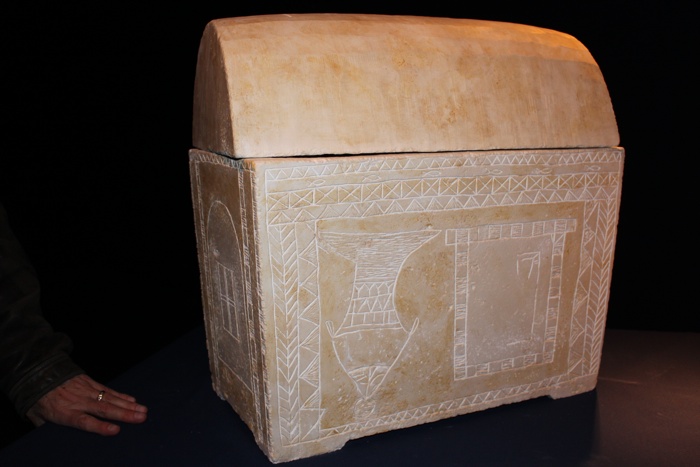 |
| Replica 1 (February 2012) |
 |
| Replica 2 (April 2012) |
If you think they look pretty similar, you would be right. But there are some telling signs that illustrate beyond doubt that these replicas are different. Let's take a look at them side by side:
 |
| Replica 1 (left) and Replica 2 (right) |
There are several tell-tale signs. Notice how in Replica 1, there are some lines drawn inside the square shaped object to the right of the vessel / fish, whereas in Replica 2, these lines are completely absent:
Notice also how the top left tip of the vessel / fish is next to the pointed part of a triangle in Replica 1 but next to the flat part of a triangle in Replica 2:
Similarly, notice how at the bottom left of Replica 1, the triangular shape protrudes across the border whereas in Replica 2, the triangle is neatly inside of its border:
Similar observations could be repeated for other elements in the two replicas, but I am sure that you get the basic point. Now one of the reasons that this is worthy of comment is that the replica (singular) has always been called "museum quality" and its accuracy has been praised. Yet, far from this being one, accurate "museum quality" replica, it is two contrasting replicas, in which attention to detail is far from the order of the day.
It is not just the question of accuracy and representation that is at issue here, or the apparent failure to flag up the differences between the two replicas. It is that Replica 2 makes several changes that may be the result of engaging with criticisms of the project. Let me attempt to explain what I am getting at.
Replica 1 appears in all the publicity for the documentary, book and website from February to March 2012. Replica 2 first appears, again as far as I can work out, and subject to correction, on April 3 or 4 2012, in Jerusalem:
In between the release of Replica 1 and Replica 2, there had been a lot of criticism about the project's claims including, among other things, the idea that there are drawings of little "fish in the margins". Robert Cargill demonstrated that the little oval shapes had been "inked in" so as to make them appear like fish. Now notice how the "fish in the margins" changed between the two replicas. In Replica 1, before the criticism had appeared, they were presented as fish, with very clear, long tails:
In Replica 2, which appeared after the criticism had been made, these shapes resemble more closely the actual shapes on the ossuary. The tails have gone:
Now, since Replica 2 appeared some time after Replica 1, I began to wonder whether there were also any changes in the way that the alleged YWNH ("Jonah") inscription appeared. Does the alleged inscription differ at all between Replicas 1 and 2? There is, indeed, a major difference in the way this appears between Replicas 1 and 2. Here it is in Replica 1:
This replica appears to have been produced before the "YWNH" inscription theory had emerged. The lines really look like random lines. Notice in particular what would become the letter "nun" -- it is here completely broken, just as it was in the CGI composite photograph and all the pictures up to this point (Do the lines in the "fish" head spell out Jonah?). No one looking at this picture would for a moment think it was spelling out "Jonah".
However, in Replica 2, the transformation of these lines is remarkable. Now the inscription could indeed be taken to spell out "Jonah". Notice how the "nun" is now one single, connected line. It is no longer broken. The "he" is given the appearance of stopping with one thick line forming the top of the letter, and only a thin line going on to the border. And the "yod" has a little loop on it just as it does in the "tracing" of the letters that appeared when the alleged inscription first came to light. Here's a close-up:
 |
| Replica 1 has a drawing inside the square which Replica 2 lacks |
Notice also how the top left tip of the vessel / fish is next to the pointed part of a triangle in Replica 1 but next to the flat part of a triangle in Replica 2:
 |
| Triangle border differs next to top left of vessel / fish |
 |
| Replica 1: triangle protrudes across the border in contrast to Replica 2 |
Similar observations could be repeated for other elements in the two replicas, but I am sure that you get the basic point. Now one of the reasons that this is worthy of comment is that the replica (singular) has always been called "museum quality" and its accuracy has been praised. Yet, far from this being one, accurate "museum quality" replica, it is two contrasting replicas, in which attention to detail is far from the order of the day.
It is not just the question of accuracy and representation that is at issue here, or the apparent failure to flag up the differences between the two replicas. It is that Replica 2 makes several changes that may be the result of engaging with criticisms of the project. Let me attempt to explain what I am getting at.
Replica 1 appears in all the publicity for the documentary, book and website from February to March 2012. Replica 2 first appears, again as far as I can work out, and subject to correction, on April 3 or 4 2012, in Jerusalem:
 |
| Simcha Jacobovici shows off Replica 2 in Jerusalem, 3/4 April 2012 |
 |
| Replica 1: "fish in the margins close up" (screengrab from Steve Caruso) |
 |
| Replica 2: "fish in the margins" now appear more like ovals |
Now, since Replica 2 appeared some time after Replica 1, I began to wonder whether there were also any changes in the way that the alleged YWNH ("Jonah") inscription appeared. Does the alleged inscription differ at all between Replicas 1 and 2? There is, indeed, a major difference in the way this appears between Replicas 1 and 2. Here it is in Replica 1:
 |
| Close up of alleged "Jonah" inscription on Replica 1 |
However, in Replica 2, the transformation of these lines is remarkable. Now the inscription could indeed be taken to spell out "Jonah". Notice how the "nun" is now one single, connected line. It is no longer broken. The "he" is given the appearance of stopping with one thick line forming the top of the letter, and only a thin line going on to the border. And the "yod" has a little loop on it just as it does in the "tracing" of the letters that appeared when the alleged inscription first came to light. Here's a close-up:
 |
| Close up of Replica 2, showing YWNH lettering clearly marked |

 |
| Yellow tracing of the alleged letters, James Tabor's blog, April 2012 |
I don't know what to make of all this, but I thought in the interests of analyzing Talpiot Tomb B, and the claims made by those involved with the "Jesus Discovery" project, it would be useful to lay out what I have found by analyzing the two contrasting replicas, and to see if others also see what I am seeing. Why is it that the "fish in the margins" are recrafted in between Replicas 1 and 2? Why is it that the "YWNH" inscription suddenly becomes clear only in Replica 2?
It may be worth adding that the replica shown to Prof. Puech in the video released last week is clearly Replica 2, which has a version of the "YWNH" inscription that we see above, and not the ambiguous representation of Replica 1:
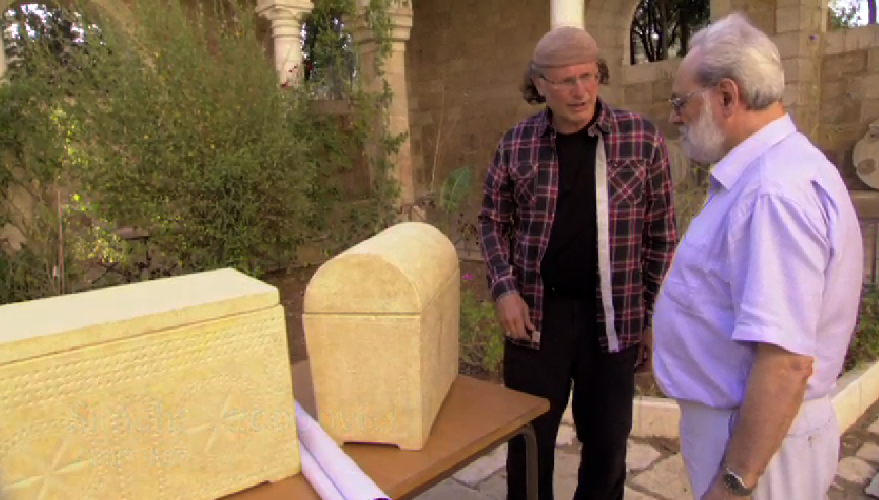 |
| Simcha Jacobovici shows Émile Puech Replica 2 |
Émile Puech's Statement on the Talpiot Tomb Images
I expressed some surprise over Prof. Émile Puech's apparent endorsement of Simcha Jacobovici's claims about the Talpiot Tombs on Thursday in a post headed Simcha Jacobovici and the Talpiot Tomb Again.
It now appears that Prof. Puech is very unhappy with the way that he was treated by Jacobovici and he has spoken out about this, first in en email reproduced on Jim West's blog, and subsequently in emails to several scholars including James Tabor, who publishes the email in a blog posted headed Emile Peuch’s [sic] Position on the “Jesus Discovery” and “Lost Tomb of Jesus” Films.
I am grateful to Prof. Tabor for publishing Prof. Puech's comments, and I think it is greatly to his credit that he has done so.
I hope that Simcha Jacobovici will be issuing a public apology to Prof. Puech as soon as possible.
It now appears that Prof. Puech is very unhappy with the way that he was treated by Jacobovici and he has spoken out about this, first in en email reproduced on Jim West's blog, and subsequently in emails to several scholars including James Tabor, who publishes the email in a blog posted headed Emile Peuch’s [sic] Position on the “Jesus Discovery” and “Lost Tomb of Jesus” Films.
I am grateful to Prof. Tabor for publishing Prof. Puech's comments, and I think it is greatly to his credit that he has done so.
I hope that Simcha Jacobovici will be issuing a public apology to Prof. Puech as soon as possible.
Friday, April 26, 2013
The Jesus Discovery? A Sceptic's Perspective
The third in the series of papers on the claims made by James Tabor and Simcha Jacobovici on the Talpiot Tomb is now up on the Bible and Interpretation website. All three papers are revised versions of presentations given at the SECSOR meeting in Greenville, SC, on March 16 this year:
Mark Goodacre
My paper gathers together my thinking about Talpiot Tombs A and B as they have emerged here on the NT Blog over the last five years. The primary focus is the more recent claims about Talpiot Tomb B (Is it is fish? Is it a vase? Is it a stick man with seaweed wrapped around his head? Are those scales of a fish or patterns on a vessel? Are those fins or handles?) but there is some discussion also of Talpiot Tomb A, and I am afraid that I could not resist the temptation to bring out John, Paul, George, Alan, Martin and Ziggy for a reunion concert.
Renewed thanks to Ralph Hawkins for the invitation to speak last month at SECSOR, to Mark Elliott for inviting us to publish our papers on Bible and Interpretation, and to James Tabor and Christopher Rollston for stimulating exchanges.
Sunday, February 10, 2013
Myths of Mary and the Married Jesus on Youtube
The Cadbury lecture I gave in Birmingham just over a week ago is now available on Youtube here:
Or watch it on Youtube here. The lecture is 48 minutes long. It features much of the powerpoint, but some slides have been omitted for copyright reasons. All of the Q&A is also features, though under the veil of darkness.
Update (12 February 2013): I have now made the audio available as an extended episode of the NT Pod. This version has the advantage of enabling you to hear the talk without seeing the speaker constantly waving his arms around.
Or watch it on Youtube here. The lecture is 48 minutes long. It features much of the powerpoint, but some slides have been omitted for copyright reasons. All of the Q&A is also features, though under the veil of darkness.
Update (12 February 2013): I have now made the audio available as an extended episode of the NT Pod. This version has the advantage of enabling you to hear the talk without seeing the speaker constantly waving his arms around.
Monday, June 11, 2012
James Charlesworth on Talpiot Tomb B (Revised and Updated)
This is a fully revised and updated version of my earlier post James Charlesworth on Talpiot Tomb B which commented on an earlier version of an article by James Charlesworth on Talpiot Tomb B that was subsequently removed. This post revises that one so that it responds to the new version of the article.
--
Those with an interest in the claims made by Simcha Jacobovici and James Tabor on Talpiot Tomb B, "the Patio Tomb", have been looking forward to hearing more about the views of Prof. James Charlesworth of Princeton Theological Seminary who acted as the "primary academic consultant" on the project (Tabor, Preliminary Report, 1, n. 2) and who appears in the documentary labelled The Resurrection Tomb Mystery (USA) / The Jesus Discovery (Canada). His report is now available, as a PDF on the Bible and Interpretation website:
What is the Message of the "Patio Tomb" in Talpiot, Jerusalem?
James Hamilton Charlesworth, Princeton, June 2012
The article provides a useful summary of the issues raised by the documentary and the related book (but not the Jesus Discovery website or the Preliminary Report, neither of which is mentioned). Charlesworth is broadly supportive of Tabor's and Jacobovici's claims, but he is cautious and sceptical at several points. Charlesworth discusses the different possibilities for the interpretation of the image on ossuary 6 (nefesh, amphora or fish?) and he defends his reading of YONAH at the bottom of that image. He asks lots of questions and encourages continued debate.
The piece is aimed at a non-scholarly audience for whom Charlesworth explains terms like "ossuary" and "nefesh"; he explains what happened in 66CE (2); he notes the correspondences between Hebrew and English letters (9) and explains that "Hebrew is written right to left" (9).
In spite of that target audience, I will admit to some disappointment that Charlesworth does not engage directly with any of the scholars' critiques of the project, whether here, on the ASOR blog, on Bible and Interpretation, on Robert Cargill's blog, on Christopher Rollston's blog or elsewhere. He does mention "scholars and non-scholars" who "have been reporting and blogging" and he speaks about his dismay over "occasional ad hominem comments" (1). As one who has experienced some unpleasant remarks, including from those involved in the making of the documentary, I very much share Charlesworth's concern on that front. Nevertheless, I think there is a danger in only mentioning blogging in the context of complaining about those who abuse the medium because it can all too easily be taken as a reason not to engage with serious scholarly criticism of the claims.
In relation to this, it is disappointing that Charlesworth simply repeats the sight reading of the inscription on Ossuary 5, "Divine [YHWH], who lifts up (or raised up), from (the tomb or death?)" (6), which is seen in the documentary. With the exception of a brief footnoted reference to Bauckham (15, n. 10), he does not engage with the careful analysis and criticism of this claim, with alternative readings, offered by Richard Bauckham, Christopher Rollston and others (see also Rollston's review here; see further links in those posts). The difficulty with not engaging with the critics is that it can give the impression that the reading in question is uncontested and somehow self-evident. It is not. It is controversial and unclear.
By contrast, there is some exposition of the alleged YONAH inscription that appears at the bottom of the image on Ossuary 6 (6-11). It is useful to have this exposition given that previously Charlesworth's views were only known through reports (See most fully Taborblog). Charlesworth is actually quite guarded about his suggestion and only puts forward the reading quite tentatively. Of the four alleged letters, he regards only the he as "unmistakable" (9). The yod may be a zayin; "some imagination is required" for the reading of the waw (9) and the nun "is not prima facie obvious" -- it may be a lamed (9).
Having read Charlesworth's own defence of this claim, I admit to being no more convinced than I was before, and pleased to see the way in which he makes the suggestion only tentatively. One of the reasons for my own scepticism has been the confusing nature of the case. With so much going on in the head of the fish / base of the vessel -- arms and legs of a stick man, a mouth and an eye of a fish, Hebrew letters that extend unusually and further lines that are unaccounted for -- it is doubtful that YONAH is there (see further The Texas Sharpshooter Fallacy and the Talpiot Tomb).
Like Tabor and Jacobovici, Charlesworth is inclined to see a stick man here too (5, 9-10 and especially 11), though he does not explain which lines belong to the stick man, and whether any of the lines that form the stick man do double duty as parts of the alleged YONAH inscription (see further my Changing Body of the Stick Man and links there). I suspect that most scholars will remain sceptical about the presence of a stick man given the lack of clarity about which lines represent his arms and legs.
Charlesworth does, however, add a new element to the discussion of the stick man with an interesting speculation about the size of his head:
Moreover, one of the issues mentioned by Charlesworth does have a straightforward explanation. He asks:

But what of the image itself? According to Jacobovici and Tabor's Jesus Discovery, at the time of viewing, Charlesworth "offered without hesitation the same interpretation of the fish" (loc. 1041). In the new article, he is still inclined towards the "fish" interpretation, but he suggests that there are merits also in the ideas that it is a nefesh monument or an amphora. Indeed he wonders whether the artist was being deliberately ambiguous, perhaps attempting to depict all three. He suggests, for example, that:
Charlesworth's concern with the amphora theory relates to the handles:

Moreover, since he does not mention it in the article, Charlesworth may be unaware that in May 1981, Zvi Ilan reported that the first excavators of the tomb, who actually saw the ossuary, interpreted the image in question as an amphora (ASOR blog). Furthermore, Charlesworth does not mention the image on the side of ossuary, the image that Tabor and Jacobovici had interpreted as a "half-fish" but which clearly appears to have handles on either side, as I have often mentioned here (see How the half-fish became a vase and why it matters and links there):

The key point about this image, which Tabor and Jacobovici concede may have been interpreted as a vase in 1981, is that it provides the all-important contextual information about the image on the façade. Vase on the side; vase on the front.
Charlesworth's post concludes with reflections on the meaning of the image, and although he suggests that "meaning resides in ambiguity and all symbols are multvalent" (11), he focuses on the idea of Jonah and the fish, linking this first with repentance and then with resurrection. He draws attention to the repentance theme in Luke 11.29-32 and adds that
Charlesworth goes on to mention the connection between the resurrection and the sign of Jonah in Matt. 12.38-41, the text that is key in Tabor's and Jacobovici's case (See my The Talpiot Tomb, Jonah and Q). The big question here relates to dating. Most scholars (me included) date Matthew after 70CE, after the dates of the ossuaries in this early Roman period tomb, which places a question mark against Tabor's and Jacobovici's case. Charlesworth's comment is:
Before concluding this post, I would like to comment on three other things of interest. The first is the mention of a "rubbing of that image" (Q & A with Ben Witherington, footnote 1), i.e. the image of the fish / vessel on ossuary 6. I had not heard about this before and so asked Prof. Charlesworth for clarification. He responded by saying emphatically that "there was no rubbing" and in the revised article, the reference has been changed to "a CGI generated image created from a composite of several photographs from different angles and in different lighting" (14, n. 2).
Second, I was interested to see measurements for the fish/vessel image (23 x 15 x 9 x 3) for the first time (4). This is helpful information, but I am curious about how the image was measured.
Third, it is helpful to have some clarifications of the dates in this article. Charlesworth here dates his involvement to June 2010, which coheres with the dating in The Jesus Discovery and corrects his earlier dating of June 2011.
In summary, after having read Charlesworth's article carefully, I am sorry to say that I remain completely unpersuaded by the claims made in the documentary, the book, the website, and the preliminary report.
----------------------
Appended Note 1: Two of Richard Bauckham's comments to the earlier version of this post remain relevant to this revised version, so I will quote them again here:

--
Those with an interest in the claims made by Simcha Jacobovici and James Tabor on Talpiot Tomb B, "the Patio Tomb", have been looking forward to hearing more about the views of Prof. James Charlesworth of Princeton Theological Seminary who acted as the "primary academic consultant" on the project (Tabor, Preliminary Report, 1, n. 2) and who appears in the documentary labelled The Resurrection Tomb Mystery (USA) / The Jesus Discovery (Canada). His report is now available, as a PDF on the Bible and Interpretation website:
What is the Message of the "Patio Tomb" in Talpiot, Jerusalem?
James Hamilton Charlesworth, Princeton, June 2012
The article provides a useful summary of the issues raised by the documentary and the related book (but not the Jesus Discovery website or the Preliminary Report, neither of which is mentioned). Charlesworth is broadly supportive of Tabor's and Jacobovici's claims, but he is cautious and sceptical at several points. Charlesworth discusses the different possibilities for the interpretation of the image on ossuary 6 (nefesh, amphora or fish?) and he defends his reading of YONAH at the bottom of that image. He asks lots of questions and encourages continued debate.
The piece is aimed at a non-scholarly audience for whom Charlesworth explains terms like "ossuary" and "nefesh"; he explains what happened in 66CE (2); he notes the correspondences between Hebrew and English letters (9) and explains that "Hebrew is written right to left" (9).
In spite of that target audience, I will admit to some disappointment that Charlesworth does not engage directly with any of the scholars' critiques of the project, whether here, on the ASOR blog, on Bible and Interpretation, on Robert Cargill's blog, on Christopher Rollston's blog or elsewhere. He does mention "scholars and non-scholars" who "have been reporting and blogging" and he speaks about his dismay over "occasional ad hominem comments" (1). As one who has experienced some unpleasant remarks, including from those involved in the making of the documentary, I very much share Charlesworth's concern on that front. Nevertheless, I think there is a danger in only mentioning blogging in the context of complaining about those who abuse the medium because it can all too easily be taken as a reason not to engage with serious scholarly criticism of the claims.
In relation to this, it is disappointing that Charlesworth simply repeats the sight reading of the inscription on Ossuary 5, "Divine [YHWH], who lifts up (or raised up), from (the tomb or death?)" (6), which is seen in the documentary. With the exception of a brief footnoted reference to Bauckham (15, n. 10), he does not engage with the careful analysis and criticism of this claim, with alternative readings, offered by Richard Bauckham, Christopher Rollston and others (see also Rollston's review here; see further links in those posts). The difficulty with not engaging with the critics is that it can give the impression that the reading in question is uncontested and somehow self-evident. It is not. It is controversial and unclear.
By contrast, there is some exposition of the alleged YONAH inscription that appears at the bottom of the image on Ossuary 6 (6-11). It is useful to have this exposition given that previously Charlesworth's views were only known through reports (See most fully Taborblog). Charlesworth is actually quite guarded about his suggestion and only puts forward the reading quite tentatively. Of the four alleged letters, he regards only the he as "unmistakable" (9). The yod may be a zayin; "some imagination is required" for the reading of the waw (9) and the nun "is not prima facie obvious" -- it may be a lamed (9).
Having read Charlesworth's own defence of this claim, I admit to being no more convinced than I was before, and pleased to see the way in which he makes the suggestion only tentatively. One of the reasons for my own scepticism has been the confusing nature of the case. With so much going on in the head of the fish / base of the vessel -- arms and legs of a stick man, a mouth and an eye of a fish, Hebrew letters that extend unusually and further lines that are unaccounted for -- it is doubtful that YONAH is there (see further The Texas Sharpshooter Fallacy and the Talpiot Tomb).
Like Tabor and Jacobovici, Charlesworth is inclined to see a stick man here too (5, 9-10 and especially 11), though he does not explain which lines belong to the stick man, and whether any of the lines that form the stick man do double duty as parts of the alleged YONAH inscription (see further my Changing Body of the Stick Man and links there). I suspect that most scholars will remain sceptical about the presence of a stick man given the lack of clarity about which lines represent his arms and legs.
Charlesworth does, however, add a new element to the discussion of the stick man with an interesting speculation about the size of his head:
If this is a large fish and Jonah is intended, then it is possible to image [sic, imagine?] a stick figure inside the fish. If so, the head is absurdly large. Why? Obviously, some Jews imagined the resurrection body to be similar to but different from the fleshy body. Would some early Jews have imagined a resurrected body would have a large head? Is that the ideal body? We simply need to raise questions and be open to dialogue. (5).I would be interested to hear if there is any analogy for the idea of the resurrection body having a massive head. I would doubt it, but I will listen with interest. But in any case, the key question presumably would relate not to the resurrection body but to the book of Jonah, where there is no hint that the character has a massive head, either before or after being swallowed by the fish.
Moreover, one of the issues mentioned by Charlesworth does have a straightforward explanation. He asks:
Why has the engraver spent so much time on the lines within the spherical "bottom"? One can count at least 14 strokes. Why? What was imagined? (5).As Juan V. Fernández de la Gala has helpfully illustrated (ASOR Blog), those lines are the way that the artist shades in the vessel, seen also at the top of the vessel (the "fish tail") and the vessel decorations (the "scales"):

But what of the image itself? According to Jacobovici and Tabor's Jesus Discovery, at the time of viewing, Charlesworth "offered without hesitation the same interpretation of the fish" (loc. 1041). In the new article, he is still inclined towards the "fish" interpretation, but he suggests that there are merits also in the ideas that it is a nefesh monument or an amphora. Indeed he wonders whether the artist was being deliberately ambiguous, perhaps attempting to depict all three. He suggests, for example, that:
A symbol must be interpreted and usually has many meanings. Symbols appear in a world of ambiguity and bring with them more than one meaning (4).Charlesworth adds:
But, something is intended. We should move beyond what it could possibly be and ask what is the intentionality that created this image (5).I must admit to struggling with this. It is difficult to ask about the "intentionality" of the artist without having a clear handle on "what it could possibly be". Perhaps my fondness for Occam's Razor is the problem. Where Charlesworth wonders about the decorative squares inside the image --
Did the inscriber attempt to meld an image of a fish with a nefesh? Is there some conflation of symbols? Are there multiple meanings to be contemplated? (5),-- I can't help thinking that it is unnecessary to interpret the image as a conflated nefesh-fish when the vessel interpretation appears more plausible.
Charlesworth's concern with the amphora theory relates to the handles:
The image has something on each side. Could these be handles? If so, they are not like any known handles on an amphora, whether drawn or part of an amphora itself (4).Since Charlesworth does not mention any of the scholarly critiques of the project, it may be that he is unfamiliar with the attempts to illustrate answers to this type of question. Antonio Lombatti's detailed and helpful illustrated article Observations on the “Jonah” Iconography on the Ossuary of Talpiot B Tomb, for example, provides several useful analogues, including this graphic from a useful post by Thomas Verenna:

Moreover, since he does not mention it in the article, Charlesworth may be unaware that in May 1981, Zvi Ilan reported that the first excavators of the tomb, who actually saw the ossuary, interpreted the image in question as an amphora (ASOR blog). Furthermore, Charlesworth does not mention the image on the side of ossuary, the image that Tabor and Jacobovici had interpreted as a "half-fish" but which clearly appears to have handles on either side, as I have often mentioned here (see How the half-fish became a vase and why it matters and links there):

The key point about this image, which Tabor and Jacobovici concede may have been interpreted as a vase in 1981, is that it provides the all-important contextual information about the image on the façade. Vase on the side; vase on the front.
Charlesworth's post concludes with reflections on the meaning of the image, and although he suggests that "meaning resides in ambiguity and all symbols are multvalent" (11), he focuses on the idea of Jonah and the fish, linking this first with repentance and then with resurrection. He draws attention to the repentance theme in Luke 11.29-32 and adds that
Jonah is still read on the evening of Yom Kippur (the Day of Atonement) to signal the importance of seeking forgiveness before God (11).There is, however, no evidence that I am aware of that Jews were reading Jonah on the Day of Atonement as early as the first century. The first reference I know of to Jonah being read at Yom Kippur is b.Meg. 31a. But in any case that does not help with the imagined Christian identification of the tomb.
Charlesworth goes on to mention the connection between the resurrection and the sign of Jonah in Matt. 12.38-41, the text that is key in Tabor's and Jacobovici's case (See my The Talpiot Tomb, Jonah and Q). The big question here relates to dating. Most scholars (me included) date Matthew after 70CE, after the dates of the ossuaries in this early Roman period tomb, which places a question mark against Tabor's and Jacobovici's case. Charlesworth's comment is:
These Jewish reflections [Matthew's] are from the first century CE, but after 70CE they were reported by those who were claimed to have seen a resurrected Jesus (12).And Charlesworth goes on to quote 1 Cor. 15.3-8 followed by Joseph Ratzinger's Jesus of Nazareth. It looks like Charlesworth is here distancing himself from interpreting the sign of Jonah as a sign of the resurrection in the pre-70 period, and so aligning himself more with sceptics like me than with Tabor and Jacobovici. But I could be wrong -- it is not easy to parse Charlesworth's prose here (What does "they were reported by those who were claimed to have seen a resurrected Jesus" mean?).
Before concluding this post, I would like to comment on three other things of interest. The first is the mention of a "rubbing of that image" (Q & A with Ben Witherington, footnote 1), i.e. the image of the fish / vessel on ossuary 6. I had not heard about this before and so asked Prof. Charlesworth for clarification. He responded by saying emphatically that "there was no rubbing" and in the revised article, the reference has been changed to "a CGI generated image created from a composite of several photographs from different angles and in different lighting" (14, n. 2).
Second, I was interested to see measurements for the fish/vessel image (23 x 15 x 9 x 3) for the first time (4). This is helpful information, but I am curious about how the image was measured.
Third, it is helpful to have some clarifications of the dates in this article. Charlesworth here dates his involvement to June 2010, which coheres with the dating in The Jesus Discovery and corrects his earlier dating of June 2011.
In summary, after having read Charlesworth's article carefully, I am sorry to say that I remain completely unpersuaded by the claims made in the documentary, the book, the website, and the preliminary report.
----------------------
Appended Note 1: Two of Richard Bauckham's comments to the earlier version of this post remain relevant to this revised version, so I will quote them again here:
(2) Charlesworth's reiteration of the reading of the Greek inscription that he made when he first saw it (shown in the film) without taking any notice at all of any of the very considerable subsequent discussion of it by fellow-scholars is extremely disappointing, especially as he himself says in this article that "we need each other in a dialogue that appreciates the input of others" (p. 5).
(3) I was puzzled by his appeal to the multivalency of symbols in relation to the fish/nephesh/amphora image when he first made it in email correspondence back in the autumn, and his elaboration of it in this article still leaves me baffled. He says, "Any attempt to enter the mind of an engraver in order to discern the intention of an “artist” borders on unsophisticated methodology," but then goes on precisely to discuss all sorts of considerations precisely with a view to discerning the engraver's intention. Furthermore, what exactly does he mean by calling this image a symbol. His footnote refers to his own extensive discussion of the image of the "serpent" in his book on that topic, reporting that he found this to have about thirty meanings. But these are all meanings of the image of a SERPENT. This scarcely seems a valid parallel to the suggestion that the image on the ossuary may be ambiguously a nephesh or an amphora or a fish. If it is indeed a fish, then one might say that the fish is a multivalent symbol - conceivably, for example, an early Christian engraver might have intended both Jonah's fish and the Christian ICHTHYS acronym (though Jim Charlesworth himself rather dogmatically dismisses the latter as having any relevance). An amphora might also have more than one possible symbolic significance (a funerary symbol? one of the famous Temple vessels?). In such cases, we could be dealing with an intentionality on the part of the engraver to provide a symbol with a range of meaning or we could have an image so ambiguous that we can't discern the engraver's intentionality, given our limited evidence. But what does it mean to say that the image is ambiguously a nephesh and a fish and an amphora? I don't think Charlesworth means that the engraver could have intended such an ambiguity (see page 4, paragraph 4, beginning "It is easy..."). He seems to mean that the image is ambiguous to us and we find it very difficult to discern the engraver's intentionality. Even so, as I have pointed out, Charlesworth himself offers plenty of considerations towards resolving the ambiguity. So is his appeal to the multivalency of symbols no more than a warning to us not to seize too quickly on an interpretation, but to engage, as he says, in "a dialogue that appreciates the input of others, whether philologists, archaeologists, biblical scholars, or specialists in ancient art" (p 5). If that is all it amounts to, then I must say it seems to me that a good deal of such dialogue has actually occurred in the extensive discussions, especially in the highly reputable location of the ASOR Blog. I can say this as someone who has not contributed to that particular dialogue myself (reserving my own contributions to the discussion of the Greek inscription).
Appended Note 2: See also James Tabor's comments on the earlier draft of Charlesworth's article at Taborblog. Tabor echoes Charlesworth's focus on the "intention" of the engraver and suggests that "Often only a trained eye can decipher what the writer intended". This may well, of course, be the case, but the "intention" of the writer still has to be demonstrated on the basis of what s/he actually wrote.
Tabor also echoes Charlesworth's stress on the notion that all the strokes at the base of the vessel / fish are accounted for:
Also, as Charlesworth points out, those who read these markings as intentional Hebrew letters do not claim that all the marks in the mouth of the fish are part of the letters, some are related to the fish itself (i.e., the straight line of the mouth), whereas others seem to form the eye of the fish as well as the arms and legs of a stick-like figure, attached to the large head. What does seem to be the case is that all of the inscribed markings (not the scratches or imperfections in the stone) are intentional.
There are, I think, a couple of difficulties here. First, Charlesworth does not appear to be convinced that the image is a fish. He thinks it might be, but he also finds the nefesh and amphora theories compelling, even suggesting some conflation of all three, with ambiguity and multivalence. But if it is not a fish, then all the extra lines in its "head" need explanation because they can no longer be relegated to the background in order for the alleged YONAH inscription to stand out.
Second, even if some lines are attributed to YONAH, some to a stick man (variously configured) and some to a fish head and mouth, there are still some lines left over. See, for example, Bob Cargill's helpful graphic here:

Notice especially the several "ignored lines".
Third, both Charlesworth and Tabor make clear that they don't see all the marks here as forming Hebrew letters. Charlesworth writes:
Obviously, I never intimated that all the lines in "the head of the fish" are letters; anyone who imagined that I did make such a claim or that I ignored some lines simply was dependent on a journalist's summary of my rather lengthy and detailed comments (9).
And Tabor here echoes the comments. I am puzzled by their insistence on this point since I am unaware of anyone who says that they claimed that "all the lines . . . are letters". It is a fact, though, that several of the lines in the "head of the fish" do not do service as letters or lines in the fish head or lines on a stick man. But to repeat my earlier point, I think it is always preferable to cite those against who one is arguing so that one can check up on whether the argument is fairly represented.
Update (13 June): Thanks to George Makrauer for letting me know that Prof. Charlesworth's article now also appears here (PDF) on the Foundations on Judaism and Christian Origins website. As far as I can tell, the two versions are identical (with the exception of the preparatory material) but the page numbers to not tally. The page numbers in my response above refer to the Bible and Interpretation version.
Friday, April 27, 2012
Accused of slander for criticizing the "Jesus Discovery" claims
I was disappointed to see Nicole Austin, Associate Producer on The Resurrection Tomb Mystery documentary (The Jesus Discovery in Canada), characterizing this blog as engaging in slander. In a comment on Robert Cargill's blog today, she responded to Paul Regnier who had asked her a question about the scholars working on the project. She wrote:
You are repeating the same slander which has dominated the Cargill/West/Goodacre blogs and has kept the majority of true scholars away from this discussion.Nicole, who works for Associated Producers Ltd., goes on to make other rude remarks, mentioning me by name again, but it is the accusation of slander that I find especially disappointing. The others mentioned in this comment can of course answer for themselves, but I would say that I have always attempted, both in relation to the recent project and the one from 2007, to be fair and accurate, to state any objections in a calm and reasonable way, basing them solely on the evidence presented. If this kind of honest, rigorous critical analysis is characterized as slander, then it is clearly impossible to have a serious discussion about the claims made in the Simcha Jacobovici and James Tabor's project.
Friday, April 20, 2012
Do the lines in the "fish" head spell out Jonah?
Just over a week ago, James Tabor discussed an interesting suggestion made by James Charlesworth that the name "Jonah" might be spelt out in Hebrew letters in the head of what they see as the "fish" in Ossuary 6 in Talpiot Tomb B, the image that others see as some kind of vessel or vase, Name of “Jonah” Encrypted on the Jonah and the Fish Image (see also The Hebrew Name “YONAH” Embedded in the Image of the Fish on the Talpiot Tomb Ossuary).
My worry about the suggestion was that it led to a revision of an already problematic aspect of the case, the idea that the image featured a "stick figure" of Jonah emerging from the fish, a point made by Stephen Goranson and illustrated in my post headed The Changing Body of the Stick Man in Talpiot Tomb B. But more importantly, the suggestion about the letters spelling out Jonah was received with scepticism -- Christopher Rollston in the Globe and Mail aticle; Jim Davila in Paleojudaica, Antonio Lombatti, Robert Cargill, Robert Cargill again, Steve Caruso and Steve Caruso again.
Now James Tabor makes clear that, as far as he is concerned, the Inscription on the “Jonah image” Says YONAH. He complains about several blog responses and he quotes from troubling posts that I have not seen. My preference is, of course, to deal with matters of substance and there is something I would like to draw attention to.
One of the difficulties that some have seen with the new proposal is that one of the alleged letters, the nun, appears to be broken in the middle, and thus does not appear to be a nun at all. Here, for example, is Robert Cargill's helpful illustration:
On the left is a close up of the bottom of the image as it appears on ossuary 6. On the right is Robert Cargill's representation of the engraved lines. The alleged nun is here represented by the yellow and green lines in the picture on the right.
The difficulty with this letter is that there is an obvious break between the elements of the alleged nun. James Tabor maintains, however, that the lines are clear and that they are not random markings. He does not acknowledge that there is any break at all in the lines that constitute the alleged nun. In his pictures, the line is represented as continuous. Take for example the recent illustration on his blog:
But how do we test the competing claims? Is the alleged nun here continuous or broken? Tabor maintains that the letters are "crystal clear" but I remain sceptical. One of the main reasons for my scepticism is that the break in the middle of the alleged nun is actually "crystal clear", to borrow Tabor's language. This is not a nun; it is two random lines.
Indeed, one can test for the clarity of the lines here by returning to the CGI composite image of what is depicted on ossuary 6. This image aims to represent what the authors of the project used to regard as clear and self-evident and yet it is quite clear that before this new "Jonah" reading had been proposed, they too saw a break in the line that is now held to be a nun. In other words, before the "Jonah" inscription interpretation, they too could not see the continuous line of a letter "nun".
It's worth taking a close-up look at the image. The original CGI image is oriented horizontally, but a rotation and a zoom-in helps us to compare this with the images used to illustrate the alleged inscription:
A glance at the image confirms that those involved with the project could not see what is now interpreted as a nun. The two lines are quite clearly unrelated. To draw attention to this clear non-nun, I have added a red circle here to show the key area in question:
It is not just sceptics of Tabor's and Jacobovici's claims who are struggling to see the name of Jonah spelt out here. It is the project authors' own CGI picture, designed before the new claim, that bears testimony to the difficulty in seeing the letters that they now wish to see.
Update (6.54am): Link to James Tabor's post above fixed (with thanks to James Davila). See now Jim Davila's helpful comments on Paleojudaica, including the following:
Update (4.45pm): See now also Antonio Lombatti, Is YONAH there or not? and Robert Cargill, When is a nun not a nun?. (See what he did there?!). See too Steve Caruso, Unfaithful Representation.
My worry about the suggestion was that it led to a revision of an already problematic aspect of the case, the idea that the image featured a "stick figure" of Jonah emerging from the fish, a point made by Stephen Goranson and illustrated in my post headed The Changing Body of the Stick Man in Talpiot Tomb B. But more importantly, the suggestion about the letters spelling out Jonah was received with scepticism -- Christopher Rollston in the Globe and Mail aticle; Jim Davila in Paleojudaica, Antonio Lombatti, Robert Cargill, Robert Cargill again, Steve Caruso and Steve Caruso again.
Now James Tabor makes clear that, as far as he is concerned, the Inscription on the “Jonah image” Says YONAH. He complains about several blog responses and he quotes from troubling posts that I have not seen. My preference is, of course, to deal with matters of substance and there is something I would like to draw attention to.
One of the difficulties that some have seen with the new proposal is that one of the alleged letters, the nun, appears to be broken in the middle, and thus does not appear to be a nun at all. Here, for example, is Robert Cargill's helpful illustration:
 |
| Image (bottom) on Ossuary 6. Original image here .Coloured lines courtesy of Robert Cargill. |
The difficulty with this letter is that there is an obvious break between the elements of the alleged nun. James Tabor maintains, however, that the lines are clear and that they are not random markings. He does not acknowledge that there is any break at all in the lines that constitute the alleged nun. In his pictures, the line is represented as continuous. Take for example the recent illustration on his blog:
 |
| Alleged letters spelling out "Jonah" on James Tabor's blog |
Indeed, one can test for the clarity of the lines here by returning to the CGI composite image of what is depicted on ossuary 6. This image aims to represent what the authors of the project used to regard as clear and self-evident and yet it is quite clear that before this new "Jonah" reading had been proposed, they too saw a break in the line that is now held to be a nun. In other words, before the "Jonah" inscription interpretation, they too could not see the continuous line of a letter "nun".

It's worth taking a close-up look at the image. The original CGI image is oriented horizontally, but a rotation and a zoom-in helps us to compare this with the images used to illustrate the alleged inscription:
 |
| Close-up of CGI composite of the bottom left facade of Talpiot Tomb B |
 | |
|
Update (6.54am): Link to James Tabor's post above fixed (with thanks to James Davila). See now Jim Davila's helpful comments on Paleojudaica, including the following:
If Professor Tabor wants to convince his colleagues that there is an inscription there and that it says "Jonah," he needs to take up the objections one by one and demonstrate that (1) the lines he says he sees on the ossuary, especially those of the "nun," are really there and as he sees them and (2) that each supposed letter shape can be closely paralleled by specific letters in other Herodian informal lapidary inscriptions such as appear on ossuaries.
Update (4.45pm): See now also Antonio Lombatti, Is YONAH there or not? and Robert Cargill, When is a nun not a nun?. (See what he did there?!). See too Steve Caruso, Unfaithful Representation.
Subscribe to:
Posts (Atom)