Friday, October 04, 2013

Jimmy Carter, Jesus and "the Matthew effect"

I have discussed the Matthew effect here before whereby a a piece of research, an idea, a quotation, a story gets associated with a more famous, more prominent person.  There's a famous example of it in our field, the misattribution of a saying to Schweitzer (about looking into the well and seeing our own reflection) that was actually said by George Tyrrell.

There was another example of it circulating on the internet not long ago, where a saying was misattributed to the Dalai Lama.  Today I saw another great example of the Matthew effect in a quotation attributed to Jimmy Carter (right).  The quotation is actually extracted from an interview with John Fugelsang.  Here is the quotation in context:
Who would Jesus vote for in this election? 
I don’t know. I don’t think he would vote for either of the two major party candidates. I think Jesus would be third party all the way, if he did vote. I bring up the fact that Jesus never lived in a democracy quite a bit, because when you hear people say, “Jesus said to help the poor, but he didn’t say the government should do it!” I always respond, “Yes, but Jesus didn’t have democracy.” If you want your tax dollars to help people over here instead of blowing them up over there, then vote that way. And if you don’t want your tax dollars to help the poor, to help the sick, to avoid violence, to take better care of those in prison, to help the needy, fine. Don’t vote that way. But don’t ever say you want a government based on Christian values, because you don’t.
I actually prefer the original quotation from Fugelsang in which one may hear an allusion to Matt. 25.31-46 (Sheep and the Goats).  Also, the term "government" makes better sense here than "country".  In order for the briefer, pseudo-Carter version to work, ". . . But don't ever say" has to be adjusted to "then stop saying", but otherwise the saying is clearly the same.

There's a nice analogy here for Christian origins scholarship in another way too.  It is sometimes said that simpler, briefer, terser sayings are likely to be more primitive than longer sayings, and this works as a common criterion in historical Jesus research, especially as it is practised by the Jesus Seminar and John Dominic Crossan.  However here, as also in early Christianity, the briefer, terser version can be later than and dependent on the earlier, more detailed version (see further Thomas and the Gospels, 145-50).

Wednesday, October 02, 2013

Candida Moss takes on Bill O'Reilly

This is so impressive.  Three cheers to Professor Candida Moss, Professor of New Testament and Early Christianity at Notre Dame University!  For those who don't know, Candida wrote a witty and intelligent review of Bill O'Reilly's new book Killing Jesus for the Daily Beast the other day.  O'Reilly invited her onto his Fox News show tonight and she showed us how it's done -- calm, collected, polite, respectful and yet authoritative, intelligent and showing killer instinct!

You can find the clip on Mediaite here or over on Youtube here:


Very nicely done indeed, Candida.


Friday, September 27, 2013

Was Jesus the first person to tweet?

From my room on Toronto, I caught on CBS news this morning Cardinal Ravasi's claim that Jesus was the first person to tweet.  His sermons, the cardinal said, were "brief and full of meaning".

Funnily enough, I talked about this in a segment of my online office hours a couple of years ago, Would Jesus tweet?


Actually, this has given me a great idea for the next NT Pod.

Thursday, September 26, 2013

York Christian Apocrypha Symposium 2013

I am on my way to the York Christian Apocrypha Symposium 2013 in Toronto.  Today (Thursday) is arrival day for the speakers, but the conference gets going on Friday and continues through to Saturday afternoon.  

The organizer, Tony Burke, has put together an excellent symposium and you can read the details here:

2013 York Christian Apocrypha Symposium
The 2013 York Christian Apocrypha Symposium, “Forbidden Texts on the Western Frontier: The Christian Apocrypha in North American Perspectives,” will take place at York University September 26–28, 2013. 
The event is organized by Tony Burke (York University) in consultation with Brent Landau (University of Oklahoma). It brings together 22 Canadian and U.S. scholars to share their work and discuss present and future collaborative projects . . . 
Tony Burke has been previewing the symposium on his Apocryphicity blog.  He has added profiles of speakers over the last few months.   I look forward to seeing some of you there.  It looks like it is going to be an excellent symposium.  For those who can't make it, I should say that I will be taking my blogging machine and I hope to get the chance to chat about the conference here on the NT Blog.

Sunday, September 22, 2013

How accurate is that replica, and why does it matter?

After discussions of the Talpiot Tombs resumed recently in the blogs (see James McGrath, Talpiot Tomb Latest and Talpiot Tomb Representation and Rhetoric), I have found myself reviewing some of the materials and looking back at old contributions.  The fact that some time has passed since the excitement of March-April 2012, when details of and theories about Tomb B emerged, actually helps one to get the kind of perspective that only time can provide.

One thing that has become clearer to me with the passage of time is the importance of distinguishing between the evidence itself and the project leaders' interpretations of the evidence.  Because the academy at large has been broadly critical of the project leaders' theories, it is easy to give the mistaken impression that we are not genuinely fascinated by the materials that they have uncovered.  If we have not underlined that sufficiently in the past, it's worth doing it again here -- the new finds in Talpiot Tomb B are fascinating and well worth studying. Nevertheless, our interest in the evidence does not, of course, commit us in any way to accepting the project leaders' interpretations of the evidence.

And there is a difficulty here.  A lot of the evidence has got bound up with the interpretations of the evidence.  Thus, the CGI composite image of the "fish" should only be used as an illustration of Jacobovici's and Tabor's theory.  It should not be used, as it was back in March 2012, as if it were an actual photograph.  It represents the theory.  It is not part of the data set.

It is clear now also that both ossuary replicas are best understood as attempts to represent Jacobovici's and Tabor's theory about the tomb.  As such, they are very useful.  In order to see this, we need to play down the language about the accuracy of the replicas, and especially Replica 2 (e.g. recently in the video interview with Prof. Puech).  While there are important points of contact between the replicas and the artifacts that they are modelling, there are also important points of divergence.

Let me illustrate.  I pointed out the other day that one of the ways that Replicas 1 and 2 differed was in the depiction of the border of the ossuary -- see here:

Replica 1 (left); Replica 2 (right), bottom left facade
Replica 1 is far more accurate here than Replica 2.  Replica 2 simply produces regular triangles without any attention to what is actually on the ossuary.  It is as if someone has just said "Do me some regular triangles in the border".  Replica 1, on the other hand, attempts to depict what is actually on the ossuary.  Take a look. I can only find two published photos that feature that part of the ossuary, one on the Jesus Discovery site and one on James Tabor's blog, but notice how on each you can see that the triangles are not even, and the bottom one protrudes over the border.  This is the clearest one:


Bottom left of ossuary 6 showing triangle protruding over border, as in Replica 1
Here, then, Replica 1 is more accurate than Replica 2, and we should treat the claims about the great accuracy of the replica with a touch of caution.

However, the point of this post is not solely to point to the problems with the claims of the accuracy of "the replica", but to reflect on what this tells us about how the filmmakers are looking at the photos.  Allow me to explain.

We already know that the alleged "Jonah" inscription does not feature on Replica 1 but appears clearly on Replica 2 (See A Tale of Two Replicas, and see now also with helpful illustrations in Unfaithful Representation: The Second Replica and A Comparison of the First Replica on Steve Caruso's blog). The reason that that is interesting is that it illustrates the value of the replicas for showing how those involved in the project are seeing the evidence.  The replicas function not so much as facsimiles of artifacts but instead as models of theories.

The point can be further illustrated by looking at the issue of the shading on certain areas of Replica 2.  Several of us have been saying for some time that the lines in the ball-shaped object at the bottom of the image do not represent Jonah's seaweed-wrapped head, as James Tabor and Simcha Jacobovici argue, but rather they are the artist's typical means of shading his image (e.g. Juan V. Fernández de la Gala).  The same shading appears all over the ossuary, in the borders and in the image itself.  Here is the relevant area:

Close-up of bottom of image on Ossuary 6 (source; also here

Notice the shading in the ball area at the bottom.  It's the same shading that we see here at the top of the same image:

Close-up of top of image on Ossuary 6 (source)
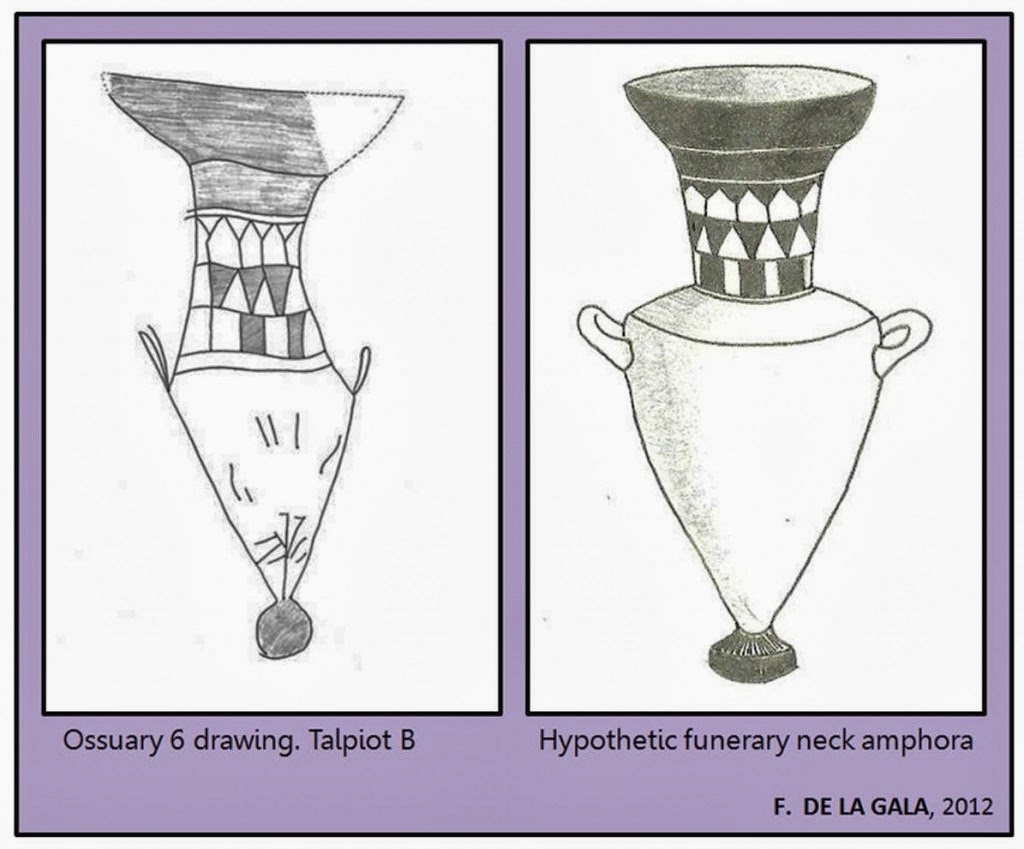
That's not seaweed wrapped around the top of the image; it is the artist's way of shading in his image, helpfully illustrated in this reconstruction by Juan V. Fernández de la Gala:

Juan V. Fernández de la Gala's illustration (source)
What Replica 2 illustrates, however, is that Jacobovici and Tabor appear not to be paying attention to the shading at the top of the image.  Replica 2 depicts the shading at the bottom of image:

Close up of Replica 2 showing the shading at the bottom of the image (source)
This is where they are attempting to depict Jonah's head wrapped in seaweed.  However, at the top of the image, the shading is left blank:

Close up of Replica 2 showing the lack of shading at the top of the image (source)
What the replica does is to illustrate the theory that this is an image of Jonah and the fish.  The shading of the "tail" is irrelevant to that theory, just as the shading in the border triangles is irrelevant, so they are left blank.  It is the same issue as the alleged "YWNH" inscription, that the elements relevant to the model are illustrated and the elements that do not fit the model are not illustrated.

For what it's worth, I don't think that there is anything wrong with providing helpful illustrative models of theories.  In fact, I think it's a really useful way of proceeding because it helps one to explain the theory as clearly as possible so that scholars can assess it.  The point is to be clear in this context about what the replicas are -- they provide illustrative models for a theory.

Nevertheless, the issue over the replicas, like the issue earlier over the CGI composite image (originally simply called a "blow up"), is that a fascinating and highly worthwhile project of excavation, exploration and analysis has become inextricably linked with a particular theory about the project, a theory that many of us regard as untenable.  In other words, it is a project that is driven by an interpretative model that has serious problems.

Unfortunately, the analysis of the finds is difficult because any resistance to the project leaders' theory is interpreted not as honest, rigorous, critical analysis of the evidence, but as irrational reflections that proceed from some kind of reactionary, theological agenda.  But this is why I refuse to engage in the kind of playground games that the project leaders like (see Response to Simcha Jacobovici's "Pants on Fire") and instead prefer to reflect critically on the evidence.


Saturday, September 21, 2013

Philip Esler Appointment at the University of Gloucestershire

News of Philip Esler's appointment at the University of Gloucestershire:

University announces new Portland Chair in New Testament Studies
The University of Gloucestershire has announced the appointment of the eminent theologian, author and academic, Professor Philip Esler, to one of its most distinguished posts -  the Portland Chair in New Testament Studies. 
The Portland Chair is an important part of the University’s theological tradition, which dates back to its foundation in the 1840s.  The Chair is supported by an endowment from the Kirby Laing Foundation, which has also endowed chairs at the Universities of Oxford, Cambridge and Aberdeen. 
The Chair leads the University of Gloucestershire International Centre for Biblical Interpretation, and the position must be filled by a distinguished scholar who has an interest in the theological interpretation of the Bible. 
Professor Esler has been appointed to the Portland Chair in succession to Professor Andrew Lincoln.  Professor Esler was born in Australia, and trained as a lawyer.  He attended Magdalen College, Oxford in 1981 to study a D. Phil in the New Testament.  He became the first Chief Executive of the Arts and Humanities Research Council in 2005, and in 2010 became Principal and Professor of Biblical Interpretation at St Mary’s University College in Twickenham. He is a member of the Council of the Society of Biblical Literature. 
His new role will include undertaking research and writing for publication, supervision of research degrees, mentoring staff, contributing to teaching programmes in theology and religious studies, and acting as an ambassador for the University and School of Humanities  . . . .
More at the link above.  Great news for the University of Gloucestershire and its students!

Friday, September 20, 2013

Q and Q reading the Critical Edition of Q!

Many thanks to AKMA for for this one.  I had said:
"Anyway, I love this cartoon in which those two famous Qs read the British magazine Q.  It would be even better if they were reading the Critical Edition of Q, but you can't have everything."
And now, here are Q and Q reading Q!

Thursday, September 19, 2013

Q is for . . . . Q and Q reading Q

We reached the stage of my New Testament Intro class today when we were looking at the question of Q.  It's tough to teach because one has to explain to puzzled students why Q is a credible theory, and why it is the dominant one in the field.  Luckily for me, I have an "out" in that I am sure there never was a Q, and I can explain why the standard arguments for its existence are problematic.

I sometimes wonder how far famous fictional Qs like Desmond Llewelyn's Q in James Bond or John de Lancie's Q in Star Trek: The Next Generation make our Q feel rather exotic.  Perhaps it's a problem for the Q theorists because the most famous Qs are fictional.  Perhaps it's a help to them because it gives their hypothetical source a certain frisson.

Anyway, I love this cartoon in which those two famous Qs read the British magazine Q.  It would be even better if they were reading the Critical Edition of Q, but you can't have everything.  The cartoon dates back to 2010, from Neil Cameron's excellent A-Z of Awesomeness, previously mentioned here.

NT Pod 66: Oral Tradition and the Game of "Telephone"

It's been far too long since we've had an NT Pod!

I've put out a new episode tonight, NT Pod 66: Oral Tradition and the Game of "Telephone".

It relates to something that has come up here before, the question of whether the game of "telephone" (known in the UK as "Chinese Whispers") is a good analogy for the early Christian traditioning process, discussed in a post on The Gospels and the Telephone Game.  See too Missives from Marx.

You can listen to the NT Pod online or subscribe in your preferred reader or subscribe via iTunes.  You can also find the NT Pod on Facebook, or follow the NT Pod on Twitter.

Wednesday, September 18, 2013

Response to Simcha Jacobovici's "Pants on Fire"

I am grateful to Simcha Jacobovici for taking the time to respond to my blog post A Tale of Two Replicas in which I detailed the differences between the two replicas of Ossuary 6 from Talpiot Tomb B and asked some questions about them.  I have been blogging and writing about the Talpiot Tombs for several years now and although I have sometimes received indirect responses from members of his production team, this is the first time that Jacobovici has responded himself.  I had always assumed that he did not read my blog, especially as I have often engaged with his theories about the tombs, so it was a honour to receive a public response to my most recent post.

Jacobovici's post is entitled Pants on Fire.  Although the primary reference is presumably to the rhyme, "Liar, liar, pants on fire", from the school playground, it is also a clever and amusing allusion to Jacobovici's characterization of his critics as underwear bloggers, and I am apparently a member of this group.

Most of Jacobovici's post is general abuse, some of it quite funny, some of it puzzling, most of it presumably intended to provoke a reaction.  I am grouped together with others like Prof. Robert Cargill and we are regarded as "personal and hysterical", "masquerading as scholars", "enforcers of Pauline theology" (?) who make "libelous statements".  It is "pseudo-scholarship" that aims "to rewrite history in Orwellian fashion".  Jacobovici ends the post by planning to take a shower "because I feel slimed by these guys".

Although most of the post is in that vein and so of limited use in the actual discussion, there is some content.  I am pleased to see my basic contention verified, that there were indeed two separate replicas made of the ossuary in question, and that there were significant differences between them.  Replica 1 was produced first and Replica 2 later, in April 2012.  Prof. James Tabor kindly clarifies the matter further in a useful comment to my post, and he expresses some surprise that I had not realized that there were two different replicas.

I suppose that I in turn should express some surprise at Tabor's and Jacobovici's surprise.  They have consistently talked about the museum quality replica as if there were only one and before posting on the topic, I reviewed everything that I could find.  I could not find any statement anywhere about the production of a second replica, in the media, in the blogs, in correspondence, in the official website.  They repeatedly and consistently talk about just the one replica.  And from the reactions more broadly to my post, I can tell that no one else seemed to realize that there was more than one replica.

However, it turns out that I had in fact missed something, and for this I apologize.  About half-way through a lengthy post on another subject on 4 January 2013, nine months after Replica 2 was produced, James Tabor mentions the two replicas, and provides a picture of each, with a view to making some insinuations about Amos Kloner.  I had missed that paragraph in my research.  Mea culpa.  And it turns out that while Jacobovici himself had not talked about the two replicas (again, subject to correction, as always), he did re-blog Tabor's blog post in which that paragraph appeared, at the same time, ninth months after its production.

The point of my post, though, was to draw attention to differences between the two replicas and to ask some questions about them.  Tabor confirms my point that the "fish in the margins" were adjusted between the production of the two replicas, apparently in response to scholarly critique of the way that they had been represented (the critique was by Robert Cargill, though neither Tabor nor Jacobovici mention this), and it is useful to know that.

My key question related to the replica shown to Prof. Émile Puech.  Since it is on video, there is no doubt at all that the replica is informing the discussion.  It is clearly Replica 2, the replica that features an apparent attempt to spell out "YWNH" (Jonah), in contrast to Replica 1, which does not have it, and which was produced before the "YWNH" inscription theory had emerged.  Jacobovici does not comment on this issue, the relationship between Puech's statement and Replica 2.

A further issue does arise from this about how accurate the "museum quality replicas" really are, but that's a blog post for another day.

Monday, September 16, 2013

A Tale of Two Replicas

The recent renewed discussion of the Talpiot Tombs, brought about by Simcha Jacobovici's post featuring an interview with Professor Émile Puech of the École Biblique in Jerusalem (See Simcha Jacobovici and the Talpiot Tomb again), and followed up by Prof. Puech's own statement on the affair , has sent me back once again to the photographs, the blog posts, the media reports and the articles that I have in the past spent such a long time looking at.  But this time I spotted something new, what I am calling "A Tale of Two Replicas".

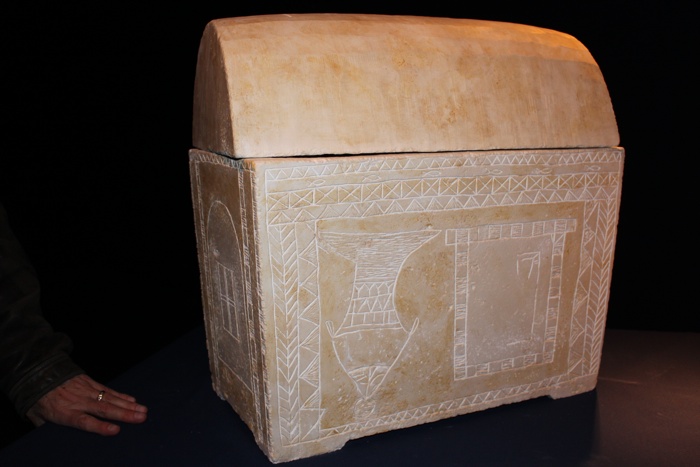
Throughout the discussions of the Talpiot Tomb, right from the first, Simcha Jacobovici, James Tabor and others involved with the "Jesus Discovery" project (website here) have talked about and publicized what they call "the museum quality replica" of ossuary 6 from Talpiot tomb B.  But here's the curious thing.  It's not one replica.  There are two different replicas. As far as I am aware -- and I think I have read everything -- they have never admitted that they produced a second replica to replace the first.  (Please correct me if I am wrong).  And when one notices what changes between the two replicas, there is some cause for concern.

Here is the first replica.  This one was on the first version of the Jesus Discovery website and dates back to when the site was first published in February 2012, as you can see from the archive.org capture.

Replica 1 (February 2012)
Here is the second replica, which dates back, as far as I can tell, to April 2012, and which replaced the first on the Jesus Discovery website.  This is the one you see there now.


Replica 2 (April 2012)
If you think they look pretty similar, you would be right.  But there are some telling signs that illustrate beyond doubt that these replicas are different.  Let's take a look at them side by side:

Replica 1 (left) and Replica 2 (right)

There are several tell-tale signs.  Notice how in Replica 1, there are some lines drawn inside the square shaped object to the right of the vessel / fish, whereas in Replica 2, these lines are completely absent:

Replica 1 has a drawing inside the square which Replica 2 lacks

Notice also how the top left tip of the vessel / fish is next to the pointed part of a triangle in Replica 1 but next to the flat part of a triangle in Replica 2:

Triangle border differs next to top left of vessel / fish 
Similarly, notice how at the bottom left of Replica 1, the triangular shape protrudes across the border whereas in Replica 2, the triangle is neatly inside of its border:

Replica 1: triangle protrudes across the border in contrast to Replica 2

Similar observations could be repeated for other elements in the two replicas, but I am sure that you get the basic point.  Now one of the reasons that this is worthy of comment is that the replica (singular) has always been called "museum quality" and its accuracy has been praised.  Yet, far from this being one, accurate "museum quality" replica, it is two contrasting replicas, in which attention to detail is far from the order of the day.

It is not just the question of accuracy and representation that is at issue here, or the apparent failure to flag up the differences between the two replicas.  It is that Replica 2 makes several changes that may be the result of engaging with criticisms of the project.  Let me attempt to explain what I am getting at.

Replica 1 appears in all the publicity for the documentary, book and website from February to March 2012.  Replica 2 first appears, again as far as I can work out, and subject to correction, on April 3 or 4 2012, in Jerusalem:

Simcha Jacobovici shows off Replica 2 in Jerusalem, 3/4 April 2012
In between the release of Replica 1 and Replica 2, there had been a lot of criticism about the project's claims including, among other things, the idea that there are drawings of little "fish in the margins".  Robert Cargill demonstrated that the little oval shapes had been "inked in" so as to make them appear like fish.  Now notice how the "fish in the margins" changed between the two replicas. In Replica 1, before the criticism had appeared, they were presented as fish, with very clear, long tails:

Replica 1: "fish in the margins close up" (screengrab from Steve Caruso)
In Replica 2, which appeared after the criticism had been made, these shapes resemble more closely the actual shapes on the ossuary.  The tails have gone:


Replica 2: "fish in the margins" now appear more like ovals

Now, since Replica 2 appeared some time after Replica 1, I began to wonder whether there were also any changes in the way that the alleged YWNH ("Jonah") inscription appeared.  Does the alleged inscription differ at all between Replicas 1 and 2?  There is, indeed, a major difference in the way this appears between Replicas 1 and 2.  Here it is in Replica 1:


Close up of alleged "Jonah" inscription on Replica 1
This replica appears to have been produced before the "YWNH" inscription theory had emerged.  The lines really look like random lines.  Notice in particular what would become the letter "nun" -- it is here completely broken, just as it was in the CGI composite photograph and all the pictures up to this point (Do the lines in the "fish" head spell out Jonah?).  No one looking at this picture would for a moment think it was spelling out "Jonah".

However, in Replica 2, the transformation of these lines is remarkable.  Now the inscription could indeed be taken to spell out "Jonah".  Notice how the "nun" is now one single, connected line.  It is no longer broken.  The "he" is given the appearance of stopping with one thick line forming the top of the letter, and only a thin line going on to the border.  And the "yod" has a little loop on it just as it does in the "tracing" of the letters that appeared when the alleged inscription first came to light.  Here's a close-up:

Close up of Replica 2, showing YWNH lettering clearly marked

One can see the whole of Replica 2 in high definition here, if you want to take a closer look.  Notice also that there are no extraneous lines here.  Everything appears to be doing service in the representation of "YWNH".  Here's the tracing of the letters as it appeared on James Tabor's blog:

Yellow tracing of the alleged letters, James Tabor's blog, April 2012
In each, the "yod" has a loop, the "nun" is unbroken and the top line of the "he" does not extend all the way to the border.

I don't know what to make of all this, but I thought in the interests of analyzing Talpiot Tomb B, and the claims made by those involved with the "Jesus Discovery" project, it would be useful to lay out what I have found by analyzing the two contrasting replicas, and to see if others also see what I am seeing.  Why is it that the "fish in the margins" are recrafted in between Replicas 1 and 2?  Why is it that the "YWNH" inscription suddenly becomes clear only in Replica 2?

It may be worth adding that the replica shown to Prof. Puech in the video released last week is clearly Replica 2, which has a version of the "YWNH" inscription that we see above, and not the ambiguous representation of Replica 1:

Simcha Jacobovici shows Émile Puech Replica 2
As we have seen above, it is only Replica 2 that has a representation of the "YWNH" inscription that conforms with the interpretation of those involved in the project.  Did the representation of "YWNH" on Replica 2 influence Prof. Puech's reading?

Émile Puech's Statement on the Talpiot Tomb Images

I expressed some surprise over Prof. Émile Puech's apparent endorsement of Simcha Jacobovici's claims about the Talpiot Tombs on Thursday in a post headed Simcha Jacobovici and the Talpiot Tomb Again.

It now appears that Prof. Puech is very unhappy with the way that he was treated by Jacobovici and he has spoken out about this, first in en email reproduced on Jim West's blog, and subsequently in emails to several scholars including James Tabor, who publishes the email in a blog posted headed Emile Peuch’s [sic] Position on the “Jesus Discovery” and “Lost Tomb of Jesus” Films.

I am grateful to Prof. Tabor for publishing Prof. Puech's comments, and I think it is greatly to his credit that he has done so.  

I hope that Simcha Jacobovici will be issuing a public apology to Prof. Puech as soon as possible.

Thursday, September 12, 2013

Simcha Jacobovici and the Talpiot Tomb Again!

I have spent a lot of time, some would say wasted a lot of time, engaging critically with claims made by Simcha Jacobovici in relation to two tombs excavated in Talpiot, East Jerusalem.  I won't go into detail on how things have panned out in the past, but I documented some of it in my article published on The Talpiot Tomb and the Bloggers, and have written a lot about it here on the NT Blog.  My most recent extended discussion is found on Bible and Interpretation, The Jesus Discovery? A Sceptic's Perspective, an article based on an enjoyable critical exchange with James Tabor and Christopher Rollston at SECSOR in March this year.

The general response from Simcha Jacobovici himself has either been dismissal or mockery.  Although he asked his critics to point out the mistakes, he has never responded to my attempts to explain why I am unconvinced by his claims, preferring instead either to ignore the critical response or to mock what he calls underwear bloggers.  That's me, and people like me, sitting on the couch, blogging in our underpants while we eat takeaway pizza!

In a post published yesterday, Jacobovici draws attention to a new interview with Professor Émile Puech of the École Biblique in Jerusalem, Jesus Tomb Finds Dramatic Support.  The post includes a video interview with Prof. Puech, who explains Jacobovici's theory about the tomb, indicating his own support for this interpretation, that the controversial image is actually an upside-down fish spitting out a stick-figure Jonah.  It is not a standard vase or vessel.  Moreover, Prof. Puech lends his support to the suggestion that the name "Jonah" is spelled out in Hebrew on the "head" of the "fish".

I must admit that I was a little surprised to see an esteemed, senior figure like Prof. Puech supporting Jacobovici's interpretation of the ossuary.  I accept that there will be disagreements in the guild, and that this is the stuff of academic debate.  I would love to be able to ask Prof. Puech what he makes of things like repeated geometrical shapes in the body of the "fish" that correspond to the same geometrical patterns on the borders of the ossuary, or the handles on the "half-fish", which make the Jacobovici interpretation so problematic for many of us, but I doubt that I will get the opportunity.

Nevertheless, that's the substance of academic debate, and I accept that academics just disagree with one another.  I should perhaps admit also that I was disappointed that there was no new substance in Prof. Puech's interview, i.e. there was nothing to refute those who have argued against Jacobovici.  It is interesting nevertheless that Prof. Puech is convinced by Jacobovici's unusual claims.  I find it surprising, baffling even, but there we are.  That's life in academia.

However, I do want to draw attention to elements in Jacobovici's post that I think problematic.  He attempts to summarize the debate so far, incorporating discussion of both Talpiot Tombs, and drawing attention to why he sees the case for the identification with Jesus and the Jesus movement to be so strong.

There are three particular elements I would like to draw attention to.  These are all elements that have been criticized in the past.  To suggest that each point is self-evident is the real problem here.  In summarizing the case for the identification of Talpiot Tomb A with Jesus and his family, Jacobovici writes:

(1) "Six of them have inscriptions. One of them explicitly states; 'Jesus, son of Joseph'"

The difficulty with this statement is that the inscription is really difficult to decipher.  Indeed Émile Puech himself is on record as doubting the clarity of this inscription, for example here:
Another prominent expert whom Jacobovici did not consult, across town in the tranquil offices of the French Biblical and Archeological School in east Jerusalem, was Prof. Emile Puech. His response to the inscription was much the same as Naveh’s. ‘It’s very crude lettering,’ said the bearded, French-born Father Puech. ‘The ‘Joseph’ is clear. The ‘son of’ is no problem. The ‘Jesus?’ It’s certainly possible to read it that way.’
It may be that Prof. Puech has changed his mind about this but, if so, there is no indication of this in the current article.  This is not to say that the inscription could not be "Jesus" but just to draw attention to our uncertainty about the reading.  It is absolutely not "explicit".

He also writes:

(2): "A third has 'Yose', a very rare version of Joseph. 'Yose', 'Joses' in the King James version of the Gospels, is described as a 'brother of Jesus' by the Gospels of Mark (6:3) and Matthew (13:55-56)".

This is incorrect.  Only Mark has "Joses".  Matthew has "Joseph". And the textual witnesses demonstrate unequivocally that the two names were regarded as interchangeable.

Jacobovici also claims:

(3): "If this is not enough, there was an inscription in Greek of a certain Mary called 'Mariamene'. In all of Greek literature, this particular spelling of Mary is used in reference to Mary Magdalene and no one else."

This is false. The word "Mariamne" is used twice in early Christian literature, once by Hippolytus (third century) and once in the Acts of Philip (fourth). On neither occasion does the author say that this Mary is "Mary Magdalene". Indeed, both authors, Hippolytus and the author of the Acts of Philip, depict Mariamne as having a sister named Martha, which illustrates that they are not talking about the historical first century figure of Mary Magdalene but the later, composite literary figure of the apocryphal Mary who incorporates characteristics from the full range of Marys.

Now of course it could be the case that my readings of the primary texts are wrong, in which case I would welcome some good, robust, critical engagement.  My guess is that I am more likely to receive dismissal or abuse, which is the norm, but I am always happy to be surprised.


Tuesday, September 10, 2013

Simon Schama's misreading of Paul

I've greatly enjoyed the first couple of episodes of Simon Schama's Story of the Jews currently airing on BBC2.  Schama is a wonderful story-teller and he knows how to make his subject matter compelling and memorable, always very impressive given the constraints of the documentary medium, with the need to summarize,  to simplify, to splice and dice.

Because of my admiration for Schama and the current series, I was disappointed to hear the kind of ignorant caricature of Paul that one would normally only see in a sensationalist documentary.  About fifteen minutes or so into the second episode, Schama looks at Constantine's conversion to Christianity, and begins to explain how early Christians reacted to Jews and Judaism.  This is my transcription of the section:
Born a Jew, like his saviour, was Paul who, within a few years of Jesus' death began the process of liberating Christianity from the claims of Jewish ritual.  Christianity was either universal or it was nothing.  So Paul aggressively de-Judaizes the Christian message and there was no surer way of doing that than insisting on the divinity of Jesus.  That violated the first supreme principle of Judaism which was the indivisible oneness of God.  Echad.  Two: "Father and son" had Jews scratching their beards.  Three: "The holy spirit".  Why not five?

And it was Paul who repeated the sinister note sounded in the early Christian Gospels, -- the Jews as Christ-killers crying out for Jesus' crucifixion -- "his blood be on us and on our children".
There are several problems with this section of the documentary, all of which could have been simply ironed out if Schama had consulted someone competent in the study of Christian origins.  To take them in turn:

(1) Although Schama acknowledges that Paul was "born a Jew", the implication is that Paul converted away from Judaism to something different, called "Christianity".  But Paul never mentions "the Christian message" or "Christianity" and he would have been appalled by the notion that he "de-Judaizing" anything, still less that he did so aggressively.  Paul insists on his Jewish identity and without understanding that, one cannot understand Paul (Phil. 3.4-6, Rom. 9.1-5) or, for that matter, the early Jesus movement.  Schama's misunderstanding is a classic one.  Paul is an eschatological Jew who believes that the Messiah has come and that the Gentiles are now being included in the people of God.  He is not founding a new religion purged of Jewish ritual.

(2) Affirming Jesus as Messiah and God's son did not "violate the first supreme principle of Judaism".  On the contrary, Paul believed that Jesus' appearance was an affirmation of that very principle, and he goes to some pains to stress this in his Christological re-affirmation of the Shema (1 Cor. 8.6, "Yet for us there is one God, the Father, from whom all things came and for whom we live; and there is one Lord, Jesus Christ, through whom all things came and through whom we live").  Nor does Paul talk about "the holy spirit" as a person of the trinity -- this is as anachronistic as "Why not five?" is sarcastic.

(3) No one, apart perhaps from some fundamentalists, think that the Gospels were written before Paul.  The line that Schama is quoting is from Matt. 27.25 and all contemporary scholars date Matthew long after Paul, some by decades.  So Paul is not "repeating the sinister note sounded in the early Christian Gospels", nor is that note found in Paul, who does not have a Passion narrative in his letters.

To reiterate, I think this is a superb documentary and I am a big fan of Schama.  But I think this section falls below his usual standards. One of the reasons that this is important is that getting the history right plays a key role in Jewish-Christian relations.  Given the appalling history of Christian attitudes to Jews and Judaism documented by Schama, it is worth paying careful attention to what Jews like Paul, right at the beginning of the Jesus movement, actually said.

Monday, September 02, 2013

How it used to look!

This is how it used to look back then (or at least as far back as I can get it on the wayback machine).  I must admit that I rather liked the old design, which I hand-coded.  That NT Gateway logo was designed by a nice guy called Geoff Love.


One of the funniest things is looking at the blogroll back then -- just two blogs!  A few weeks later it had expanded to four.  Good grief -- no wonder it was so much easier to keep up with what was going on in the blogosphere!

NT Blog's Ten Year Anniversary!

Happy birthday to me!  The NT Blog is ten years old today.  Its first post in what was then called "The NT Gateway Blog" went out on September 2 2003, Welcome to the NT Gateway Blog.  3,887 posts later and we are still here!

I began this blog as a bolted on extra to the New Testament Gateway which was then absorbing a huge amount of my time.  I'd been a fan of Jim Davila's Paleojudaica for a while and one day it dawned on me that I could do something similar.  I had never even heard of blogging until Paleojudaica appeared, and it struck me that a blog would enable me to gather together lots of the things that I had been trying to do with the NT Gateway, like drawing attention to great websites and adding "notices" of forthcoming events as well as, at the same time, discussing the New Testament in the news.

As time went on, the NT Blog became bigger than the site that spawned it, and the proliferation of other blogs enabled me to find my own niche.  I still wish that I could post more often, but I enjoy the blog, and I enjoy participating in the blogging community where I have found friends as well as some great intellectual stimulation.

I have written so often about the art of academic blogging, its successes and failures, that I don't have anything fresh to add here -- so please check out this cache of posts if you are interested: NT Blog: Academic Blogging.

My previous blogiversary posts are self-indulgently gathered here.

David Meadows celebrates ten years of Rogue Classicism today too -- don't forget to pop over there to thank him for all his great work over the years.  If only I had posted so often!

Many thanks to everyone over the years who has offered encouragement and who has commented and provided interaction on the other blogs.  There's no question about it -- it's the communal side of blogging that makes it worthwhile.

Tuesday, August 13, 2013

The art of writing negative book reviews

 A couple of years ago, I asked whether Paul Foster's review of Bartosz Adamczewski's Q or Not Q? might qualify as The most negative book review in our area?, having mentioned Peterson's review of Shedinger as another contender.  I am grateful to kolhaadam (in comments) for drawing attention to this one, just out in the Review of Biblical Literature, by Gregory Mobley, of a book by Marty Alan Michelson on Reconciling Violence and Kingship: A Study of Judges and 1 Samuel.  From the review:
I took no pleasure in reading this book, nor do I take any in cataloguing its flaws. The title itself with its initial, indecisive participle hamstrings progress toward coherence . . . . The publication history page, with its reference to the “british Library” damages the credibility before we even reach page i . . .
. . . . Who is to blame for what constitutes the most poorly written work of published “scholarship” I have ever read? . . .
. . . . Unfortunately, I cannot recommend this book to anyone. Neither its ideas nor its writing meet any standard I recognize for publishable biblical scholarship.
So he's not mincing his words, then.  I must admit that I did enjoy this turn of phrase:
Nowhere does Michelson acknowledge that it served monarchic interests writing “after” to exaggerate the evils of the time “before,” in the same way that weightloss advertisements contrast images of slouching corpulence with svelte elegance.
It's interesting to ask how far it is worthwhile to write a really, really negative book review.  My general policy has been to turn down the invitation to write reviews of books that I think very bad.  I tend to think that there comes a point where it is better for a book not to be reviewed at all than for it to be reviewed really negatively.  I suppose I worry too much about what the author's mum might think if she were to see the negative review.  Perhaps negative reviews do have a part to play, though, in alerting publishers to material that has made it through their processes, or to alerting doctoral dissertation committees of radically dissenting opinions about the worth of the project.

Thursday, August 08, 2013

Sean Freyne on Galilee, Jesus and Christology -- on Youtube

While reflecting tonight on the sad news of Sean Freyne's death earlier this week, I fell to wondering if any of his lectures had been recorded and released on Youtube and I am happy to say that there is a wonderful three lecture series from Yale Divinity School on "Galilee, Jesus and Christology".  These were the Shaffer Lectures at Yale in 2010.  Here are the text links followed by the embedded videos:

Sean Freyne: Galilee, Jesus and Christology, First Shaffer Lecture


Sean Freyne: Galilee, Jesus and Christology, Second Shaffer Lecture


Sean Freyne: Galilee, Jesus and Christology, Third Shaffer Lecture

Death of Paul W. Meyer

More sad news.  I was sorry to hear through Michael Gorman just now (on Fb) of the death of Paul W. Meyer.  Princeton Theological Seminary has released a notice here:

Word has been received of the death of Dr. Paul William Meyer, the Helen H. P. Manson
Professor of New Testament Literature and Exegesis Emeritus. Professor Meyer, who died at the age of 89 on Monday, July 29, in Chapel Hill, North Carolina, is survived by his wife, Mary Lou, and by two daughters, Katherine and Elizabeth.
The son of missionaries to India, Professor Meyer earned his Th.D. from Union Theological Seminary, New York, before beginning a teaching career at Yale University Divinity School as Assistant Professor of New Testament. At Yale, he began a lifelong friendship with J. Louis Martyn and was a teacher of both Wayne Meeks and Moody Smith. He subsequently became Professor of New Testament Interpretation at Colgate Rochester Divinity School (1964-1970), before joining the faculty of Vanderbilt (1970-1978), followed by Princeton Theological Seminary where he served until his retirement in 1989. He was the Shaffer Lecturer at Yale in 1976. His collected essays, and his masterful, succinct commentary on Paul’s Letter to the Romans, were published in 2004 under the title, The Word in this World, edited by John T. Carroll . . .
You can read more at the link above.

Paul Meyer was a fine scholar and also a true gentleman.  I was lucky enough to get to know him in recent years since he lived in North Carolina and was a regular at Joel Marcus's New Testament and Jewish Studies colloquium at Duke.  I hear from his students that he had a knowledge of the literature that was unsurpassed, but at the same time he was a gracious and insightful teacher.  He will be greatly missed.

Update (11.55pm): Many thanks to Matthew Montonini for sending over the picture above.

Death of Seán Freyne

I was very sorry to hear earlier in the week of the death of Professor Seán Freyne (Larry Hurtado, Jim West, Jim Davila, Michael Bird).  The Irish Times has its obituary here:

Eminent theologian Seán Freyne dies
One of Ireland’s best-loved and most respected theologians, Seán Freyne, has died in Dublin. Director of the Centre for Mediterranean and Near Eastern Studies, Dublin, he was professor of theology (emeritus) in the school of religions and theology at Trinity College.
His academic interests included a study of Galilee in the Hellenistic and Roman periods, the historical Jesus, the gospels, and aspects of early Jewish and early Christian history. He published several books, most recently Jesus a Jewish Galilean: A New Reading of the Jesus Story . . . .
Freyne was a fine scholar who made a major contribution to the study of the historical Jesus, and especially Jesus' Galilean context.

He was also a kind, witty and delightful human being.  In a world where many academics think that pomposity is a virtue, Freyne was simply a pleasure to be with.  He let his erudition emerge in the process of engaging in an open and lively way with his audience, not in instruction or dogmatism.  I heard him lecture several times and it was always a pleasure.

I met him for the first time in August 1996, at the SNTS in Strasbourg.  As a young scholar at my first international conference, I often felt lonely and ill at ease, but Seán was one of the handful of senior scholars present who was kind and friendly.  I was on the same corridor as him in a rather steggy hall of residence, but he invited me to participate at his late night whisky gathering on condition that I brought my own glass.  All I could find was the lid of my deodorant bottle and I don't think whisky has ever tasted so bad, but it did not matter given that he made me feel welcome.

To get a feel for his scholarship and his lively, engaging personality, I recommend this interview done by BAR a couple of years ago:

BAR interviews Sean Freyne: Jesus of History vs Jesus of Tradition


Raymond E. Brown Website

Today, on the anniversary of Raymond Brown's death, Matthew Montonini has released a new website that pays tribute to him.  Anyone who has done any academic work on the New Testament knows and admires Ray Brown's scholarship and Matthew has done a great job in putting this site together:

Raymond E. Brown, S. S.

It features pictures, video-clips and several full PDFs of Brown's articles.  Strongly recommended.

Monday, August 05, 2013

The Canon of Doctor Who and the Canon of the New Testament

With the announcement of the twelfth doctor's casting still fresh in our minds, it's perhaps time for blog post about Doctor Who.  I've long thought that the way that Doctor Who fans talk about "canon" is rather different from the way that we might talk about the "canon" of the New Testament and, given that the term "canon" in fandom is derived from "canon" in early Christianity, I have sometimes thought about how the two discussions might inform one another.

My friend Chip, better known as the author of the esteemed Two Minute Timelord podcast, currently a Parsec Awards finalist, recently invited me to sit down for a chat in a time-dilation episode about this topic.  You can now listen to 2MTL 316.  Download it on iTunes, or using your standard podcast catcher, or listen here:


It was great fun to have this discussion, and I'm grateful to Chip for the invitation.

More Caird Lectures Online

Jeffrey Gibson recently made available a whole bunch of audio recordings of George Caird's lectures.  I uploaded these to my webspace, and Matthew Montonini indexed them (See George Caird's New Testament Theology Lectures Online).

Jeffrey has now dug out another fifteen lectures, this time on the epistles to the Romans and the Synoptic Problem, and dating from 1983.  I have uploaded them (Raw indexing here) and Matthew has added links here:

George B. Caird New Testament Theology Audio Lectures

Matthew also blogs on this here.

Friday, August 02, 2013

Academic Blogging: What are the benefits?

Continuing on with Joshua Mann's questions (see Why Blog? and When and Why?), he asks next:

2. What are a few of the benefits you see in blogging?

I suppose one could ask about the benefits to the blogger and the benefits to the reader.  It's easier to talk about the benefits to the blogger.  Academics are a big-headed bunch and blogging gives them a nice outlet for their desire for self-publicity.  And the nice thing about academic blogs is that not many people read them, so the academics can get on their soapbox and go and sound off to a handful of readers and get that out of their system, hopefully honing their purer and better thoughts for proper publications like books and articles.

I sometimes wonder whether one should think of publication as being on a continuum, from tweets to blogs to critical notes to articles to introductory books to monographs.  The summit of all publication is the monograph, and the well-written monograph actually takes some real skill and effort.  Tweets, on the other hand, at the other end of the spectrum, are forgotten almost as soon as they are uttered.  Blogs are somewhere in between.  They take a bit more effort than a tweet but like them they are pretty ephemeral.  It's remarkable just how quickly we forget them, and that's if we ever read them in the first place.

When it comes to the benefits to the reader, I think there is one major benefit and here, again, I have to point to Jim Davila's Paleojudaica as a fine example of the genre.  The blogs have genuinely had some success in holding the media to account.  Extravagant claims in the media have often been successfully challenged in the blogs.  Here the collaborative, "horizontal" nature of some of the best blogs has made a key contribution because where many eyes look at the same data, they are more likely to notice key elements. Further, the range of different expertises in the different blogs also plays its part.

I'd like to think also that the blogs have helped those who read them to be a bit better informed about developments in our area.  I know that when I talk to the (vast majority of) colleagues who never read the blogs, I am often surprised about news items they have missed.  If you read the blogs, you do get to hear about interesting discoveries, new TV and radio programmes, sad deaths in the area, conference announcements, new books, new journals, new journal entries and so on.

So while we might poke fun at the bloggers, and laugh at their self-indulgence, in fact they have proved their worth in recent years by keeping us all informed and engaged, and sometimes, if all too rarely, entertained and amused.


Thursday, August 01, 2013

Academic blogging: When and Why?

Now that my ridiculous pre-amble is written, here is the first of my answers to Joshua Mann's questions, with thanks for his interest, and apologies, in advance, if my answers are a bit rubbish. Question one and answer follows:

1. When and why did you start blogging?  

"When" is easier than "why".  If only it were this easy with dating the Gospels!  For the Gospels, I'm inclined to think there that the "why" is easier than the "when".  We know only roughly when the Gospels were written (sometime after 70, I argue), but it's fairly obvious why they were written (to tell the "good news" about Jesus Christ in narrative fashion to as many as far as possible).

But yes, it's about ten years since I started blogging.  I started blogging because I thought it would be fun.  Jim Davila was already doing it on Paleojudaica and he was brilliant at it.  He still is.  Somehow, Jim just has an instinct for how to do it well, and to this day I don't think there is anyone who has such a natural, instinctive feel for medium as Jim has.  Somehow, he is able to get exactly the right balance between between reporting the latest in the area and providing compelling, accurate and lucid comment, and without the sort of self-indulgence that is all to common elsewhere.

Actually, since I've started on this, let me rant a little longer.  What I like about Paleojudaica, and the reason that it is still the blog that provides the template, is that it understands what academic blogging is about.  It is about critical engagement with what else is out there on the net pertaining to the area in question.  Sometimes -- more often than not -- Jim can see that all that you need is a link and a description. Let the punters know what is out there -- quick link, quick description, quick bit of background,with links, if necessary.

But sometimes, Jim knows that a bit more is needed.  Because of the trust he gains by means of the sober, newsy items, he is able to add a little more comment when it is required. And he gains the reader's trust by giving us a whole list of background links.  "For background, see here", etc.  The reader is calmly assured that there is a history to to whatever the item is, and you will be able to follow it up in the blog.

I sometimes wonder if one of the reasons for the continued strength of Paleojudaica is that he has resisted adding a facility for comments.  I recently distinguished between what I call the "horizontal" blogs and the "vertical" blogs.  Vertical bloggers thrive on the interaction with their own commenters and generally resist the "horizontal" interaction with fellow bloggers.  Jim is the opposite.  With no comments at all, he can interact with other blogs where necessary, and with the focus on the news, he can avoid the self-indulgence that is too easy for those whose blogs largely focus on their own ideas and enthusiasms.  Moreover, he does pick up and engage with email commenters and my guess is that this too enhances the quality of the product.

But yes, it was because of Paleojudaica that I began blogging.  There was another major issue which was unique to me, however, which was that I was running a website called The New Testament Gateway that was giving me some grief.  Long before I had heard about blogging, I used to have a "log book" on the site which I used to record every update to the site.  I also used to have a "Featured Links" section.  A decade ago, it occurred to me that I could combine the idea of blogging, following Jim, with some of the peripherals from my NT Gateway, like the log book and the featured links section.  And this worked well for several years until I leased off the NT Gateway from the blog, and the NT Gateway blog became the NT Blog, as it is now.  So that's all to say that my blog was never quite the same as the purer biblioblogs.  It used to be an integral part of the NT Gateway, and you can see that if you look back through the archives, but now it is its own strange, malformed beast.

One last thing.  I love the fact that there are a million other blogs in the area and to a large extent, this has helped me to post less.  In the early days of the biblioblogs, when it was just me, Jim Davila, Jim West, AKMA, Stephen Carlson, Rubén Gómez, Tim Buckley and co, there were few reporting and commenting on the key news stories.  But now, you can guarantee that someone has got to it before you, and that enables you to be much more selective.


Wednesday, July 31, 2013

Why blog?

In one of my favourite TV series ever, The Prisoner (1967), there is an episode dealing with 1960s anxieties about the ever-increasing powers of the computer.  The episode is called "The General".  In the episode, our hero, Number 6 (Patrick McGoohan) confounds the computer by asking it a question that has long been "insoluble . . . for man or machine".  The question is "WHY?"  But of course the answer to the question has always had a solution ready to hand.  The answer is, of course, "Why not?"

I feel the same way about blogging.  If someone asks me "Why blog?", my answer is "Why not?"  There is actually a danger in getting too navel-gazing about it.  If you want to blog, or think you might want to blog, give it a go.  See how it goes.  If you enjoy it, great.  If others enjoy it, even better.  If not, you've not lost anything, except perhaps a little time.

I was recently perusing the wayback machine's archive of the old Biblioblog interviews as part of my research for a paper I was writing for the SBL International (Biblioblogs.com still defunct).  Happily, the Biblioblog Top 50 has now rescued these from oblivion.  One of the things that is fun about looking at these interviews is that several of them are of bloggers that have long since vanished from the blogosphere.  And I think that that's great.  It's not great that they have gone (I loved Bruce Fisk's, for example), but it is great that they gave it a go and found that it was not for them.

Recently, Joshua Mann asked me a series of questions about blogging, one of which was "Why blog?", to which the answer is definitely, "Why not?"  Several have already had a go at Joshua's questions and have done a great job -- see his blog.

I suppose that what I am trying to get at is that you don't know until you've tried.  Why not give it a go?  I kind of love blogging and wish I did it more often.  And I suspect that there are loads of people who would be great at it who never give it a go.  And there are loads of people who are rubbish at it and who should probably have given up on it.

I was going to get to Joshua's questions in this blog post, but realize now that I have spent so long on my pre-amble that I am going to have to wait for the next post to answer the actual questions.  And that illustrates something about blogging -- it is spontaneous, self-indulgent, ephemeral and probably a complete waste of space.

Pericopes, passages or paragraphs?

Scholars love their jargon.  And New Testament scholarship is choc-full of jargon.  Sometimes I get a bit tired of it.  For a bit of fun, I am experimenting with banning myself from using certain jargon-y words and phrases in an introductory article I am writing at the moment.  One of the things I am trying to avoid is "pericope".

There are several disadvantages with the use of the term "pericope" for Synoptic-Gospel units of text.  The first is that it is a jargon-word and functions mainly to make scholars feel superior to everyone else.  It's "in" language.  If you talk about a Biblical "passage", you are not one of us!  You are probably doing a horrid Bible Study with your horrid, non-academic friends, and you have no idea about how to study the Bible academically.  If you were an academic, you'd talk about pericopes!  

The second disadvantage is that no one knows how to do the plural of "pericope".  It's pericopae if one is being truly clever and "in".  But some scholars worry that this is a step too far.  It's just too ponsey.  So they go for "pericopes".  And that looks even more ungainly.

The third great problem with the word is that it cannot survive in the age of auto-correct.  MS Word knows that there is no such word as "pericope".  Surely, you must be intending to write "periscope".  And it will change it for you.  Without even asking you.  It's a free chuckle every time I see "periscopes" in a student paper.  And lest I become too puffed up, I have found it more than once in my own hand-outs, where auto-correct has done its worst.

In any case, what was ever wrong about talking about "passages" in the first place?  The word "pericope" is in any case a legacy of the kind of form-critical approach to the Gospels that we have all long-since abandoned.  Austin Farrer so disliked that kind of atomistic approach that he used to talk about "paragraph criticism", noting that he was quite happy to look at isolated paragraphs but that, in the end, it was the Gospel as a whole that rewarded careful, critical study.