Friday, August 07, 2009

Simon Peter in Matthew's Gospel: Article and NT Pod 7

I made available the latest NT Pod earlier this week, NT Pod 7: Simon Peter in Matthew's Gospel. It's the first time I have done a kind of "sequel" episode, this one following on from NT Pod 5: Simon Peter in Mark's Gospel. In this latest piece, I explore the way that Matthew works with Mark's portrayal of Peter and suggest that we can see the same "Peter Pattern" here as we see in Mark. As in Mark, the "rocky ground" Peter is the one who enthusiastically receives the word with joy but stumbles when trouble or persecution arises on account of the word (Mark 4:16-17 // Matt. 13:20-21).

Matthew takes forward the characterisation of Peter as the disciple who is scandalized by the idea of "Christ crucified" (1 Cor. 1:23), and he underlines and enhances the same language of skandalon and skandalizomai ("stumbling block", "to fall away"). Far from whitewashing the disciples, Matthew in fact proves to be a strong reader of Mark, understanding and elaborating on his presentation. One of the reasons that we fail to see this is our over-reliance on redaction-criticism, and our tendency only to pay attention to the parts where Matthew differs from Mark; we do not take seriously the elements that Matthew takes forward and underscores in Mark.

For those who would like to follow up the discussion on this point, I have an article available on the issues. It was published in 2006, but I am happy now to make it available online in toto (PDF):

"The Rock on Rocky Ground: Matthew, Mark and Peter as Skandalon," in Philip McCosker (ed.), What Is It That the Scripture Says?: Essays in Biblical Interpretation, Translation, And Reception in Honour of Henry Wansbrough Osb (Library of New Testament Studies; London & New York: Continuum, 2006): 61-73

The essay has been available in the above Festschrift for Henry Wansbrough for the last three years, but I am happy now to make it available free for all on the internet.

The Stuff of Earth is back!

It's true -- Michael Pahl is back! It's still called The Stuff of Earth, but it's now on Word Press, and there are other changes. I, for one, am looking forward to seeing what Michael has in store.

Thursday, August 06, 2009

The NT Blog and the NT Pod finally get ref-tagged!

I have been meaning to add Logos's RefTagger to this blog for as long as I can remember and finally I have got round to it. The gist is that you add a little bit of code to your template, and it automatically brings all your Biblical references to life. So if I want to refer to Mark 15:39, for example, reftagger hyperlinks the reference and sends it to bible.logos.com. It does it with whole passages too, e.g. Matthew 1:1-17, and it seems to work in a range of formats, e.g. with either the dot (Matthew 1.1-17) or the colon. Impressive, huh? I've added it to the NT Pod's web page too, where I always list the key texts for each podcast in the given entry.

The Subversive Graham Stanton

Thanks to Steph Fisher for sending over a link to this nice comment on the life of Graham Stanton:

The Dunedin School Remembers Graham Stanton (1940-2009), Subversive

Wednesday, August 05, 2009

The Real Paul at Religion & Ethics News Weekly

There is a pretty good and very interesting essay on PBS's Religion and Ethics Newsweekly site about Paul. It focuses mainly on the new book, The First Paul, by John Dominic Crossan and Marcus Borg, but it roams into other related territory too:

Review Essay
By Allen Dwight Callahan

I have not yet read the new book by Crossan and Borg, but whenever faced by the anti-imperialist Paul, I always want to know what the scholars in question do with Romans 13, and Callahan clearly has the same question:
The radical Paul of Borg and Crossan is not really very radical at all. This becomes painfully clear, among several other instances that could be adduced, in their contorted exegesis of Roman 13:1-7, Paul’s infamous exhortation to obey ruling authorities—read the Roman imperial regime—because they are “ordained of God,” who has given them the sword to enforce law and order.
Borg and Crossan explain that Paul feared his Roman audience would resort to “violent tax revolt” against Rome: “Paul is most afraid not that Christians will be killed but that they will kill, not that Rome will use violence against Christians but that Christians will use violence against Rome.” This danger of violent revolt whips Paul into a “rhetorical panic’ and causes him to “make some very unwise and unqualified statements with which to ward off that possibility”—the possibility that church folk in Rome would use their marginalized, persecuted faces to scuff the brass knuckles of Roman state terror. The hermeneutic here would be hilarious if Paul’s “statements” in this toxic text were not so “unwise and unqualified.” With radicals like this, who needs reactionaries?
That is only a brief snippet, though, and I encourage you to look at the whole article, which also draws in Pope Benedict XVI's and other's recent treatments of Paul.

Blogger backup

Following a hint from Michael Halcomb, I have decided to back up my entire blog, all six years or so of it, and have used the utility he suggested, Blogger Backup. I used to have all the blog files located on my own web space at NTGateway.com, and I would back up that entire site from time to time, but now have them all on blogger, so decided that it would be a good idea to keep a local back up of the blog archive. In the light of recent hacker activity, I would recommend others taking similar action.

Doug Chaplin's blog hacked?

Unless Doug Chaplin is in the middle of an elaborate hoax on himself, it seems that his clayboy blog is the victim of a hacking attack. Sympathies, Doug, and I hope that all will be back to normal soon. In the mean time, a reminder to us all of the dangers of such things. Heck; has anyone got any guidance on how to avoid such attacks?

Beginning Blogging Questions

A correspondent thinking of starting a new blog recently got in touch and asked me a series of questions, and he has encouraged me to post my answers here. These are very much my own perspectives on the issues from my own experience, and others will feel quite differently, I am sure, so please feel free to blog your own responses to these questions, or to add a comment below.

1. Which is the best site to go with--or does it make a difference?

Blogger is, I think, simpler to use and you can have your blog up in minutes. It is pretty efficient and is fine for what most people need from a blog. However, I do think WordPress is the superior product and I have very much enjoyed using it for the new NT Gateway and NT Gateway blog since I went into partnership with Logos for that site. For my NT Blog, I am fairly happy with blogger, which I have used since 2003. For the NT Pod, I went with blogger for the "shop front", as it were, though the audio files themselves are all located elsewhere, and I slightly regret that decision. Word Press is the superior product for podcasting, it seems to me.

2. I would like to blog about three things--Bible, ministry and Macs. Is it best to have three separate blogs?

Well, people feel differently about this one. I like to keep one blog for academic stuff and one for the rest (the Resident Alien) in which I talk about things connected with the life of a British expat in the US, and some other stuff of personal interest. I do this because I don't assume that people who want to read the academic stuff necessarily have any interest in things that happen to interest me, like The Prisoner, Doctor Who, and Abba. Similarly, there are those who are interested in some of that stuff but who could not care less about academic NT studies. But it's very much an individual thing. Some like to combine everything into one blog, and that clearly works for them and for their readers. My guess is that there will be those interested all three of those things, Bible, ministry and Macs, and so a one blog approach might be best.

3. What about name registration? I see you have stayed with having .wordpress but others have their own names for their blogs. Is this straightforward?

Well, we have retained ntgateway.com for the NT Gateway site, but yes, I have a .blogspot address for the NT Blog. I actually find hosting on blogger much easier than hosting on my own site. Blogger updates incredibly quickly. Holding all the archives on my personal space and publishing via FTP sometimes took a very long time. The most straightforward thing, I would say, is simply to publish on Wordpress or Blogger's own sites, and so to have a .blogspot or a .wordpress address. And the massive advantage there is that it is free!

Library of New Testament Studies Web page updated and moved

I have updated and moved the Library of New Testament Studies web page. It is now found at:

Library of New Testament Studies

Monday, August 03, 2009

Paul Hollenbach

I was sorry to read about the death of Paul Hollenbach at the weekend (Controversial Theologian Pushed for Critical Study of the Bible). Hollenbach (83) taught at Iowa State University's dept of Religious Studies and published several articles on the New Testament including "Social Aspects of John the Baptizer's Preaching Mission in the Context of Palestinian Judaism" in ANRW (1979) and "Jesus, Demoniacs, and Public Authorities: A Socio-Historical Study" (Journal of the American Academicy of Religion 49/4 (Dec. 1981): 567-88 and "The Historical Jesus Question in North America today" in Biblical Theology Bulletin 18 (1988): 11-22.

Jesus films latest: a new "Superstar" and "Him"

Over on Bible Films, Matt Page notes (from Peter Chattaway) that there may be a new version of Jesus Christ SuperItalicstar in the works. As a fan of the original 1973 film ("Do you think you're what they say you are?"), I have the same mixed feelings about a new version as I have had in the past about popular culture's search for big money reboots (e.g. The Prisoner, Doctor Who, and the music of Abba, just to list my obsessions). I would be delighted if it works, but ready to pour scorn if it does not. One of the things that may make Jesus Christ Superstar difficult to recreate for the big screen now, though, is that it is such a period piece. Norman Jewison's 1973 film works because it is so much of its time, and made within only a couple of years of the musical's theatrical debut. On the other hand, theatrical productions have continued now for nearly forty years, and they remain popular, so it will be interesting to see if they can pull it off for a new Superstar. And since the composers (Andrew Lloyd Webber and Tim Rice) are still alive, perhaps they could be called upon to do a few updates? A new song or two? That would be interesting.

The other element of curiosity on the Bible Films blog deals with Him, the gay Jesus film. Matt has more to confirm what has become increasingly clear over recent years (See Gay Jesus Film Hoax?) that this is not a hoax. It's probably one of the worst marketed films of all time, though. Imagine a film, with a topic as controversial as that, making so little impact that people wonder seriously whether the film even existed.

Wright on Resurrection in Today's Guardian

N. T. Wright has a short piece, a kind of numbered list, in today's Guardian, responding to Adam Rutherford who has been attending an Alpha Course* and who is writing up his experiences as he goes:

The resurrection was as shocking then as it is now
When Adam Rutherford talks about the resurrection, he misses the point. It isn't an extra thing, bolted on to our moral philosophy

Fans of Wright's work will find the piece a robust and engaging summary of familiar themes from his work on the resurrection, like the claim that the ancients found resurrection as perplexing an idea as we do ("we all know that dead people don't rise. Actually, the early Christians knew that too") but there was one element that appeared new to me, the idea that "The other "raisings" in the NT are of course what we would call 'near death experiences' – people who are clinically dead and then find themselves called back," but it is possible that I have missed that in Wright's writings.

A couple of other things occur to me. The first, underlined for me all the more after reading James McGrath's post today on Preach your doubts, is that I am quite taken aback by the degree of confidence that Wright has in his historical analysis. For those who do not share the same degree of confidence, the certainty expressed here, the repeated "of course" (x 6 in a short article), may perhaps be tough to handle. I wondered too whether this kind of vigorous response quite met the more impressionistic jottings-style commentary of Rutherford's original piece in his ongoing response to the Alpha course he is attending.

*The Alpha Course is a popular British evangelical week-by-week introduction to the Christian faith, usually consisting of a talk, a meal and some discussion.

Friday, July 31, 2009

August Charts and Carnivals

It's 1 August and we are treated to a Smörgåsbord of biblioblogging highlights in a couple of places, by TAFKANTW and Jim West:

Biblical Studies Carnival 44: The Funhouse Edition

Biblioblog Top 50: July 2009

Both are fantastically comprehensive. I am very impressed! Biblioblog Top 50 is, in fact, a top 200 and something. And Jim West shows himself to be master of the art of the Biblical Studies Carnival. It's difficult to imagine how much work both have put in on these, so it is a big thanks from us all.

Podcasting -- everyone's at it!

In the words of Lily Allen, "everyone's at it". Well, six of us in the biblioblogging world, anyway! Steve Wiggins has a new podcast over on Sects and Violence in the Ancient World. I first saw reference to this on Daniel and Tonya's Hebrew and Greek Reader. There are three so far, the latest, Whence Monotheism, out today. It's a bit longer than 5 Minute Bible and the NT Pod. Because of this steady growth in the number of podcasts in our area, I have set up a new page on the NT Gateway on Podcasts (see also the recent NT Gateway blog post) and I'll be adding Steve Wiggins's next, though I'm hoping he sets up a separate tag for the podcasts because at the moment they simply occur among the other blog posts. Also today, a new Targuman podcast from Chris Brady.

Thursday, July 30, 2009

NT Pod 6: Resurrection and After-life in Paul: Programme Notes

I uploaded the latest NT Pod last night, touching on one of those perennial topics of interest to NT scholars, Resurrection and the After Life in Paul. My original plan to keep the NT Pod to 5 minutes or so an episode now appears to be under threat, as today I went over nine minutes for the first time. At this rate, the NT Pod will be up to the hour mark by this time next year!

For those who are less familiar with the material discussed in this episode and who would like to follow up on it, I will throw in a little bibliography. The classic essay I refer to in the piece is the following:

C.H. Dodd, "The Mind of Paul: I"; and "The Mind of Paul: II" in New Testament Studies (Manchester: University Press, 1953), 67-82 and 83-128.

The key piece is the second one, which deals with Paul's eschatology, and it is compulsory reading for anyone who wants to take the topic seriously. Both essays were originally written in the 1930s and published in the Bulletin of the John Rylands Library. I think they are Dodd at his best -- some of his finest writing. Unfortunately, neither is available online and it is my hope that one day that will change. A further bibliographical note: this is one of Dodd's own collections of essays that is called New Testament Studies. It is not the journal of the same name. Many a student has gone searching in the wrong place for this one.

I also mention N. T. Wright's "life after life after death" suggestion. The best place to access this in detailed discussion is in his Resurrection of the Son of God (Christian Origins and the Question of God, Vol. 3; London: SPCK, 2003), though I am sure there are many popular places to access the same thinking. Indeed, googling for "life after life after death" will turn up a surprising number of hits.

The piece in Josephus to which I refer in passing is War 3.374f:
Do not you know that those who depart out of this life according to the law of nature, and pay that debt which was received from God, when he that lent it us is pleased to require it back again, enjoy eternal fame; that their houses and their posterity are sure, that their souls are pure and obedient, and obtain a most holy place in heaven, from whence, in the revolutions of ages, they are again sent into pure bodies; while the souls of those whose hands have acted madly against themselves are received by the darkest place in Hades, and while God, who is their Father, punishes those that offend against either of them in their posterity? for which reason God hates such doings, and the crime is punished by our most wise legislator.
(Quoted from Whiston for ease of copying and pasting!). Wright discusses this and related material in Resurrection, 129-276 (specifically 176).

Reading and Hearing Papers -- John Hobbins weighs in.

Over on Ancient Hebrew Poetry, John FH has an excellent post On Reading and Hearing Papers at SBL-Rome 2009. He writes:
After ISBL-Rome 2009, I am more convinced than ever that most people do not understand what kind of content can be delivered and how to deliver it effectively before an audience which has sat through several presentations already whose point was barely intelligible or not intelligible at all.
And he goes on to list several "common errors". Given my comments on the topic here, over several years (Presenting Papers), John's post is music to my ears. I particularly liked common error number 5, "Wall-flower presiders". This is a great term, and one I am tempted to adopt myself.

SBL Annual Meeting 2009 talk

It is only July, but all over the biblioblogosphere, people are already talking about the SBL Annual Meeting in New Orleans on 21-24 November. Many bloggers will be there and many are reading papers. Daniel and Tonya have compiled a full list; Anumma is talking about a Tweet-up; Jim West has organized a massive bibliobloggers dinner; and now Stephen Carlson has the most important list of all, Dukies at SBL, an impressive looking bunch.

All this confirms that the SBL Annual Meeting is truly the "San Diego Comic-Con" of the world of Biblical Scholarship.

John Sweet Obituary in the Telegraph

There is an obituary of John Sweet, with a picture, in today's Telegraph:

Canon John Sweet, who died on July 2 aged 82, was for 36 years a greatly admired and much loved figure in the life of Cambridge University.

It's a fine obituary, and I am pleased to see that the warmth, generosity and kindness of John Sweet comes through so clearly. Like Graham Stanton, who has also recently died, John Sweet was a model of kindness and generosity in his interpersonal relations, and greatly loved by his colleagues, students and friends. I might well have mentioned him too in my recent piece On Scholarly Conduct over at Bible and Interpretation.

It looks like a copy editor has inserted an "s" in the book of "Revelations", which I hope someone will fix quickly.

Tuesday, July 28, 2009

Bible and Interpretation "In my view" piece

I have joined several scholars who are submitting regular op-ed style pieces to the Bible and Interpretation site. The new section of their site is called In My View and so far features pieces by Philip Davies, Robert Cargill, Thomas Thompson and me. My piece, published this morning, is called On Scholarly Conduct.

Monday, July 27, 2009

Comments on the Library of New Testament Studies

Nijay K. Gupta has recently successfuly completely a PhD thesis at the University of Durham and has been reflecting on the possibilities for going from PhD thesis to monograh, also in Choosing a monograph series to publish with. Nijay asked me a few questions about the Library of New Testament series and you can read it here: Interview with Mark Goodacre on Publishing with LNTS.

Friday, July 24, 2009

Academic publishing online -- and increased sales

It's good to see Robert Cargill weighing in on the question of academic publishing online, where he is commenting on a new article in the Chronicle of Higher Education by David Wiley, Giving Away Academic Books Online Can Actually Help Print Sales. The great thing about that short piece is that it actually features some research suggesting that this might indeed be the case. The anecdotal case has always appeared strong to me, that greater online access leads to great sales, and there are parallels to the same kind of thing in other areas. People who watch poor quality versions of TV programmes on Youtube will often subsequently order the DVD. With academic books, I know that I have on occasion spent so long on Google Books or Amazon's "Search Inside" that I have gone on and ordered the book I am getting a taster of. But the key, presumably, is more research on whether free online availability of books will boost sales of the same.

Of course it may not be the case of all or nothing. I would be interested to see more publishers developing models like those found in the music industry, where buying an mp3 version of a song is cheaper than buying the same thing on CD. I know that where an electronic vs. a print edition of a book is concerned, I will go for the print edition every time, just as I still prefer good old CDs to mp3s when it comes to music. The fact is that we are still in the early days of the online revolution, and now is a challenging time to be a publisher, I imagine.

Thursday, July 23, 2009

Codex Sinaiticus Podcasts

While I was away, I didn't get chance to blog on the big news event in our area, the launch of the online Codex Sinaiticus on July 6. Now, ITSEE news notes some new podcasts from the British Library all about the Codex Sinaiticus project, and it features some familar names. They are between 7 and 12 minutes long and there are five of them altogether. Here at the NT Blog, we like podcasts, so here is the link to the page:


These podcasts are part of the From Parchment to Pixel: The Virtual Reunification of Codex Sinaiticus exhibition at the British Library. These five podcasts mostly take the form Juan Garcés conducting telephone interviews with David Parker, Amy Myshrall, Rachel Kevern and Timothy Arthur Brown. The first is an introduction by Juan Garcés himself.

The British Library's embedded media player (Windows Media Player) does not seem to be working in Firefox or Chrome, though it is working in IE. If that is the case for you too, they have a link to each podcast that you can use instead.

There is a great line in the podcast featuring David Parker, where he says that today is the most exciting time to be editing texts possibly ever.

Wednesday, July 22, 2009

Graham Stanton Obituary

Cambridge Network publishes today an obituary from the University of Cambridge on Graham Stanton:

NT Pod 5: Simon Peter in Mark: Programme Notes

The latest NT Pod deals with the topic of Simon Peter in Mark's Gospel. Against the background of the famous issue of Mark's negative portrayal of the disciples, I explore a little the interesting thesis of Mary Ann Tolbert that the interpretation to the Parable of the Sower (Mark 4.13-20) reflects programmatically the way that different people respond to Jesus in Mark, with a pun on Peter's name covered in the rocky ground (πετρῶδες). Peter, like those on the rocky ground, receive the word with joy when they hear it but they fall away (σκανδαλίζομαι) when trouble or persecution arise (Mark 4.16-17). This is what I call the "Peter pattern" in Mark, immediate enthusiasm followed by a falling away in the face of the cross, persecution, suffering. It is most clearly encapsulated in the Caesarea Philippi episode, where Peter initially gets things right, having understood and confessed that Jesus is the Christ (Mark 8.27-30), but then gets things horribly wrong, when he rebukes Jesus for talking about the cross and himself receives a rebuke from Jesus, "Get thee behind me, Satan" (Mark 8.31-33).

My own addition to this discussion is to link the portrayal of Peter in Mark with the perception in early Christianity of "Christ crucified" as a "stumbling block" to Jews (1 Cor. 1.23). It is the connection between the Christ and crucifixion that causes Peter to stumble, and Mark repeatedly stresses this using the same language of σκάνδαλον and σκανδαλίζομαι (Mark 4.17, 14.27, 14.29). Mark's narrative makes Peter the character through whom the reader comes to understand (and ideally to overcome) the anxiety in the concept of a crucified Messiah.

Tuesday, July 21, 2009

More tributes to Graham Stanton

Peter Head has a wonderful personal reminiscence of his interactions with Graham Stanton over on Evangelical Textual Criticism. I did not know Graham Stanton so well, but on the several occasions I met him, he was unfailingly kind. I remember being somewhat intimidated by my first experience of an SNTS meeting back in 1996 in Strasbourg, when many senior scholars refused to speak to the unknown youngster, but Graham, who was the president that year, run off his feet, still took the time to introduce himself and to ask how I was getting on and to make me feel welcome. He was also hugely supportive a few years later when we hosted the British New Testament Conference in Cambridge -- again he took the time to be personally encouraging and friendly. For those who didn't meet him, it is worth underlining that this is not just people being positive about someone after their death. He really was well loved in the guild in a way that is quite uncommon.

The tributes are beginning to come in at the guest book in The Times, including one from Wayne Meeks.

Update: Dominic Mattos offers his reflections at the T and T Clark blog.

Graham Stanton death

The Times today publishes the sad news of Graham Stanton's death, mentioned here on Saturday morning:
Graham Norman. Lady Margaret's Professor of Divinity Emeritus, Cambridge, passed away at home on 18th July 2009, aged 69. Loving husband, father and grandfather who will be greatly missed by so many. Funeral Service at Emmanuel URC, Trumpington Street, Cambridge, at 2.30pm on Friday 24th July 2009. No flowers please, donations to Cancer Research UK.
Links to obituaries here as they appear.

Monday, July 20, 2009

Martin Hengel: The Times Obituary

The Times tomorrow has its obituary of Martin Hengel:

Martin Hengel: Historian of Religion

For a thorough round-up of other comments and obituaries so far published, see Jim West's blog.

Saturday, July 18, 2009

Sad news: Death of Graham Stanton

I have just heard the sad news of the death of Graham Stanton, a great scholar and a true gentleman. He will be greatly missed.

Friday, July 17, 2009

Latest NT Pod: 1 Cor. 11.15

I released the latest NT Pod earlier today, NT Pod 4: Does 1 Cor. 11.15 refer to a "testicle"? It is a six minute summary version of my paper from the recent SBL International Meeting in Rome, but packaged for a general audience as is the norm for the NT Pod.

As usual, I am grateful for any feedback. I think the sound quality of this latest podcast is improved. I have invested in a nice new microphone and after some experimentation, it made recording much easier. Also, for those few interested in the technical sides of these things, I have located the problem that has been annoying me for earlier podcasts, a kind of blurring or slight doubling of my speaking voice. This appeared to be happening at the moment when I exported the recording as an MP3. It turned out to be connected to the way that LAME mixed the opening and closing theme with my voice, combining a stereo track and an mono track. By re-working the music into a mono track on Audacity, it synchronizes properly with my voice when I export to MP3 on LAME. You lose the stereo in the opening and closing theme, but I think that's a price worth paying to have the audio overall sounding better. Like all these technical things, recording and editing podcasts is a matter of constant experimentation and, I hope, gradual improvement. In a year's time, I will probably be laughing at these early efforts!

Friday, July 10, 2009

SBL International Report and new pic

The SBL site has a new picture of the international meeting last week in Rome, and once again it is from our Pauline Epistles section on the Wednesday morning. From left to right the characters are me (obscured!), Marilou S. Ibita, Soham Al-Suadi, William Campbell, Janelle Peters, Jeffrey Peterson, Kenneth Waters. Also, Kent Richard has a Report from the International Meeting.

Thursday, July 09, 2009

John Sweet (1927-2009)

I am sorry to be sharing the news of the death of John Sweet on 2 July. I heard the sad news when in Cambridge earlier this week. Selwyn College makes the announcement here:

Revd Canon Dr John Sweet

They have a book of condolences. I will add references to obituaries as they appear, but I have not seen any yet.

I met John Sweet for the first time at the SNTS Strasbourg in 1996 where he showed me great kindness. It was my first ever conference and I felt like a little fish in a big pond. Many of the scholars there were stuffy and unfriendly, some were rude. But John was generous with his time, charming and delightful. He was a contemporary of Michael Goulder's at Eton, and they shared a life-long friendship and admired one another's scholarship. He was a fine scholar and a real gentleman and will be greatly missed.

Death of Martin Hengel

I am on the road at the moment, enjoying a stay in England and seeing family and friends, as well as doing some work-related things, so I have not had time to add a mention of the sad passing of Martin Hengel. The biblioblogs have had some notice and comment; see, for example, Jim West's notice with lots of updates. No obituaries yet in the British press, as far as I can see.

Saturday, July 04, 2009

Rome Travel Diary 4

It's the end of the SBL International Meeting here in Rome and from my perspective, the meeting has been a great success. We have we had a chance to see some of the great sites in Rome and to enjoy some wonderful Italian food, and the conference wasn't bad either.

Among the more interesting sessions I have attended over the last couple of days was the Bible and Music section this morning. I reckon that one of the strengths of the SBL International is in specialist sessions like this. First up was Richard Wright (Oklahoma Christian University), talking about "The Sounds of Silence: Hearing the Music in Pauline Assemblies", probably the best presentation of the conference that I heard. As it happens, I ran into Richard yesterday when we were in Piazza di San Giovanni in Laterano, and we managed to snap this photo of the chance encounter. (That's my daughter Lauren in the picture too). Today's session took place in one of the little wooden classrooms, like the one I mentioned in SBL Travel Diary 3. Unfortunately, the Saturday morning at the International Meeting is a bit like the Tuesday morning at the Annual Meeting and the session, which began with about 15 people, was down to 5 by the end, for Shu-chwen Chen's paper, including the speaker and chair.

Conclusion later . . .

SBL Rome

Today marks the end off the SBL International Meeting in Rome. It has been my first international and I have had a great time. My final Travel Diary is forthcoming but in the mean time, I am grateful for permission to reproduce the picture of the first Paul and Pauline Literature section on the Wednesday morning, which appears on the main SBL Site at the moment. You can see me on the far right of the picture. If you could see my facial expression, it would be expressing great relief that my paper was done, while listening intently to the others in the section.

Thursday, July 02, 2009

Rome Travel Diary 3

Second full day at the SBL International Meeting in Rome and this time I had the good sense to walk through the streets from Trastevere to the Pontifical Biblical Institute with a t-shirt on and then to change when I got there. Another warm day. I seemed to meet lots of people at the conference today, old friends and colleagues, a real pleasure. The academic highlight was the afternoon session on the Bible and Visual Culture, organized by Martin O'Kane. Ian Boxall (St Stephen's House, Oxford) was up first with a wonderful presentation on "Visualising John’s Island: Patmos in Botticelli and Burgkmair", with nicely illustrated colour handout. As it happens, I ran into Ian Boxall later on just in front of the Pantheon and we managed to get a quick photo (left).

The other papers in the session were Nicoletta Bonansea (Università degli Studi di Torino), "The Role of Jonah in Christian “Imaginaire” Between the Third and Fourth Centuries", Linda Sue Galate (Drew University), "Secondary Signals II: Beyond the Symbol Specific in Ante Pacem Art" and Laura Carnevale (University of Bari), "Job: Iconography and History in the Middle Ages", all also fascinating and, for me, educational. I suspect that these kinds of sessions are going to be the most richly rewarding at the meeting. Those speaking were experts in materials with which I am not familiar, and the session was friendly and fascinating. It was held in a little old fashioned wooden classroom, with the speaker sitting proud in front of a wooden-framed blackboard, like teacher, at a raised desk. I have made a strong mental note to go to more sessions like this in the future, not least because I stayed awake almost throughout, which is something of an achievement for me.

I also made it to much of the Pauline Epistles section again, where 25-30 people were squeezed into a small, claustrophobic whitewashed room, much less pleasant than the one previously mentioned. There were seven hours of Pauline epistles today, three and a half hours this morning and three and a half hours this afternoon, both with 30 minute breaks half-way. I wish I could boast that I had managed to stay awake through these sessions too (with no disrespect intended to the excellent speakers in these sessions).

In the evening, we took in the Trevi Fountain and then the Pantheon, when the evening thunderstorm began, as on each of the previous evenings. We tried to take cover under the awnings of a nice looking restaurant in Piazza Della Rotonda, but soon the rain and wind was so heavy that we had to run inside the restaurant. We had a lovely meal there and several in our party thought it the best of the week; my seafood pizza was good but not as good as I have had in Trastevere on other nights this week, and of course we paid tourist prices in the centre compared to the cheaper food in our area.

After the storm, we walked through streets from the Pantheon back towards the Trevi Fountain, taking in an ice cream at San Crispino on the way. San Crispino is the best Gelateria in Rome, so they say. I enjoyed walking through the alley-ways in this area -- lots of Italians and, I suppose, tourists eating pasta and pizza and drinking wine on the streets. A nice place for a romantic weekend away.

Biblioblogging Carnivals and Charts

It's the beginning of a new month and there are new things to see in the world of the Biblioblogging aggregators. Pat McCullough has the latest Biblical Studies Carnival 43, Or the Apocalypse of Eve. It's an entertaining take on the format, with a big thank you to Pat for his trouble in digging up this ancient document. Not sSurprisingly, the ancients had no some idea what podcasts were, and the NT Pod, which launched in June, doesn't gets a mention in the Apocalypse of Eve. Luckily, though, it gets a mention in the latest Biblioblog Top 50 (blurb), also just out. As usual, TAFKANTW has done a remarkable job there. Thanks to all, and congratulations to Jim West who comes out on top once again!

Update: It turns out that a new, interpolated version of the the Apocalypse of Eve does feature a prophecy about the NT Pod, so I have amended the above accordingly.

Wednesday, July 01, 2009

Rome Travel Diary 2

First full day of the SBL International Meeting in Rome today and it was a really early start. We are staying out in the Trastevere district, a couple of miles away from the Pontifical Biblical Institute which is hosting the meeting this year. We have been walking everywhere and have clocked up many miles so far. Normally, it doesn't matter too much, with jeans and t-shirts and plenty of time. This morning at 7.45am in smart clothes, we walked in and sweated much too much in the ridiculously warm and humid early Roman morning. Luckily, I was not on first for the 8.30am session, and I had the chance to cool down a little before it was my turn.

The Pauline Epistles section was a lengthy three and a half hours in what appears to be a fairly typical arrangement at this conference, in contrast to the SBL Annual Meeting where two and a half hours is the norm. William Campbell, in one of his famous elegant striped jackets, was chairing the session. Jeffrey Peterson from Austin Graduate School of Theology was first up, talking about Wisdom and the Cross in 1 Cor. 1-4. As it happens, we managed to catch him for a photo earlier this week in front of the Constantine Arch (above). That's me next to him.

I was on second, at 9am, on the topic "Does περιβόλαιον mean “testicle” in 1 Corinthians 11.15?" (Handout (PDF) here). The point of the paper was to investigate an article by Troy Martin in JBL 2004 that made this claim, and to find it wanting. I was pleased with the reception of the paper and several useful comments and questions. For the first time at a conference too, my family were present, and it was nice to have their support, if a little unusual to see them present when I was talking about a rather sensitive topic (I quoted a large section from Martin's intriguing summary of ancient understandings of anatomy and sex).

Third up was Janelle Peters (Emory University) on "Practice Makes Perfect: Corinthian Veils as Stoic Kathekonta". There was a thirty minute break, again as seems to be standard at the SBL International, and the session continued with Soham Al-Suadi (University of Basel), "Kuriakon Deipnon: When Utopia Becomes Real", Marilou S. Ibita (Katholieke Universiteit Leuven), "The Story of the Lord's Supper in Corinth: A Narrative-critical Reading of 1 Corinthians 11:17-34" and Kenneth L. Waters (Azusa Pacific University), "No Cursing in the Church: Anathema in the Corinthian Congregation (1 Corinthians 12:3) and the Letters of Paul". All of the speakers read their papers, most sat down. I was not too keen on the idea of sitting down so stood up to address the room, and did my usual thing of presenting rather than reading.

My first impressions of this, my first SBL International Meeting, is that it is a bit like a cross between the SBL Annual Meeting and the British New Testament Conference. Or perhaps the SBL Annual Meeting and one of the SBL Regionals. It has all the marks of the SBL Annual, with formal sessions, presiders, 30 minute papers, the SBL brand, with the same kind of program book, badges and so on. But the scale is very much smaller. In our session, one of the more popular ones, there were 30-45 people across the three and a half hours, where there would have been many more in the Annual Meeting. I noticed far smaller audiences in some of the other sessions as I walked around. The book exhibit is like that of a smaller conference; the major players were there but they were often on one table, with just one rep.

Because of the smaller numbers here, one could go along to the almost adjacent restaurant, Abruzzi's, and easily get a seat; there was no need to walk a long way, even if there was that same experience of spotting people you know coming to the same restaurant, or walking down the road past you and waving.

The Pontifical Biblical Institute itself seems to be an ideal location. It is easy to find, in the centre of Rome, and has (of course) a famous history. Some of the rooms were a little more like classrooms than the conference rooms one is used to at the Annual Meeting. One of the rooms, where the Psalms / Writings group was meeting, was a delightful wooden affair straight out of Indiana Jones. And there is a bar / snack bar open for business throughout, the thirty minute breaks giving everyone long enough to grab a drink and a snack during sessions.

No doubt my impressions will develop over the coming days. So far it has been a positive and enjoyable experience and I would definitely recommend the event to others thinking about coming in the future. On a personal note, the overwhelming feeling at the moment is relief to have my paper done, with time now to enjoy the conference -- and more of Rome -- in a more relaxed frame of mind.

Update (23.39): On Evangelical Textual Criticism, Tommy Wasserman has an excellent and thorough report on his experiences of the conference so far. Thanks too to Sharon Johnson for adding a link to this blog and to Tommy Wasserman's posts on the main SBL Site.

Update (3 July, 00.19): The SBL Site has a nice picture of our session on its main page. You can see me on the far right of the picture.

Tuesday, June 30, 2009

Rome Travel Diary I

I have been in Rome since Sunday, after several days spent in England with family in Derbyshire last week. Here in Rome I am sharing an apartment in the Trastevere district with my family and other friends. I have found Rome wonderful so far and the visit to the Coliseum yesterday the highlight -- quite breathtaking. I found time when I was last here in 2004 for a beer at a cafe next door to the coliseum, but this was my first proper visit. You can watch any number of documentaries, read any number of books and articles, but being inside the real thing is exhilarating.

Today we walked to Vatican city and spent time in St Peter's Square before going to the Vatican Museum and the Sistine Chapel. With feet aching by early evening, we walked back with thunderstorms behind us and found a nice little pizzeria off the beaten track near our apartment. Likewise last night -- a super little streetside restaurant, very reasonably priced. On both occasions I have eaten proper Italian pizza and it's been excellent.

Tomorrow morning I will be properly reminded why I am here, to participate in the SBL International Meeting which got underway tonight. It is my first SBL International and I look forward to sharing my first thoughts tomorrow. I'm on at 9am, I think, in the Pauline Epistles section, so I will need to be up bright and early.

Monday, June 29, 2009

Handout for SBL International Talk

Greetings from Rome! Travel diary and perhaps some photos to follow.

Here's the handout for my talk tomorrow entitled "Does περιβόλαιον mean “testicle” in 1 Corinthians 11.15?":

Handout (PDF)

Friday, June 26, 2009

The last time I was in Rome

Next week I'll be in Rome for the International SBL. I am looking forward very much to the experience. Here's some Youtube footage from the last time I was in Rome, with Robert Beckford, for the Channel 4 documentary, Who Wrote the Bible? (Travel Diary: Day 1, Day 2, Day 3).

Wednesday, June 24, 2009

What is "redaction"? The MPs and the NT

In my most recent NT Pod (and don't forget to subscribe if you haven't had a chance to do so yet; each episode is a bite-sized 6-8 minutes long so you can slot it into your busy life), I discussed the question "What is 'redaction'?" I wanted to choose this topic for this week's podcast because I kept hearing the term in the British media in relation to the vexed question of the official publication of MP's Expenses, where the term "redacted" is being used over and over again. The term in this context is pretty different from the way that we use it in Biblical criticism. In the political context, a "redacted" document means one in which key information, usually the alleged personal or private details, has been censored or blacked out, as in the example shown here (source). In an enjoyable Telegraph blog post, Emma Hartley reflects on the word's usage:

. . . . Last night I received a text message from an Oxbridge-educated friend who works for the Times Literary Supplement from time to time, asking “What does redaction mean?” From the context, he’d clearly been watching Newsnight, which ran a piece about MPs’ expenses, and I realised that I only knew what it meant myself because I’d looked it up when we began to break this story. Before that I don’t recall ever having heard it, so to a pleasing extent it’s time and place specific - a word that the Telegraph can make a small claim on. Obviously the purpose of language is communication, but if a newspaper can’t popularise words, who can?

In my dictionary, (product placement alert) kindly supplied to the Telegraph’s offices by the Oxford University Press, it says under redact: rare. Edit text for publication. Similarly, redaction: the process of editing text for publication . . . .
Hartley's post confirms that the term has been relatively unknown in the British media, at least until recently, and the post concludes:
So redaction is bureaucrat-speak for drawing a big black line through something. And now it’s also a small part of history.
In Biblical criticism, though, the term is a much broader, all-encompassing one. It does not refer to the simple elimination of data by an evangelist ("redactor") from his source material. Rather, it refers to the whole process of editing, deleting, adding, composing and arranging materials. Here's what I give out as an introductory note for my New Testament Introduction class:
Definition: Redaction Criticism is the study of the way in which the evangelists (= “redactors”) moulded their source material, with a view to discovering their literary and theological agendas

Aim of redaction-criticism: to discover the evangelists’ agendas, and to learn more about the communities from which they came.
  • Why did they include the traditions they included?
  • Why did they mould their traditions in the ways they did?
  • Why did they add, omit and change what they did?
  • What can we know about them and their communities?
Focus of redaction-criticism: the evangelists and their communities.

Heyday of redaction-criticism: 1950s – present.
The recent increased usage of the term in the media is making me wonder whether it is going to make it more difficult for us to use the term in the classroom. Are our students going to default to thinking that the term is all about the way in which Matthew blacks out bits of Mark? The fact that something like that, crudely, is sometimes in play may make the teaching task here a little more difficult. Indeed, talking about the term on my recent podcast reminded me of the first time I heard the term myself, back when I was sixteen years old and working on my 'A' Level RE (Religious Education). I remember my teacher holding a copy of Norman Perrin's What is Redaction Criticism? and I remember thinking, "Wow that sounds scary -- and fascinating!" and I imagined that it must have something to do with the scholar's elimination of lots of material from the Gospels in order to get to some kind of core.

As I mention in the podcast, I am a fan of redaction criticism, though I think there are some difficulties with it. I published an article on one of those difficulties not long ago, "The Rock on Rocky Ground: Matthew, Mark and Peter as Skandalon" in Philip McCosker (ed.), What Is It That the Scripture Says?: Essays in Biblical Interpretation, Translation, And Reception in Honour of Henry Wansbrough Osb (Library of New Testament Studies; London & New York: Continuum, 2006): 61-73. Since it's an essay in a collection, I should make it public on the web.

Tuesday, June 23, 2009

NT Pod 3: What is "Redaction"?

For those who haven't subscribed yet, I have uploaded the latest NT Pod. This episode asks the question "What is 'redaction'?" and I hope to add some additional reflections on the blog later.

Update (one minute later): I just published this post and noticed the Google ads that were being served up nicely confirmed the point with which the pod begins, i.e. that "redaction" means something a bit different in contemporary usage from what it means in New Testament criticism. A company dealing with "Redaction Software" list as their funtion that they "Remove privacy content from any document".

Friday, June 19, 2009

NT Pod 2

The second episode of the NT Pod is now available, this time discussing "Paul the letter speaker". Details over on the NT Pod's site, or subscribe via iTunes or Duke's iTunes U.

Tuesday, June 16, 2009

Discovering iTunes U and Duke's iTunes U

The birth of the NT Pod has necessitated my finally coming to terms with the world of iTunes, something I have flirted with in the past but had never really embraced, preferring to access podcasts through Google Reader and so on. Well, it seems that one of the amazing developments on iTunes, about which I was only dimly aware, is a special section for higher education authors and users called iTunes U. It's a remarkable phenomenon, a kind of new Open University, where anyone can go and download lectures, podcasts, conference talks and so on. The idea in part is to provide multi-media materials for students on courses, and so some parts of iTunes U will be institution and course specific. But massive swathes of material are available free to all members of the public. It's a revolution in what British universities used to call "extra-mural learning", education beyond the walls of the university.

Many universities and colleges have their own iTunes U sites, including my own, Duke University, which has an impressive iTunes U site with lots of materials of interest. A lot of it consists of audio materials from conferences or public lectures, but some is created specially for the web. Here's the link to Duke's iTunes U site:

Duke on iTunes U

The links on that page will encourage an iTunes application to launch, so you will need to have iTunes installed if you don't have it already.

So what's available in our area over at Duke's iTunes U site? If you look to the left on the main menu, you will see Religion listed as one of the topics. Included under this topic is one thing that I have mentioned previously, the link to Dale Allison's 2008 Kenneth Clark Lectures. See also Carol Meyers on Women in Scripture; Beyond the Da Vinci Code with Bart Ehrman and Richard Hays; and Two Views of the Resurrection with Gary Habermas and Joel Marcus. And now also the NT Pod, with me!

Many thanks to Stephen Toback and Tom Freeland for their help in introducing me to the world of iTunes U and adding the NT Pod to its service.

Monday, June 15, 2009

NT Pod on iTunes

The NT Pod is now available in the iTunes store. So iTunes users can subscribe here:

NT Pod at iTunes

Or just go to iTunes and search for the NT Pod.

The NT Pod will also be on iTunes U in due course, over on Duke's iTunes U section. More on that when I have it, I hope by the end of the week.

Biblioblogs interview with John Anderson

The latest interview over at Biblioblogs.com is with John Anderson of Hesed we ‘emet. It's a full and enjoyable read, especially for Dukies. I particularly liked the line "Everyone on faculty that I talked to said if you wanted to do Bible you went to one of three places: Duke, Emory, or Princeton."

Friday, June 12, 2009

New Podcast: the NT Pod

I have a new podcast on the New Testament and Christian Origins now available and it is called the NT Pod. I am aiming to produce an episode every week or so. My plan is to keep it short and sweet -- just five minutes or so of comment on a topic of interest. The site for the NT Pod is here:


Episode 1 is on Matthew 1.1-17 and you can download it or subscribe to listen to each episode as it becomes available. Within a few days, you should be able to find me on iTunes and iTunes U but for the time being iTunes users can subscribe manually by using the podcast feed.

Thank you for listening and thank you in advance for any feedback. It's still a learning process for me at the moment and I am hoping that the technical side of the podcasts will improve as time goes on.

Wednesday, June 10, 2009

The Gospel of Thomas and Q

Over on her Forbidden Gospels blog, April DeConick mentions a new website with essays on Early Christian Religion by Robert Oerter. One of these essays, on Gospel Truth, which spends some time on the Synoptic Problem, includes an argument for the existence of Q on the grounds of its alleged similarity with the Gospel of Thomas,
[Q] is entirely unlike the canonical gospels in which the sayings of Jesus are interwoven with a continuous narrative. During the 1950s this peculiarity of Q was used as an argument against it. No such sayings gospel was known from the early Christian period, the critics charged. Q proponents needed to postulate not just a single text but an entire unknown genre of Christian literature. Ironically, just a few years earlier an amazing document had been unearthed, a document whose existence would turn this argument on its head . . . .

. . . . Such discoveries are exceedingly rare, and historians must usually be content with rearranging old data in new ways. Short of finding an actual copy of Q, more striking support for the Q document hypothesis can hardly be imagined. From the analysis of gospel interrelationships a hypothetical document had been reconstructed. That document required the existence of a previously unknown literary genre, the sayings gospel. The discovery of the Gospel of Thomas now confirmed that assumption. What had been seen as a weakness of the Q document hypothesis was suddenly transformed into a brilliantly successful prediction.
The argument sounds persuasive because it relies on the notion of "prediciton confirmed", but the premise, that Thomas is like Q, is faulty. I devoted the last chapter of The Case Against Q to setting out the case that the first third of Q has a clear narrative sequence, with a chronological, geographical, cause-and-effect progression, of the kind that is quite foreign to a sayings Gospel like Q. I argued that these differences between Q and Thomas were actually more telling than the similarities in that they pointed to a source-critical rather than a genre-critical solution to the problem. The reason that the first third of Q is rich in narrative and in narrative sequence is that it corresponds to the section of non-Marcan elements in Matthew's reworking of Mark, located in Matt. 3-11. After that point Matthew works closely with the Matthean order, and it is inevitable that double tradition material loses its narrative sequence.

Since many remain unfamiliar with the contents of Q, it is worth reminding ourselves again, in outline, of this narrative sequence. John the Baptist is introduced (Q 3.2) and located in the region around the Jordan (Q 3.3); crowds come to him for baptism (Q 3.7); he speaks to them about repentance (Q 3.7b-8) and he prophesies a “coming one” to whom he is subordinated (Q 3.16-17). Jesus is introduced and the spirit descends on him, and he is called Gods son (Q 3.21-22); the spirit then sends him to the wilderness where he is tested as God's son (Q 4.1-13); he is in Nazara (Q 4.16); he preaches a major Sermon (Q 6.20-49) and after he has finished speaking, he enters Capernaum (Q 7.1), where he heals a Centurion’s Boy (Q 7.1b-10). Messengers from John the Baptist, who is now imprisoned, ask about whether Jesus is indeed the “coming one” (Q 7.18-35), and the ensuing discourse takes for granted that Jesus heals people and preaches good news to the poor, all in fulfilment of the Scriptures, and likewise the teaching presupposes that Jesus associates with tax-collectors and sinners, and that he is criticized for doing so.

I argue that this narrative sequence points to the origins of Q as material source-critically extracted from Luke's non-Marcan, Matthean material. As so often, the devil is in the detail. The popularity of the appeal to Thomas in order to strengthen Q is still present, though, and it arises in part from a misreading of Austin Farrer. In the passage quoted above, Oerter refers only to Farrer (in a footnote) but it is worth looking at what Farrer actually said. His argument was that the strong narrative exordium led the reader to expect a culmination with Passion and Resurrection:
For Q has to be allowed to possess a strongly narrative exordium, not to mention narrative incidents elsewhere interspersed. It is no simple manual of Christ's teaching. It tells us with considerable fullness how John Baptist preached before the public manifestation of Jesus, and how Jesus, appearing in fulfilment of John's prophecies -- and, it would seem, undergoing baptism at his hands -- endured a threefold temptation in the wilderness, after which he ascended a mountain, and was joined by disciples there. Having delivered beatitudes and precepts of life, he "concluded his words" and presently made his way into Capernaum, where his aid was invoked by a centurion on behalf of his servant . . .

. . . . . This pattern of symbolism and narrative finds a natural place in St. Matthew's text, where, in our opinion, it indubitably originated. But what sort of place would it find in the imaginary Q? After an exordium so full of dogmatic weight and historical destiny, is it credible that the book should peter out in miscellaneous oracles, and conclude without any account of those events which, to a Christian faith, are supremely significant? . . . What is hard to believe is that he should supply the exordium, while omitting the conclusion; that he should set in train the only story of unique importance, and break it off. (On Dispensing with Q, 59-60)
There are things that Farrer missed in his discussion, and there are some emphases that might be a little different from ours, but Farrer had seen the problem with the Q document that the Q hypothesis implied, and he had seen it more clearly than many of the advocates of the hypothesis. The Q-Thomas alignment is only persuasive on a kind of simple, basic level; it does not bear closer examination.

Historical Jesus Missing Pieces IV: Placing the Baptsm

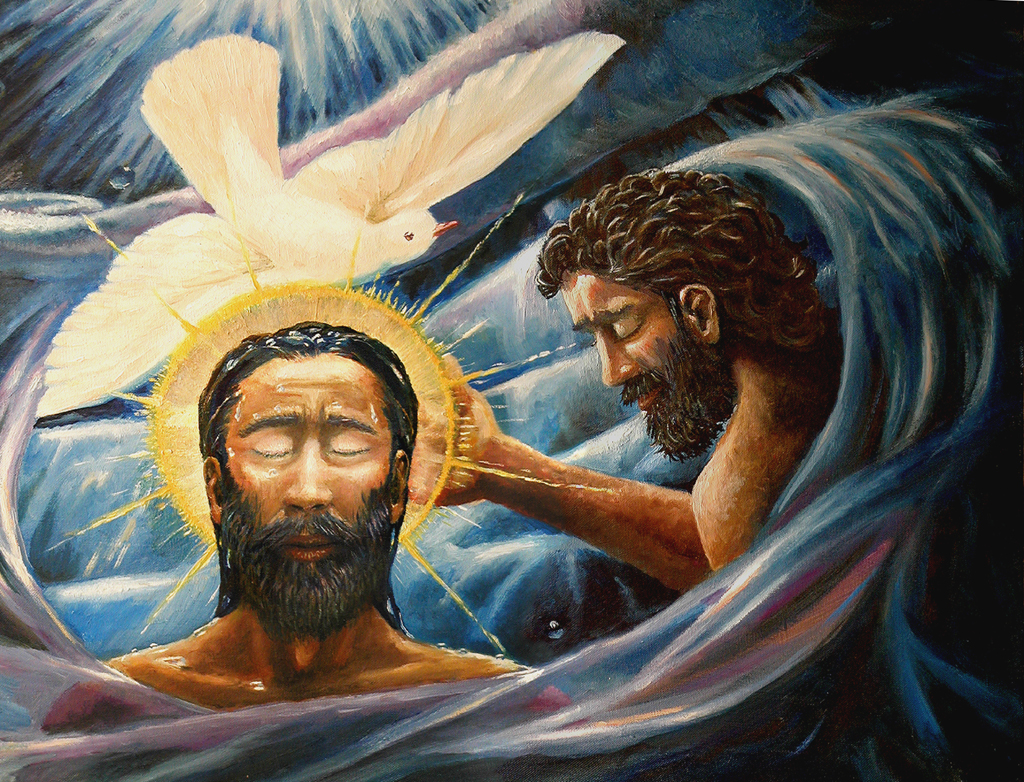
David Zelenka, Baptism of Christ, at WikimediaI have been reflecting here for a while about the problem of the Missing Pieces in the Historical Jesus puzzle. One of my concerns is that we might be putting the right pieces in the wrong places, or arranging them into the wrong pose. I wanted to concentrate on the phenomenon in those posts, and to dwell for a little on the dinosaur analogy, but now I would like to try to illustrate what I am talking about in the first of a couple of examples.

Let's take the example of Jesus' baptism by John the Baptist. This is generally regarded as one of the most secure pieces of data we have about the Historical Jesus, and many use it as a key piece in their reconstructions. I am inclined to think that they may be right and that this is a reasonably secure piece of data. Now, for the sake of argument, let's assume that it is indeed a good piece of data, the equivalent of finding a dinosaur fossil, and ask about how we integrate it into the picture as a whole.

Most reconstructions of the Historical Jesus place this event at the beginning of what they call his "public ministry". Here is one example among many:
"Jesus went out into the wilderness to be baptized by John. The fact that we know almost nothing of Jesus' life prior to his baptism by John suggests that John's baptismal ministry inaugurated Jesus' own public work."

Paul J. Achtemeier, Joel B. Green, Marianne Meye Thompson (eds.), Introducing the New Testament: its literature and theology (2nd edition, Grand Rapids: Eerdmans, 2001), 211.
The placing of the baptism at the beginning of Jesus' ministry is, however, just a guess based on its positioning in the Synoptic Gospels. To assume that the baptism takes place at the beginning of Jesus' public life is simply to accept the narrative of Mark's Gospel at face value. The form-critics may have made a few mistakes, but the basis of their work, scepticism about the (accurate, chronological) biographical framework of the Gospels has not been successfully challenged.

There are, after all, obvious narrative and theological factors influencing Mark's placement of the baptism at the beginning of the Gospel. In his construction, John the Baptist is the Elijah figure who prepares the way for the Messiah to whom he is subordinated. In this construction, Mark is hardly going to position the baptism story half-way through his narrative, even if it actually occurred much later in Jesus' life, if, for that matter, Mark had any idea when it happened. The narrative structure is designed to subordinate John to Jesus, to make him the forerunner, who is arrested before Jesus begins public ministry in Galilee (Mark 1.14) , separating the two men both geographically and temporally.

In other words, the quotation above, which is fairly typical of Historical Jesus research, simply presupposes that the baptism is the first major event in Jesus' life that we know about. It is rarely argued that the baptism marked the beginning of Jesus' public ministry. The fact that we haven't heard anything about Jesus' life before Mark 1 does not make Mark 1 chronologically earlier any more than it makes Mark 8 chronologically the mid-point of Jesus actual, historical career.

Indeed a careful reading of the texts suggests that the Marcan construct is just that, a Marcan construct. There are indications that the two men were active at the same time. John 3.22-26 depicts Jesus baptizing alongside John, with the clear acknowledgement that the two men had parallel careers, at least for some time. Other traditions like Mark 2.18 (mentioning the disciples of John) may also witness to overlapping careers. My guess would be that John the Baptist did die before Jesus, as the Gospels suggest, and that it could have caused some reflection by Jesus on his own death, but that is a guess.

So let us imagine this kind of scenario. Jesus is engaged in some kind of public ministry in Galilee for a year or so before he has met John the Baptist. He hears about John and like several others he makes pilgrimage to the Jordan river to see him. Jesus has an epiphany; it's a confirmation that he has been doing the right thing by leaving family and home and preaching and healing. Perhaps things happened like this; perhaps they didn't. My point is not to argue for a different reconstruction but rather to draw attention to our ignorance about where to place the data and how to do our reconstruction.

Monday, June 08, 2009

Michael White on the Synoptic Problem

I recently came across L. Michael White, From Jesus to Christianity, a book I had previously missed. As usual, I couldn't help checking out its discussion of the Synoptic Problem and I was pleasantly surprised to see that White does not adhere to the now rather tired narrative common in American introductory level books that goes something like, "Once there was the Griesbach Hypothesis but Marcan Posteriority was seen to be so implausible that we need the Two-Source Theory, which is believed by everyone." Instead, Griesbach is lined up as an alternative alongside the Farrer theory. And, still better, the Farrer theory gets its own diagram (114) and there is a recommendation of E. P. Sanders and Margaret Davies, Studying the Synoptic Gospels as the best discussion. Well, that's all very encouraging.

But it is not all good news. First, it is called "the Farrar-Goulder Hypothesis" (his name is spelt "Farrer"). Second, there is one of the worst arguments against the theory that I think I have ever read, and that is saying something. White looks at the example of the Rejection at Nazareth in Luke 4.16-30, noting that "Luke would have had to remove the rejection story from Matthew's relatively late position (Matt. 13.53-58) immediately following the parables (Matt. 13.1-52) to a radically early position . . ." (115). The reason that this argument is weak is that Luke is doing exactly the same thing on both the Farrer theory and the Two-Source Theory! According to both, he is using Mark, who has the Rejection of Nazareth at Mark 6.1-6. It is hardly a valid criticism of an opposing theory to bring in an example that works the same way as the theory being advocated.

Moreover, the Farrer theory actually has a major advantage over the Two-Source Theory with respect to Luke's repositioning of the Rejection at Nazareth. One of the most notorious Minor Agreements between Matthew and Luke against Mark occurs here, in Luke 4.16, right at the beginning of the pericope in question. Matthew 4.13 and Luke 4.16 both have Jesus in Ναζαρά. It is an agreement against Mark in spelling and order (cf. the parallel spelling at Matt. 2.23 in P70 -- see further Michael Goulder, "Two Significant Minor Agreements (Mat. 4:13 Par.; Mat. 26:67-68 Par.)," Novum Testamentum 45 (2003): 365-373). It is an agreement so notorious that it finds its way into the Critical Edition of Q in order to deal with the problem it poses for the Two-Source Theory. In other words, White's example, far from being problematic for the Farrer Theory, is actually better explained by it.

Now to be fair to White, he is attempting to argue against both Griesbach and Farrer at the same time, but the fact that this is the example chosen suggests that he, like many others, is struggling to conceptualize Marcan Priority without Q. It suggests that those of us who adhere to this theory still have some work to do to help people to see the model clearly. Hey, I should do a website on it! Oh, I've already done that. I should write an introductory book on it! Oh, done that too. What about writing a monograph? Darn it, I've even done that. I suppose I'll have to settle for banging my little Farrer drum here in my corner of the blogworld for a bit longer.

Update (Tuesday, 11.34): It occurred to me this morning that I had missed something really important in the earlier version of this post. I have added the paragraph beginning "Moreover, the Farrer Theory . . ."

Regenerations for Wason and Chaplin

With months still to go before the tenth doctor regenerates into the eleventh next Christmas, Doug Chaplin and Brandon Wason are getting their regenerations in ahead of time. Brandon's new blog is called Sitz im Leben and Doug's is called Clayboy. Both have great designs, and I am looking forward to reading more.

Sunday, June 07, 2009

New Biblioblogs Search

Ask and you shall receive! A week or so, I blogged a reminder of Deinde's Biblioblogs Search and added:
One quick thought: the Deinde search mentions "140+" blogs there indexed, but there are now almost 400 listed on the Biblioblog Top 50 site. Perhaps Danny Zacharias and TAFKANTW could get together and take the search up a few notches to incorporate all that rich variety?
Well, the author of the Biblioblogs Top 50 has been listening and has now added his New Biblioblog Google Custom Search Engine. You can grab it for yourself here:


Many thanks for creating this. I've done a few test searches and it works splendidly.

KGO Radio Interview Slot on Paul

As I mentioned earlier, I appeared on KGO Radio in San Francisco today. I was Brent Walter's guest on God Talk. The topic was the Apostle Paul. I must admit that I found it an enjoyable experience, and I was very impressed with the programme, which has the freedom to go into some detail on topics that interest people like us. Brent Walters is an excellent host. I was on the third hour of the three hour show.

Saturday, June 06, 2009

Using Twitter in the Classroom?

Over on Jesus Creed, Scot McKnight asks about Twitter in the Classroom. As some of my readers know, I am a bit of a twitter-holic myself but I have never tried using it in the classroom. Well I suppose on one level, taken literally, the "in the classroom" question is a bit daft because the point of social networking is that it's something done virtually while you are not in the same physical environment. I find live-voice messaging superior when I am in the same physical space as another person. But that's being facetious. Of course the question being asked is whether we extend our engagement with students outside of the classroom by using technology like Twitter.

My kids think that Twitter is the preserve of middle-aged people. The youth all use Facebook. From discussions with my students, this kind of impression has been confirmed for their generation too. I talked a bit to my Historical Jesus class last semester about Twitter and was surprised to find out that very few students in the class even had a twitter account. Our student paper here at Duke, The Chronicle, had a nice piece called Tweet tweet. What's the Rage? this last semester, but discussions with students suggest that Twitter is hardly on their radar while Facebook is their natural hunting ground. When I suggested that one of my advisees talk to another student who shared the same research interests, I said that I would look out her email address and she replied, "Don't worry; I'll just find her on Facebook". The average undergraduate apparently has over 900 friends on Facebook.

This is all a long-winded way of saying that I don't think that undergraduates are embracing Twitter yet to the extent that it can provide a useful venue -- for me -- for supplementing teaching. The time may well come, but I like to work with things that students already have some familiarity with, like Instant Messaging, which I still think provides a great way of communicating outside the classroom.

Cat distractions

It's not always easy writing when you have cats around. But I think I've learned the secret of not getting distracted, as this picture, taken by my daughter Lauren, proves.

Guesting on KGO Radio tomorrow

I will be Brent Walter's guest on God Talk on KGO Radio (San Francisco, California) tomorrow morning talking about the Apostle Paul. The programme starts at 6am PST and I will be interviewed in the 8am time slot (that's 11am EST, 4pm BST). If you are in California, you can listen on 810AM; if you are anywhere else, you can listen live online.

Tuesday, June 02, 2009

Anti-Defamation League on that Doonesbury Cartoon

Well, no sooner had I commented on Targuman's comments on the recent Doonesbury cartoon than I spotted this interesting piece on the ADL (Anti-Defamation League)'s reaction to the same piece:

ADL: Doonesbury creator 'maligns Judaism' in comic
The Anti-Defamation League is demanding Garry Trudeau, the creator of the popular Doonesbury comic strip, apologize for a feature that the group says "maligns Judaism" and "promotes a Christian heresy."

The strip, which ran in Newsday's Sunday editions, features a character who refers to the God of the Old Testament, before Jesus was born, as "crabby and snarky," and the God of the New Testament, which centers around the life of Jesus Christ, as "about love." . . . .
It has to be said that the ADL's take is on the ball here. Perhaps the publicity gained from there objection to the piece will itself provide a useful teaching moment.

The ADL have a Press release and there is further comment from Rabbi David Saperstein.

Neo-Marcionism alert @ Doonesbury

Over on Targuman Chris Brady has some excellent comments on a Doonesbury cartoon from the weekend, The Gospel according to Doonesbury. The cartoon falls very much into the pattern of Old Testament God is mean and judgemental / Jesus is great and mellow.  It is remarkable just how widespread this kind of neo-Marcionism is in popular culture, and I think it's useful for us geeky academic types to point it out when it occurs.  Perhaps we should get a little "neo-Marcionism alert" logo of our own together and bring it out on occasions like this. 

The Gospels and the Telephone Game (Chinese Whispers)

The anonymous blogger of Missives from Marx has an excellent post on The Gospels and the Telephone Game concerning a teaching practice where students play a version of "the telephone game" in order to demonstrate how oral gospel traditions corrupt over time from their pure originals.  In Britain, the same game is called Chinese Whispers. We often used to play it at primary (AmE: elementary) school when the teacher had decided to have a more relaxed afternoon. But I well remember my first 'O' Level (14-16 years old, now GCSE) RE (Religious Education) class at which our teacher got us playing Chinese Whispers in order to illustrate the phenomenon of the gospel traditions getting corrupted through time. It is not an experiment I have ever repeated in my own teaching, nor will I, largely for the reasons so well articulated by Missives from Marx.

I would add the following. Students actually find the idea of oral transmission of traditions pretty straightforward to grasp. They are familiar with the telling of stories in our culture, jokes, anecdotes, urban legends, and they are often inclined to think intuitively that this sort of thing provides a good analogy to the transmission of early Christian traditions. What students find harder to grasp, in my experience, is the notion that the Gospels are related on a literary level, that there is a lot of copying going on.  They need to be shown the texts and to see that at least two of the evangelists are involved in some pretty serious copying.  Our culture disdains this kind of copying, and avoidance of plagiarism is now a huge issue in universities and colleges.  Students are sometimes shocked when they see the extent of agreement in the Gospels because their guess, before doing any study, is that they are independent witnesses to traditional material.  This is especially the case for churchgoers, for whom the Synoptic Problem is rarely, if ever, taught.  

I noticed this year on my Historical Jesus course a related failure of some students to grasp the idea of "multiple attestation".  In spite of some introduction to the key issues in Gospel criticism, some of the weaker students would still treat the appearance of material in all three Synoptic Gospels as "multiple attestation", imagining a model in which the Synoptics were independently relating traditional materials.

Teaching students about oral tradition is an important and challenging element in the teaching of Christian origins, but I doubt that playing Chinese whispers helps anyone to understand it well, not least given the much larger task of explaining the inter-relations of the Gospels.

Biblioblogging Carnival and Top 50

The May edition of the Biblioblog Top 50 came out at the weekend, with NT Blog maintaining a healthy-ish position at 12, just ahead of the Biblioblog Top 50 itself, which makes an entry into its own chart at 13. It would be a lot of fun if the aggregator itself entered the top 10 next month. Since so much fantastic work goes into the compilation of this chart, I wish its author would emerge from the cloak of anonymity, but I suppose it is a forlorn hope.

Meanwhile, the latest Biblical Studies Carnival is out. It is number 42 and the author is Jim Getz of the Ketuvim blog. Jim does a great job, though it's a bit light on the New Testament this month, but that's probably the fault of people like me who failed to make any nominations.

Monday, June 01, 2009

Deinde's Biblioblogs Search

I was looking for an old post on a blog today and all I could remember was the topic. I couldn't remember the date, the author, the blog, anything. I then remembered Deinde's Biblioblogs Search and found the post I was looking for instantly (it was by Sean Winter, it turned out). I have added a link to the Biblioblogs Search to my Blogs page on the NT Gateway. One quick thought: the Deinde search mentions "140+" blogs there indexed, but there are now almost 400 listed on the Biblioblog Top 50 site. Perhaps Danny Zacharias and TAFKANTW could get together and take the search up a few notches to incorporate all that rich variety?