Monday, February 09, 2015

40 years in Biblical Archaeology with Eric and Carol Meyers

The latest Biblical Archaeology Review has a lengthy retrospective on the careers of my Duke colleagues Eric Meyers and Carol Meyers:

Looking Back with Eric and Carol Meyers
Hershel Shanks  (02/09/2015)

It's a great read, especially the discussion of the discovery of the Torah ark from the ancient synagogue at Nabratein in 1981, which Dukies will recognize from the replica that is sitting in the passageway the the entrance of Gray Building.

The article also features the legendary picture of the Meyers dressed in Raiders of the Lost Ark garb for People Magazine in 1981 (left).

Tuesday, February 03, 2015

CNN's Finding Jesus

Beginning on March 1, a new six part documentary series from CNN, Finding Jesus: Faith, Fact, Forgery.  The teaser trailer is now online:


I look forward to chatting about this some more soon!

Spelling mistake in Last Temptation of Christ

The Last Temptation of Christ (dir. Martin Scorsese, 1988) begins with a quotation from Nikos Kazantzakis, but there is a spelling mistake -- it's the wrong "principle".  It should, of course, be "principal":


Sunday, February 01, 2015

Life of Brian's Parody of the Sermon on the Mount in Jesus Films

The most iconic scene in Life of Brian is, of course, the opening post-credit scene in which Jesus is delivering the Sermon on the Mount to assembled thousands (In Judea. AD 33. Saturday afternoon. At around tea time).  Such is the success of Life of Brian that most of us are now more familiar with the parody than what is being parodied.  Everyone knows Life of Brian but relatively few are familiar with its source material.  As it happens, the scene is even funnier when viewed against the background of the Jesus films of the 1960s and 1970s.

Geoffrey Burgon's score is a superb pastiche of just what one hears at this point in both King of Kings and Greatest Story Ever Told. After shots of the crowds gathering, we have a clear shot of Jesus (Kenneth Colley) silhouetted against a blue sky.  As the camera pans back from Jesus, and as we get further and further away, we hear Jesus less and less distinctly until we arrive at Brian his mother Mandy. Mandy cannot hear a word and shouts, "Speak up!"  Iconic lines follow.  "Blessed are the cheesemakers!"  "Did you hear that? Blessed are the Greek!".

The point of the parody is the depiction of the Sermon on the Mount in the epic Jesus films like King of Kings.  Jesus is speaking to a cast of thousands and it is hardly surprising that people cannot hear:


But if you think it would take a lot of projection to speak to that crowd, compare Jesus (Jeffrey Hunter) about to give the Sermon on the Mount in King of Kings:


Jesus is so far in the distance in that shot that you can hardly see him.  Here is a little help:


It is not very different in the Greatest Story Ever Told in which Jesus (Max Von Sydow) gives his sermon to a group of disciples arranged around him in a circle, with a crowd listening at greater distance (imitating Matt. 5.1-2 and 7.28-29), and the vast landscape of Utah visible in the background:


It's not easy imagining being able to hear a word Jesus said from that kind of distance.  But take a look also at the way that Kenneth Colley is presented in close up against the blue sky in Life of Brian:


The similarity with the close-up of Jeffrey Hunter in King of Kings, who is similarly preaching against the backdrop of blue sky, is clear:


The colour in King of Kings is exquisite.  Jesus wears this unusual but rather striking red outer garment only during the Sermon on the Mount sequence in the film, and Ray makes sure to accentuate the contrast with the luscious, cloudless blue sky. 

But this draws to our attention the fact that while there are real similarities between the King of Kings sermon and the Life of Brian sermon that parodies it, there is one quite noticeable difference.  Kenneth Colley in Life of Brian looks nothing like Jeffrey Hunter or Max Von Sydow.  Why is that?  Colley in fact looks similar to Robert Powell in Jesus of Nazareth. And in 1979, when Life of Brian was released, Jesus of Nazareth was a very recent memory.  In fact, as Matt Page reminds us, Life of Brian even used some of the same sets that were used by Jesus of Nazareth out in Tunisia.  

Jesus of Nazareth does not feature a classic Sermon on the Mount scene, though it does repeatedly feature the teaching from the Sermon, and it has one scene in which Jesus gives both the beatitudes and the Lord's Prayer to a gathered multitude relatively late in the production:


The composition here, with its gorgeous oranges and browns, is quite unlike the Life of Brian and King of Kings sermons with their blue sky mountain shots, but Robert Powell's Jesus provides a close analogue to the few seconds we see of Kenneth Colley's Jesus.  Here is Colley:


His long dark hair and beard, and the arrangement of his garments is just like Powell's:


The sermon in Life of Brian thus parodies not only the scope and grandeur of King of Kings and Greatest Story, but also the very look of the Jesus most familiar to viewers in the late 1970s, Robert Powell in Jesus of Nazareth.

If you need a refresher, here is the scene from Life of Brian:


Friday, January 30, 2015

Life of Brian on Celluloid Jesus

I've been gradually adding pages to my Celluloid Jesus web pages and the latest additions are Jesus of Nazareth (yesterday) and now also Life of Brian:

Celluloid Jesus: Life of Brian

Among other things, I've linked to James Crossley's excellent "Life of Brian or Life of Jesus?" and all the footage of the Jesus and Brian Conference at King's College, London in June -- one of the academic highlights of last summer:


There are hours of entertainment there, with Richard Burridge interviewing Terry Jones and John Cleese, and papers by, among others, Paula Fredriksen, Helen Bond, Bart Ehrman, A. J. Levine, James Crossley, Philip Davies, Steve Mason.

I've also added a link to Sarah Prime's article in Marginalia that reflects on the conference.

As usual on this site, I end with my video guide, answering the question, "Where can I get hold of . . . .?"

I have certainly missed things, so please comment either here or there on things you'd like to see added.

Meanwhile, I have another blog post on the way soon about Life of Brian.

Thursday, January 29, 2015

Zeffirelli's use of Light and Windows in Jesus of Nazareth

I have fallen in love anew with Zeffirelli's Jesus of Nazareth over the last week or so as I have watched and re-watched it.  There are so many things to love about the film.  One of them is Olivia Hussey's portrayal of Mary, which is so moving that it is enough to make one want to convert to Catholicism.  Hussey herself was 26 years old when she played Mary and unlike other several other Jesus films, she plays Mary both as the teenage bride and the older, agonized mother grieving at the cross.

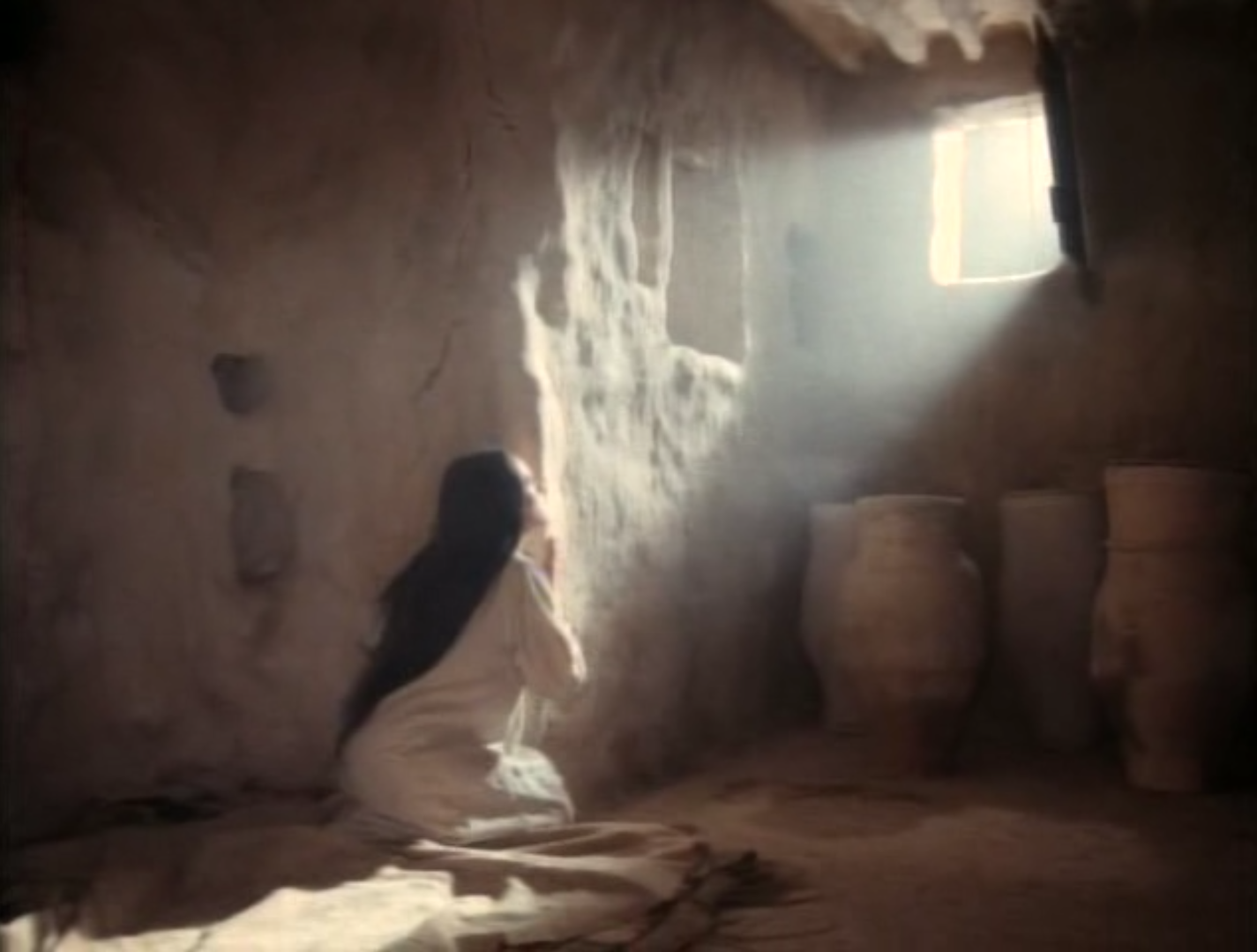
The Annunciation is one of the most visually arresting scenes in the film, not only because of Hussey's portrayal of an initially confused but ultimately devoted young woman, but also because of the striking choice not to have an actor playing the angel Gabriel.  Indeed the name "Gabriel" is not even mentioned and the viewer sees Mary as her mother Anna sees her -- it is one half of a conversation in front of light that is pouring in through the window.

Mary awakes at the sound of the window opening, and the light pouring in, and in a point-of-view shot, Mary looks up to see the window:


As she stands before the window, she converses with the angel, but the viewer, like Anna, sees only one half of the conversation:


And ultimately, Mary kneels in obedience to the angel's message in front of the window:


Here is a clip of the scene:


This motif, of light pouring through windows of a building in which a divine encounter takes place, occurs on several occasions in the film, including the raising of Jairus's daughter.  Jesus goes into the young girl's room alone (and not with Peter, James and John and the girls' parents as in Mark 5.40), and light is streaming in the window as Jesus crouches to heal the young girl.


Jesus speaks the words Talitha Cumi (Mark 5.41) and the girl rises.  The picture is beautifully composed with light coming in all three windows, and Jesus and Jairus's daughter either side of the middle window:


Incidentally, when the girl is hugged by Jesus, we have a rare shot of Robert Powell smiling with his eyes closed:


The same three-window motif occurs again when Jesus is teaching in the temple (in a scene that is only in the full, over six hour version, and not the abridged version currently found on Netflix):


Jesus is teaching in the temple while a large crowds sits, gazing in wonder, and Zerah (Ian Holm) watches from the sidelines.  The dialogue itself is taken from the Sermon on the Mount.  Here, Jesus of Nazareth, like most Jesus films breaks up the sermon, relocates it and redistributes a lot of its material.  In a tracking shot, the camera shows Jesus teaching with light streaming in three high windows.


Here is a clip of the piece:


One might also include here one of the films most iconic moments, when Pontius Pilate (Rod Steiger) sees Jesus emerging from the light in his doorway -- Ecce Homo:


Pilate is arrested by the sight of the man in the crown of thorns who has now approached him:


Wednesday, January 28, 2015

What have the Romans done for us? - Life of Brian and Jesus of Nazareth

One of the legendary scenes in Life of Brian features Judean rebels, led by Reg (John Cleese), asking, "What have the Romans done for us?"  I have been re-watching Jesus of Nazareth (dir. Franco Zeffirelli, 1977) this week and I have been struck by several Brian - Jesus of Nazareth parallels. One of these occurs at about thirty minutes into the film.

The location is Nazareth in about 4 BCE, and the Galileans Jews are discussing oppression by Rome before they are interrupted by Joseph.

"What does Rome give us?" they ask.  Here's the clip:


And in case you need a reminder, here's the famous clip from Life of Brian:


Update (Saturday 31 January): Many thanks to Matt Page who has commented over on Bible Films Blog. Among other things, he corrects my reading of the line.  It is "What does Rome give us?" and not "What do the Romans give us?"  It's interesting that I had harmonized a little to Life of Brian in my transcription, just as scribes of Mark often harmonize to the more familiar Matthean versions of Jesus' sayings!

Thursday, January 22, 2015

Godspell and the Construction of the Twin Towers

In my Jesus in Film class today we focused on Godspell (dir. David Greene, 1973).  It's not my favourite Jesus film at all and so in re-viewing it, I was looking for things that might help to improve my impression of it.  And I found one major one.  The photographing of New York City in this film is really exquisite.

There are many views of New York that are breathtaking, but one scene is especially memorable -- David Greene captures the World Trade Center as construction on it is still in progress.  The number is "All for the best".  The song features the actors dancing in different areas of New York, including Time Square, where Victor Garber and David Haskell dance in front of their own silhouettes on screen, but the scene ends with the crew dancing on the top of the North Tower:


The panoramic view of New York in the background is remarkable.  And just how close to the edge of they?!  I would be absolutely terrified. I am guessing that the camera here is itself on the North Tower.  When the camera pans back further, the actors are still at the edge of the tower, but now facing in the opposite direction.  And here, the viewer can clearly see that construction is ongoing:


Presumably the camera is on a helicopter here?  I had wondered if it was on the South Tower, but is that the South Tower in the upper left of the shot?  As the camera pans back further, we see several shots of the twin towers.  Again, I am assuming this is done on a helicopter:


As the camera pans back further, we see both towers:


And the final shot in the sequence is the long shot of the twin towers against the New York skyline:


Here's that minute or so of remarkable footage:


An article in the Washington Post from 2006 features a brief comment from Victor Garber (Jesus) on this:
"It was really a magical day," he says of filming at the twin towers, and "surreal," too, taking an elevator "as high up as it was done" before having to climb through scaffolding to reach the roof. "It was overwhelming to walk out there."
Nearly three decades later, working in Los Angeles on 9/11, Garber says it took a day or two for the reality of the twin towers' loss and his connection to sink in: "It suddenly dawned on me that we were up there. I can't quite believe it. But you have the soundtrack cover, and there it is -- we're there."

Wednesday, January 14, 2015

Celluloid Jesus: The Christ Film Web Pages are back!


For many years, I had a series of web pages which I called "Celluloid Jesus: The Christ Film Web Pages".  When we revamped the NT Gateway, back in 2008, these pages did not quite fit the new look and I decided to drop them.  I always intended to bring them back as soon as time allowed. This semester I am teaching a course on Jesus in Film at Duke and it seemed to be the perfect excuse to bring them back.  Here is the link:

Celluloid Jesus: The Christ Film Web Pages

I have ported over a lot of the older material and I have begun the process of revising and adding materials.  Currently, there are sections on Websites, Online Articles, Podcasts, Biblography and List of Films.

I have begun the process of setting up pages on each film.  I am doing this as I work through them with my Jesus in Film class.  So far, I have pages on King of Kings (1961), The Greatest Story Ever Told and The Gospel According to St Matthew.


Saturday, January 10, 2015

King of Kings (1961): Philip Yordan's Script and George Kilpatrick

I'm continuing to rewatch and research King of Kings (1961) ahead of teaching a class on it on Tuesday.  TCM has this lovely, short clip of scriptwriter Philip Yordan talking about the film.  He tells about how disastrous the script was when he first saw it -- it was just a series of biblical excerpts.  Director Nicholas Ray told Yordan that he had no money for the script but that he had his kids' college fund, and that was what he gave to Yordan to write it:


I have been wondering, though, whether there were any academic consultants involved with the film.  Like many films of the day, the credits all appear at the beginning and they are not detailed.  You're lucky if all the major actors are credited, let alone members of the crew.  There are no dolly grips or caterers here!  Nor does IMDb's entry help here.

Happily, my friend Peter Groves has been in touch with me this week to let me know that in fact Professor George Kilpatrick was employed as an academic consultant on the picture and even visited the set in Spain.  Armed with this knowledge, I noodled around on the net a little and found one or two mentions of this fact, including a Variety Review from December 1960 and a recent article by Tony Williams ("Nicholas Ray's King of Kings", CineAction 76 (Spring 2009)).  Williams writes:
Ray and Yordan worked on the screenplay with Catholic Oxford Don the Reverend George Kilpatrick who remained on the set during filming. Ray expressed his indebtedness to this scholar in a letter to Samuel Bronston. 
Williams does not give his source for this item, but I'd love to see it, or anything else that details Kilpatrick's involvement.

Update (Sunday, 3.42pm): I am grateful to Matt Page on Twitter and Stephen Goranson in comments for their help in pointing to Williams's source for the above information.  It is Bernard Eisenschitz, Nicholas Ray: An American Journey (translated by Tom Milne; London: Faber and Faber, 1993): 363:
Meanwhile he [Ray] continued working on the script with Jordan and a Catholic priest, the Rev. George Kilpatrick, an Oxford don, who remained on hand throughout filming.  In February, he wrote to Bronston to say that, thanks to Kilpatrick, he had solved the dramatic problem of how to treat the trial of Jesus. ‘For the first time since I completed the script of Savage Innocents, I feel like writing again.’
Williams does refer to this book in his footnotes, but not in the precise location where one sees the above quotation.  I wonder if Williams' paraphrase of Eisenschitz slightly over-interprets it when he says Kilpatrick "remained on the set" during filming.  We know that Kilpatrick visited the set but to "remain on hand" during filming may mean that he was available and in contact throughout, e.g. at the end of a phoneline, but I would be interested to hear more.


Carl Holladay to give the Clark Lectures

This year's Kenneth W. Clark lectures at Duke Divinity School are to be given by Carl Holladay.  Details are here:

Clark Lectures 2015: Carl Holladay

The schedule is:

Lecture 1
Tuesday, Feb. 17, 2015
4:00 – 5:15 p.m.
0016 Westbrook, Duke Divinity School

Lecture 2
Wednesday, Feb. 18, 2015
8:30 – 9:45 a.m.
0016 Westbrook, Duke Divinity School


Tuesday, January 06, 2015

King of Kings (1961): are those telegraph poles?

One of the things that happens when you watch a film many times over is that you start spotting things in the background.  I was viewing the temptation scene in King of Kings (1961) today, and there is a long shot right over the desert and I think I can see what look like two telegraph poles in the background.

Here's a screenshot:


Can't see what I'm talking about?  Take a closer look:


Here's a zoom-in at the best resolution I can manage:


See what I mean, or am I seeing things?

King of Kings (1961) Premiere on British Pathé

I am currently preparing a class on King of Kings (dir. Nicholas Ray, 1961) for the course on Jesus in Film that I am teaching this semester at Duke.  While researching for the course, I came across this delightful piece from British Pathé News on Youtube.

It is the a one and a half minute news item about the U.S. premiere of the film, with footage from both the east and west coast premieres.  You see Jeffrey Hunter (Jesus) at about 1:21, and he is looking much more like Captain Pike here than Jesus:


Also of interest is the highlight of Lauren and Preston Tisch, owners of the Loewes Corporation, who gave their names to the NYU's Tisch School of the Arts.  It's worth noting also the prominence given to "young and beautiful Brigid Bazlen" who plays Salome.  She was only seventeen at the time and never became the big star that they seem to expect here.

The news item gives a sense of just how huge the release of this film was.

Saturday, December 20, 2014

Podcasting Jesus on Duke devilTech

I sat down yesterday to talk to my friend and colleague Stephen Toback about my NT Pod and my future plans for the podcast, including venturing into video podcasting. We talked in Duke's new MPS studio, which I am greatly looking forward to using in the coming weeks. Our discussion, on the latest Duke devilTech, is available here:


Many thanks to Stephen for the invitation to appear on Duke devilTech and the chance to learn more about the MPS studio.


Jesus Films this Christmas

I am greatly looking forward to teaching a new course on Jesus in Film next semester here at Duke.  I'm encouraging those signed up for the class to begin their work over the break by seeking out Jesus films on the TV.  I have drawn up a list for them of films to look out for and it occurred to me that it would be worthwhile sharing it here on the blog too.  These are, of course, those available to those living in the USA:

Sunday 21 December:

The Bible (2013): History Channel

Monday 22 December

Bible Secrets Revealed (2013): History Channel

The Nativity Story (2006): AMC (repeated 23rd, 24th & 25th)

Tuesday 23 December

King of Kings (1961), TCM

Monday 29 December

The King of Kings (1927), TCM

For those who have have Netflix, the following films are also currently available:

Jesus of Nazareth (1977) [But note that this is the abridged movie version, not the full-length TV miniseries]

The Last Temptation of Christ (1988)

The Passion of the Christ (2004)

The Bible (2013)

For those who have Amazon Prime, the following film is also available:

The Greatest Story Ever Told (1964)

Tuesday, December 09, 2014

Richard Bauckham, Assessing the Lost Gospel: All in one

All seven parts of Richard Bauckham's assessment of Simcha Jacobovici and Barrie Wilson, The Lost Gospel: Decoding the Ancient Text that Reveals Jesus' Marriage to Mary Magdalene (New York: Pegasus, 2014), are now available combined into one article, which I have uploaded here:

Assessing The Lost Gospel [PDF] [Word]

Many thanks to Steve Walton for doing this and sending it over.

Sunday, December 07, 2014

Richard Bauckham, Assessing the Lost Gospel: All Seven Parts

Richard Bauckham's assessment of Simcha Jacobovici and Barrie Wilson, The Lost Gospel: Decoding the Ancient Text that Reveals Jesus' Marriage to Mary Magdalene (New York: Pegasus, 2014) is now complete.

I have been posting his responses over the last two weeks, and I am happy now to gather links to all seven parts here.  In each case, the main link is to a PDF of the article.  Word versions are linked in square brackets:

Part 1: The Chronicle of Pseudo-Zachariah Rhetor – Content and Context [PDF] [Word]

Part 2: Misinterpreting Ephrem [PDF] [Word]

Part 3: Misreading Joseph and Aseneth (i) [PDF] [Word]

Part 4: Responding to Simcha's Responses [PDF] [Word]

Part 5: Misreading Joseph and Aseneth (ii) [PDF] [Word]

Part 6: On Mary Magdalene and Magdala [PDF] [Word]

Part 7: Conclusion and Pauline Postscript [PDF] [Word]

Many thanks to Prof. Bauckham for this fine, detailed critical analysis.

Friday, December 05, 2014

Richard Bauckham, Assessing the Lost Gospel, Part 7

Here is the seventh and final instalment of Richard Bauckham's assessment of the new book by Simcha Jacobovici and Barrie Wilson, The Lost Gospel.

Assessing the Lost Gospel
Part 7: Conclusion and Pauline Postscript


by Richard Bauckham

The above link is to a PDF of the article.  A Word version is also available.  Part 1 is here. Part 2 is here. Part 3 is here. Part 4 is here. Part 5 is here. Part 6 is here.

I will gather all seven parts into a single post a little later on for ease of access.

I would like to thank Prof. Bauckham, on behalf of all the readers of this blog, for a masterful series of articles.


Thursday, December 04, 2014

Richard Bauckham, Assessing the Lost Gospel, Part 6

Here is the sixth instalment of Richard Bauckham's assessment of the new book by Simcha Jacobovici and Barrie Wilson, The Lost Gospel.

Assessing the Lost Gospel
Part 6: On Mary Magdalene and Magdala


by Richard Bauckham

The above link is to a PDF of the article.  A Word version is also available.  Part 1 is here. Part 2 is here. Part 3 is here. Part 4 is here. Part 5 is here. (When the response is complete, I'll gather links to all the parts in a single post).


Richard Bauckham, Assessing the Lost Gospel, Part 5

Here is the fifth instalment of Richard Bauckham's assessment of the new book by Simcha Jacobovici and Barrie Wilson, The Lost Gospel. In it, he continues the response begun in Part 3: Misreading Joseph and Aseneth (i):

Assessing the Lost Gospel
Misreading Joseph and Aseneth (ii)


by Richard Bauckham

The above link is to a PDF of the article.  A Word version is also available.  Part 1 is here. Part 2 is here. Part 3 is here. Part 4 is here.  (When the response is complete, I'll gather links to all the parts in a single post).


Thursday, November 27, 2014

Richard Bauckham, Assessing the Lost Gospel, Part 4

Here is the fourth instalment of Richard Bauckham's assessment of the new book by Simcha Jacobovici and Barrie Wilson, The Lost Gospel. In it, he responds to Simcha Jacobovici's Response to his reviews found here: Response to Prof. Bauckham’s critique of The Lost Gospel Part 1 and Part 2.

Assessing The Lost Gospel
Part 4: Responding to Simcha's Responses


by Richard Bauckham

The above link is to a PDF of the article.  A Word version is also available.  Part 1 is here. Part 2 is here and Part 3 is here.  (When the response is complete, I'll gather links to all the parts in a single post).


Richard Bauckham, Assessing the Lost Gospel, Part 3

Here is the third instalment of Richard Bauckham's assessment of the new book by Simcha Jacobovici and Barrie Wilson, The Lost Gospel:

Assessing The Lost Gospel
Part 3: Misreading Joseph and Aseneth (i)


by Richard Bauckham

The above link is to a PDF of the article.  A Word version is also available.  Part 1 is here. Part 2 is here.  (When the response is complete, I'll gather links to all the parts in a single post).


Saturday, November 22, 2014

Richard Bauckham, Assessing the Lost Gospel, Part 2

Here is the second instalment of Richard Bauckham's assessment of the new book by Simcha Jacobovici and Barrie Wilson, The Lost Gospel:

Assessing The Lost Gospel
Part 2: Misinterpreting Ephrem


by Richard Bauckham

The above link is to a PDF of the article.  A Word version is also available.  Part 1 is here.


Friday, November 21, 2014

Richard Bauckham, Assessing the Lost Gospel

I am delighted to be able to post here a piece by Richard Bauckham assessing the new book by Simcha Jacobovici and Barrie Wilson, The Lost Gospel:

Assessing The Lost Gospel
Part 1: The Chronicle of Pseudo-Zachariah Rhetor – Content and Context

by Richard Bauckham

The above is a link to a PDF of the article.  A Word version is also available.

Wednesday, November 12, 2014

N. T. Wright, Why and How Paul Invented "Christian Theology" at Duke

In my previous post, I linked to the Tom Wright's Panel Discussion with Douglas Campbell, Ross Wagner and Susan Eastman at Duke Divinity School.  This was the first of several events in the area featuring N. T. Wright.  Yesterday lunchtime, Professor Wright gave a lecture "Why and How Paul Invented 'Christian Theology'" and with thanks to Reed Criswell, it is now available on Youtube here:


Make sure that you stay all the way to the end.  There are some enjoyable Q&As at the end, including one from Joel Marcus.

Tom Wright Panel Discussion with Douglas Campbell, Ross Wagner and Susan Eastman at Duke Divinity School

We have enjoyed having N. T. Wright visiting Duke this week.  Two of the events at which he spoke are now available to view online, with many thanks to Reed Criswell for his fine work in recording and uploading them.  The first is this panel discussion on Pauline Theology which took place on Monday evening:


I was able to get to this panel discussion and I must admit that I found it really compelling stuff. The participants are my colleagues over in the Divinity School Douglas Campbell, Ross Wagner and Susan Eastman. Richard Hays was the moderator. The event was absolutely packed out. Watching Douglas and Tom spar with one another was a particular highlight. There are some great moments. The video is about 90 minutes long.

Tuesday, November 04, 2014

Call for Papers: Gospel Interpretation and the Q Hypothesis

I'm happy to post the following call for papers for a conference next June in Roskilde, Denmark:

--
Call for papers

“Gospel Interpretation and the Q‐Hypothesis”

International Conference, 21 to 24 June 2015, Roskilde (Denmark)

Organizers: Mogens Müller, Stefan Nordgaard, Heike Omerzu

This year, in June, a group of colleagues from Copenhagen held a conference on the topic of ‘Luke’s Literary Creativity’. The conference, which was headed by Prof. Mogens Müller, gave rise to a lively discussion about the Q‐hypothesis and other possible ways of explaining the similarities between Luke and Matthew, including, above all, the Farrer, a.k.a. the L/M, hypothesis. The debate was so energetic and inspiring that we, the team of organizers, decided that we quite simply had to follow up on it with another conference exclusively devoted to the topic of Luke and the synoptic problem and with the participation of both Q‐believers, Q‐sceptics and scholars who as yet remain undecided on the issue.

We have now started organizing the conference and a number of the world’s leading scholars on the topic — Stefan Alkier, Eve‐Marie Becker, Mark Goodacre, Christoph Heil, Werner Kahl, John Kloppenborg, Shelly Matthews, Clare Rothschild, Hildegard Scherer, Christopher Tuckett, and Francis Watson — have agreed to participate. We feel confident that the conference will be able to significantly further the debate between Q‐believers and Q‐sceptics, and we wish to invite anyone with an interest in the issue of the synoptic problem to submit a paper proposal for the conference. In order to allow enough time for discussion we will select up to six papers.

Paper Proposals (not exceeding one page) are to be submitted to Prof. Mogens Müller (mm@teol.ku.dk) or Prof. Heike Omerzu (ho@teol.ku.dk) no later than 1 February 2015.  

Applicants will be informed by 20 February 2015 whether or not their papers have been accepted. Papers accepted for the conference will be distributed in advance among all participants and will be discussed rather than read at the conference. We intend to select respondents for each paper who will introduce the discussion by a critical examination of its argument. In order for us to be able to distribute the papers in advance, accepted papers (not exceeding 20 pages) should be submitted by 23 May 2015. After the conference, contributors may be invited to submit their papers for publication in a collected volume edited by the organizers.

The conference is free of charge. It will be held at Comwell Hotel in Roskilde (Denmark) (www.comwellroskilde.dk). All expenses for food and accommodation (though not travel) will be paid for by the organizers.

--

The conference call (PDF) is also available here.


Tuesday, October 21, 2014

Podcasts Update

I've updated the NT Gateway: Podcasts page with the two new podcasts that have been established recently, T. Michael Law's Septuagint Sessions and the T & T Clark Podcast, the first episode of which features Dominic Mattos interviewing Chris Keith.

Update (4 Nov. 2014): the second episode of the T & T Clark Podcast is now available and features an interview with Francesca Stavrakopoulou.

Markus Barth on Ephesians and Colossians

Over on New Testament Perspectives, Matthew Montonini has made available Markus Barth's Lectures on Ephesians and Colossians (audio), originally published on cassette in 1969, but now digitized.

I've added a link on the NT Gateway: Ephesians and Colossians page.

Update (4 Nov. 2014): Matthew was facing so much traffic on these files that people were no longer able to access them, so I have uploaded them to my webspace and Matthew has updated the links -- all are now working again.

New Online Journal: The Journal of the Jesus Movement in its Jewish Setting

Thanks to Stephen Goranson for the notice about this new venture from Eisenbrauns:

--
Introducing,
the Journal of the Jesus Movement in its Jewish Setting (JJMJS) -

FREELY AVAILABLE ONLINE FROM OCTOBER 20!

JJMJS is a new interdisciplinary peer-reviewed online journal, published in cooperation with Eisenbrauns.

A rich variety of Jewish and Christian traditions and identities mutually shaped one another in the centuries-long course of Roman Late Antiquity. A no less rich variety of scholarly approaches – from the history of Christian Origins to that of the late empire, from archaeology to Dead Sea Scrolls, from Rabbinics to Patristics – has in recent years converged upon this period, the better to understand its religious and social dynamics. JJMJS seeks to facilitate and to encourage such scholarly investigations across disciplinary boundaries, and to make the results of cutting-edge research available to a worldwide audience.

JJMJS is free of charge with complete open access. The journal is published in cooperation with Eisenbrauns and will be available in hard copy, which can be ordered from Eisenbrauns.

To download individual articles please click here. If you would like to share your ideas and interact with the articles published in our journal, please visit our Forum page. We welcome your interest and warmly invite your collaboration in this new scholarly enterprise.

For further information about the journal, please see the introduction by the co-editors in issue 1 (2014) and the About tab.

--

The first issue includes articles by Mark Nanos, Dieter Roth, Jonathan Klawans and Craig Evans. I must admit that I rather like the interface they are using too -- nice and clear and easy to use.

I have added a link on the NT Gateway: Journals page.


Tuesday, October 14, 2014

Douglas Campbell: Framing Paul Book Trailer

Eerdmans have just released this book trailer for my colleague Douglas Campbell's new book, Framing Paul:


You can see more in a full interview here:


Wednesday, October 01, 2014

Philippians Videos

I'm enjoying teaching the Life and Letters of Paul this semester at Duke.  Today we reached the Epistle to the Philippians and I found a new video which I previewed in class.  It's another of the St John's Nottingham videos, and features Paula Gooder in typically lucid form:


I've added it to the NT Gateway: Philippians page just above the also excellent Bibledex: Philippians video from the University of Nottingham.

Monday, August 04, 2014

"Fifty bob Dodd"

While doing some reading today on John's Gospel, I came across an enjoyable tidbit about the great New Testament scholar C. H. Dodd (1884-1973):

"[He] had gained notoriety among scholars as “fifty bob Dodd” for his first tome on John."

This is from G. L. Borchert, John 1–11 (The New American Commentary  Vol 25A; Nashville: Broadman & Holman Publishers, 1996): 40.  The reference is to Dodd's The Interpretation of the Fourth Gospel (Cambridge: Cambridge University Press, 1958).

Borchert explains in a footnote that "When Dodd’s work was first published, scarcely any commentary at the time had cost fifty shillings, and for scholars to purchase the work was a reflection of the high regard they had for his significant work."

Having read this, I then googled "fifty bob Dodd" and it turned out that it was a googlewhack. Not for long, I'd guess, as this blogpost is now likely to come up.  I wonder how long that will take?

Sunday, June 22, 2014

Jesus and Brian Conference, Day 2

William Telford and me
After a wonderful first day, the Jesus and Brian conference began again on Saturday morning with a paper from one of the real gurus of Jesus films, William Telford. He had a superb series of reflections on the ways in which the Life of Brian parodies the Jesus films, and his paper was superbly performed.  He does not just read his paper, in the manner all too common in the guild, but he acts it.  It was compelling stuff.


Just as compelling was the second paper, "Monty Python's Life of
Philip Davies and James Crossley
Jesus", in which first Philip Davies and then James Crossley took a more subversive look at the film and argued that it is not quite so benign in its intentions as it is depicted by Burridge and others.  After a coffee break, Helen Bond gave an eloquent and fascinating paper on laughing at crucifixion.

Helen Bond
The quality of the papers continued to be high. Guy Stiebel from the Hebrew University of Jerusalem talked about "Romanti Ite Domum: Identity and Expressions of Resistance in Judaea", with fine use of Powerpoint, including one picture of some kind of ancient phallus, which caused lots of sniggers (and some remarks about "bigus dickus").

Steve Mason
Last night I blogged about my hunger after the canape reception, but today I was forced to eat my words after we were treated to a delicious sandwich lunch, and I was even invited into the speakers' room where I got to hang out with the swells.  I do miss nice British sandwiches, so it was a treat, and I sneaked one last one in to enjoy with the first afternoon paper, Steve Mason on "What have the Romans ever done for us?", a really fascinating study of first century politics and relations between Judaea and Rome, with superb use of Powerpoint (and it's not often that you can say that).

Paula Fredriksen
After Steve Mason came one of my favourite scholars, Paula Fredriksen. I must admit that I still feel a little starstruck whenever  I talk to her.  Her paper was called "Are you a virgin? Biblical Exegesis and the Invention of Tradition" and the best use of clips from the film -- each short clip was followed by some reflections on the Biblical text.

The last session of the day kicked off with a fascinating piece by David Shepherd, who explored another Biblical parody, Wholly Moses, starring Dudley Moore, which was something of a critical and commercial failure.  Shepherd showed several clips and explored the difficulties with the film.  The second of his clips, in which Dudley Moore as Hershel "does God" after having come down from the mountain, I found hysterically funny, so much so that when my head fell backwards I knocked someone's bag off their desk. The last paper of the day was given by Aaron Rosen, who talked about "Sonofagod: Images of Jesus in Contemporary Art".

There was just enough time in between the end of the formal programme and the conference banquet for a swift pint in a German style bierkeller with big screens showing the World Cup, and we just caught Argentina beating Iran 1-0 in the closing minutes.

The conference dinner took place in the Inner Temple Hall, and was hosted by Robin Griffith-Jones.  Earlier in the day, Richard Burridge had mentioned that he would try to get a chance to introduce me to John Cleese, and I was delighted that he did so.  Here, for posterity is the pic.:

Richard Burridge, John Cleese, me
Joan Taylor kindly took the picture.  I was delighted to get the chance to chat to Cleese, who was utterly delightful.  At the dinner itself, the top brass sat on high table with Cleese, with Fredriksen to his left, Griffith-Jones to his right, and Ehrman opposite.  The food was excellent and the wine flowed pretty freely.  Afterwards, Cleese gave a short speech and then invited attendees to ask him questions about the film, with Michelle going around with the mic.  Cleese dealt graciously and amusingly with each of the questions and I could have listened to him all evening.  A really marvellous occasion.

Sadly, this wrapped up my attendance at a wonderful conference.  I had a conference in Roskilde, Denmark, to get to, on Luke's Rewritten Bible (on which, more anon), so I jumped on the tube to Victoria and the train to Gatwick, in time to grab a couple of hours' sleep before my early morning flight.

The conference did continue today (Sunday) with several great speakers including A-J Levine, Adele Reinhartz and Bart Ehrman.  I would also really have liked to hear Richard Burridge's talk about the Malcolm Muggeridge and Bishop Stockwood programme.  Perhaps I'll be able to catch up via the conference video.  As far as I could tell the whole thing was being video-ed.

This pic. is nicked from the T & T Clark twitter feed, via Jim West's blog, and depicts Joan Taylor interviewing film editor Julian Doyle:

Joan Taylor and Julian Doyle
It's appropriate to conclude with a picture of Joan Taylor, who did so much hard work to make this conference a success.  It was a brilliant idea for a conference, superbly organized, with tons of amazing papers from top people.  And, of course, John Cleese.

Did I mention that I met John Cleese?

Friday, June 20, 2014

Jesus and Brian Conference, Day 1

Terry Jones, John Cleese and Richard Burridge
It's not every day that you get to go to a conference on Monty Python.  Jesus and Brian Or: What Have the Pythons done for us? is the mastermind of Joan Taylor at Kings College, London, with support from Richard Burridge.  The focus is Monty Python's Life of Brian (dir. Terry Jones, 1979), and how it interacts with scholarship on the New Testament, Christian Origins, the Historical Jesus and the history of early Judaism.  The conference began today at King's College London and continues for the next two days.

As a long time fan of Life of Brian, and with an interest in Jesus films, I could not resist the opportunity to make it to this one.  Luckily, I have a conference in Denmark beginning on Sunday, and the chance to stop off in London on the way there made it irresistible.  Having said that, travel was not straightforward.  We had a flight cancelled on Wednesday evening and another on Thursday morning and only made it in in the early hours of Friday morning.  With no more than a few hours sleep over the last three nights, this does make it more of a challenge than I had expected, but I have no doubt that it will be worth it.

Joan Taylor introduces the conference
The conference began at around 4pm today.  Immediately one could see several scholarly celebrities around -- A.-J. Levine, Bart Ehrman, Helen Bond, George Brooke, Martin Goodman, Adele Reinhartz, Philip Davies, James Crossley, Eddie Adams, and so the list goes on.  Kings College is right in the heart of London, on the Strand, with theatres and swanky restaurants all around.  As long as you are not in a car, it's a fantastic location for a conference.  I tubed in from Heathrow to Covent Garden and had just a five minute walk.

Joan Taylor introduced the conference with a lively and witty piece on "the Historical Brian".  She mentioned her delight that the Pythons themselves had expressed enthusiasm about the conference and her amazement to get a phone-call from John Cleese.  She looked also at the comparison between the Life of Brian and the Hollywood Jesus films, and especially King of Kings.  


Martin Goodman
George Brooke
Martin Goodman then spoke about "The Life of Brian and the Politics of First Century Judea" and there was a lively Q&A session afterwards.  George Brooke spoke third, on "Brian as a Teacher of Righteousness", and got the best laugh so far when he said that Brian "puts the mess back into messianism".  The audience were taking a little while to warm up, but they were gradually getting there.


From this first session we went upstairs for a nice wine reception, with a few of those posh little canapés going around on trays, the kind where you need about five hundred to fill you up.  As it turned out, this was the only food of the evening, so it was important to grab as many as you could, and I'm not sure that I was quite up to the job.  Rick Trainor, Principal at Kings, gave some opening remarks, and uttered the heresy that he had not in fact seen the film!

Terry Jones, John Cleese, Richard Burridge
After the reception, we returned to the lecture theatre for the highlight of the day.  In fact, I'm sure it will prove to have been the highlight of the whole conference.  Richard Burridge interviewed Terry Jones and John Cleese for an hour.  It was an utterly compelling session.  I have to admit that I was a little starstruck.  John Cleese took the lion's share of the discussion and pretty much everything he said was quite fascinating.

Cleese expressed genuine pleasure that the film had resulted in a conference like this, and said that it might just be one of the best things the Pythons had done.  He talked about how good a director Jones was, adding that it was because he was a megalomaniac.  He talked about an alternate story line that came to nothing about Brian (or some other character) failing to make it to the last supper.  He spoke in the most disparaging way about the media ("second rate scum") and expressed little surprise when Burridge mentioned how little interest they had shown in this conference.

Jones did do a Mandy voice at one point, and he generally seemed rather chuffed with the whole discussion while broadly happy to let Cleese dominate.  Burridge did a fine job of allowing them to relax and chat while at the same time reining them in a bit and asking some very interesting questions, including a discussion of the now famous Stockwood and Muggeridge discussion of the film, with Cleese and Palin, on Tim Rice's programme.  Cleese said that he was an admirer of Muggeridge and felt sorry for him that his responses to the film were so poor.

Terry Jones, John Cleese, Richard Burridge
If anything, the discussion with Cleese and Jones was too good.  The hour went too quickly, and I could have continued listening for hours.  There followed an opportunity to watch the film (via DVD projection) in the same theatre, but over half the audience including most of the top brass flocked out, perhaps having realized that two or three canapes is not quite enough for dinner, and going in search of food and drink.  If the timing was not ideal, it was still nice to have a chance to watch the film again, all the more so in appreciative company, and good to brush up on it ahead of a whole raft of lectures tomorrow, all of which look like they will be fascinating.

The first day of the conference was every bit as good as I thought it would be and better.  Richard Burridge has an article in the Church Times here: Is he more than a 'naughty boy'? and there is a pre-conference podcast here.

I will continue to live-tweet the conference tomorrow, along with several others, and all your reactions, using the #JesusandBrian hashtag.


Monday, June 02, 2014

Jesus and Brian Conference in London - tickets still available!

I'm surprised that this one is not already sold out, but the good news is that tickets are still available for conference about The Life of Brian coming soon:

Jesus and Brian: What did the Pythons ever do for us?
Kings College, London, 20-22 June

Full details are at the link above.  As a life-long fan of Life of Brian, I am really excited about this event.  In fact, I booked my ticket back in March, as soon as I heard about the conference.  I hope to live-blog most of it too (though sadly I'll have to miss the Sunday because I'll be heading to Denmark for another conference, on more of which anon).

There is a stellar cast of scholars lined up to speak at the conference, including Paula Fredriksen, Adele Reinhartz, Helen Bond, Bill Telford, Bart Ehrman, James Crossley, Philip Davies, Martin Goodman, George Brooke, Steve Mason, Amy-Jill Levine, as well as locals Joan Taylor and Richard Burridge, and so the list goes on.

While the programme lists Richard Burridge engaging in a "conversation with mystery guests" for the Friday evening, I have it on good authority that the guest will be Terry Jones himself!  Julian Doyle (editor) is also lined up to appear on the Sunday.  And there is another "mystery guest" for the Saturday evening who can't yet be named.

Booking details are here.  I look forward to seeing lots of you there for what is likely to be a really wonderful event.

He's not the Messiah.  He's a very naughty boy.

Monday, May 12, 2014

Maurice Casey (1942-2014)

Maurice Casey in April 2008,
Synoptic Problem Conference,
Lincoln College, Oxford
I was so sad to hear of the death of Prof. Maurice Casey at the weekend (see JimWest, Dominic Mattos, Larry Hurtado, Jim Davila).  Anyone familiar with contemporary New Testament scholarship will know of the massive contribution that he has made.

His enduring legacy will probably be the stimulation to rethink the Son of Man question, in two key works, one in 1979 (Son of Man: The Interpretation and Influence of Daniel 7) and the other in 2007 (The Solution to the Son of Man Problem), which we were delighted to have in the Library of New Testament Studies series.  Alongside this, and equally important, is his underlining of the necessity to study the Aramaic sources of the Gospels, especially in Aramaic Sources of Mark's Gospel (1998) and An Aramaic Approach to Q (2002).  In spite of the importance of these contributions, he made his mark in other major ways too.

His book on New Testament Christology, the result of his Cadbury Lectures in Birmingham in 1985, is probably the best, clearest presentation of the view he so clearly articulates in its title, From Jewish Prophet to Gentile God, and I still assign students passages from this book when we discuss early Christology.

Like almost all of his writing, the strength of that book is that it develops a coherent and stimulating thesis and argues it with clarity and force.  There is no messing about in Casey's writing.  He doesn't just present data for the sake of it but marshalls evidence as part of a stimulating argument.  He does what he needs to do without going on for ever, and his prose is crystal clear.  One of his much underrated books is Is John's Gospel True? (1996) in which he robustly lays out the case for distancing John's Gospel from the historical Jesus.  While many contemporary scholars disagree with the book, it's an ideal starting point for getting to the heart of the debate about John and history.

Casey was writing right to the end of his life and although I am not as fond as his recent book on Jesus mythicism as I am of his other works, it would be fair to say that his big book on the historical Jesus, Jesus of Nazareth: An Independent Historian's Account of his Life and Teaching (2010), makes a major contribution to Jesus research.  It's a lively read but it is also intense, passionate and full of the emphases that made Casey so important a scholar -- the emphasis on reading the source materials in their original languages, the importance of understanding accurately Jesus' historical context, and the stress on working as an historian and resisting the urge to warp the evidence with contemporary theological concerns.

I was lucky to meet Maurice on many occasions while I was teaching at the University of Birmingham.  Maurice was down the road at the University of Nottingham and was a regular at the conferences, and it was always a pleasure to chat to him at the British New Testament Conference.  I think the first time I met him was in a taxi I shared with Maurice and Michael Goulder.  They had been good friends for years, and my association with Michael instantly put me in Maurice's good books -- I always felt like I bathed a little in Michael's reflected glory.  Although I never heard them talk about this, I suspect that they respected one another not least because it's not always easy being a scholar of religion when you don't believe in God.

I have been sorry not to see more of him since I have lived in America, but I have happy memories of long discussions over dinner at the Oxford Synoptic Problem conference in April 2008.  In spite of his occasionally acerbic and witty remarks about others, I always found him delightful, kind and very funny.  I still remember clearly several elements in our conversation at dinner, at which his much-loved graduate student and close friend Stephanie Fisher was also present.  One was the observation that scholars often get much more conservative the closer they get to the grave -- they are trying to write their way into heaven, he claimed.  The other was a lengthy discussion about the properties of port, which, he felt, were insufficiently appreciated by many of those present at the conference.

And so I am pouring a glass of port now and raising it to Maurice, who will be dearly missed, and whose like we may never see again.