Tuesday, March 31, 2009

Who is behind the Dilettante Hobby Horse Blog?

In recent days there has been some speculation about the identity of the author of the new Dilettante Hobby Horse blog. As soon as it became clear that it was not by the artist formerly known as N. T. Wrong, attention turned to Jim West. Could he be the author of this new blog? Those who are inclined to think so cite several pieces of circumstantial evidence that appear to point to Jim. Some of them are pretty obvious, the repeated use of the term "dilettante", one of Jim's favourites, the repeated references to Jim ("if you are Jim West . . ."; Extra Hudson) as well as contributions from Jim (Another one for you) and regular comments (comments, comments, comments).

But of course all that that tells us is that Jim is an enthusiastic supporter of the new blog. It does not make him its author. Attention has naturally turned, therefore, to the blog's style. Does it sound like Jim? Certainly it features a striking number of his favourite language, "idiocy", "crackpot", "lunacy", "pearls", alongside the use of sarcasm and neologisms constructed around names. "Hudsonianism" and "hobby horsistians" in the new blog are analogous to famous Westisms such as "Wrightianity", "Wrightianist", "bibliobloggists", "Bentley-ism" and "Bentley-ism-anity".

It is difficult to be convinced by such speculation. The Dilettante Hobby Horse Blog cannot be Jim's work because his position on anonymous blogs is clear and often repeated, e.g. On blogging anonymously, where he comments that "Blogging anonymously is akin to citing Wikipedia, so far as I’m concerned". Or here:
An alias is a means by which a person hides him or herself, in a delightfully cowardly way, behind the mantle of anonymity. Anonymity, such persons believe, allows them to make the most outrageous and unsubstantiated claims without fear of having to give an account of themselves.

Like unprovenanced artifacts, however, unattributable comments have neither value nor worth and cannot be taken seriously by anyone. They are the academic equivalent of ‘www.juicycampus.com’ - a site devoted to slander and stupidity.
(Learning about the intelligence of readers via comments)
Moreover, Jim himself has denied being the author of the new blog (Finally, there's a place for all the dilettantes to assemble). So we have an interesting new biblioblogging mystery. Why does the author of the Dilettante Hobby Horse Blog model his language and style on Jim's? Jim: I think you have a fan!

Sunday, March 29, 2009

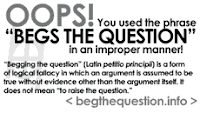
Beg the Question alert

Beg the QuestionFrom Mark Allen Powell, Jesus as a Figure in History (Louisville, Ky: Westminster John Knox, 1998), 78:

"The group's [i.e. Jesus Seminar] ideological slant, then, may have been unintentional, but it is also undeniable. The Jesus Seminar is not representative of the guild of New Testament historical scholarship today. Rather, it is representative of one voice within that guild, a voice that actually espouses a minority position on some key issues. Nevertheless, this voice is a chorus. The charge "They all think alike!" is not completely accurate but, in any case, begs the question "Why do they think alike?" The harmony of so many usually independent voices is precisely what demands that attention be given to this chorus of scholars."

(HT: Nathan Eubank)

Wednesday, March 25, 2009

The Dilettante Hobby Horse Biblioblog

The artist formerly known as N T Wrong has another new blog (see also The Biblioblog Top 50) and it resurrects one of the great innovations at the old NT Wrong blog, the dilettante hobby horse section, now given a whole blog to itself. If TAFKANT Wrong (for short) continues at this rate, we we will soon no longer be lamenting his demise:

The Dilettante Hobby Horse Biblioblog

Meanwhile a Facebook group called Come back NT Wrong continues on his trail.

Tuesday, March 24, 2009

Paleojudaica: Now We are Six!

Congratulations to Paleojudaica, today celebrating its sixth anniversary, becoming somewhat "paleo" itself. In the blog world, that is positively ancient.

Thursday, March 19, 2009

Beg the Question alert

Beg the QuestionFrom Dale Allison, "The Historians Jesus and the Church", Beverly Roberts Gaventa and Richard B. Hays, Seeking the Identity of Jesus: A Pilgrimage (Grand Rapids: Eerdmans, 2008), 79-95 (81):

"None of what has been said gives us good reason to attribute Mark 9.43-48 to someone other than Jesus, and my own strong inclination has always been that the verses go back to him. But if I am candid, I am not really sure what arguments or criteria I might muster to persuade others who are inclined to a different opinion or even no opinion at all. I can say that the language is vivid and shocking. My mind's eye beholds a bloody stump and an empty eye socket when it encounters these words, from which it follows that if Jesus did say something like Mark 9.43-48, it would stick in the memory. But this begs the question: Did he really say something like it?"

Incidentally, the article is fantastic, and I would like to blog about it in due course, but I thought I would note this incorrect usage of "beg the question" since the topic has been raised today.

Pet Peeves redux

A couple of years ago, several biblioblogs shared their pet peeves, including this one. By coincidence, two of them have re-emerged on the blogs today. First, Jim West shares his loathing of the plural "Revelations" for the Book of Revelation. As I mentioned before, I have an almost irrational degree of annoyance about this. Then on Higgaion, Chris Heard notes a fine new website, Beg the Question: Get it Right. I just happened to read an incorrect usage of "beg the question" yesterday, so I will blog that separately. And from now on, each time I see one in Biblical scholarship, I am going to mention it here.

Friday, March 13, 2009

The Ethics and the Practicalities of Blogging in the wake of the Raphael Golb affair

The fall-out from the Arrest of Raphael Golb is still making the news and it is being covered well by Jim Davila on Paleojudaica and Jim West, both of whom comment on Norman Golb's remarkable defence in Ha'aretz:
“Raphael, my son, is very devoted to my research. He realized years ago that there was an effort to close the door on my opinions. And so he started debating bloggers who were against me, using aliases. That’s the custom these days with blogs, as I understand it,” Norman Golb said.
Since I am not an expert on the scrolls, I generally avoid blogging on the topic, but the fall-out from this affair now touches on the ethics and practicalities of blogging and blog-commenting. (For full and detailed coverage, see Bob Cargill's constantly updated Who is Charles Gadda? web page).

When academics unfamiliar with the blogosphere comment on this world, they often -- unsurprisingly -- have a skewed picture. As Jim West and Jim Davila comment, Golb's view quoted above is seriously mistaken. There is no such accepted convention about the use of aliases and anyone who uses them in the way allegedly adopted by Raphael Golb is engaging in unacademic, uncivil and completely unacceptable behaviour. For those of us familiar with academic blogging, this goes without saying, but for others it may be less clear, and it is therefore worth underlining.

There is a practical problem here with the issue of blog-commenting, not least because Raphael Golb is alleged to have used multiple aliases in commenting on blogs, including my own (under the names Charles Gadda, Suzanne Shapiro and on one occasion as Anonymous, concerning the disgraceful slur on Schiffman, which I deleted). I have had commenting available on this blog almost from the beginning and on the whole the benefits outweigh the problems. Nevertheless, recent events highlight the problems quite starkly. I insist on people adding their names in comments, but what this affair shows is just how easy it is to adopt an alias and post something. In the light of this, it is easy to see why some do not allow comments and why others moderate them very heavily. I am certainly going to be much more careful in future.

The story continues in today's Chronicle of Higher Education, only available, unfortunately, to subscribers and subscribing institutions. The whole article is the best piece yet on the debacle, clear, detailed and well-narrated, and it appears now that Norman Golb admits that his son is indeed Charles Gadda (and so by implication these other aliases too):
Norman Golb told The Chronicle that he was "aghast and horrified at these charges. My son's only interest has been to follow my work, and—since he is a blogger and I am not a blogger—to engage in debate with other bloggers." The elder Mr. Golb added, "He used a pseudonym because that's what he preferred to do."

When a Chronicle reporter asked if that pseudonym was Charles Gadda, the older Mr. Golb replied, "Yeah, that's right."
The sad thing about the case is that engaging in debate is just what did not happen. Essentially, the multiple aliases were used to promote and not to debate. And it is difficult to engage in proper debate with a series of apparently different identities that all emanate from the one person.

The Chronicle article goes on to talk briefly about how scholars should be involved on the web. "Mr. Schiffman believes that descending into the fray on Web forums is a fool's errand," the article says, but Jodi Magness was also interviewed:
"We have a responsibility to disseminate our information to the wider public," she said. "The fact of the matter is that many people now get their information from the Internet, so we do have a responsibility to make what we find out known."

But while the Web allows scholars to engage the public directly, Ms. Magness said it is "not a suitable venue for the dissemination of unvetted scholarly interpretations."
I strongly agree with what Jodi says about our responsibility to disseminate our scholarship, and I agree too, in the spirit of the second quotation here, that we need to keep thinking about how best we do this. Where the blogs are concerned, the very informality and immediacy of the medium provide the opportunity to try out fresh ideas or to engage creatively with published material. Those of us actively involved in the blog world need to make sure that the abuse of the medium is not allowed to provide a reason for avoiding intelligent use of the medium.

A coda. The article has a further remarkable quotation from Norman Golb to the following effect:
At the same time, the elder Mr. Golb said he thinks "there should be tighter rules in general for bloggers so that everyone would have to have his own identification—bona fide identification."
This reminds me of Tony Blair's response to the "Cash for Coronets" scandal in the dying days of his premiership, with the suggestion that new rules were required to help the parties to avoid corruption. Legislating the bloggers is not only an absurd idea from a logistical point of view, it is also entirely the wrong reaction to the abuse of the bloggers' and blog-commenters' relative freedom. We don't need new rules. We need ethical behaviour.

Thursday, March 12, 2009

Douglas Campbell Interview

Mike Bird has a fascinating interview with my colleague here at Duke, Douglas Campbell, concerning his forthcoming Eerdmans book, The Deliverance of God (rather unfortunately and repeatedly reduced to "DOG"). It's over on the Euangelion blog. You may need to read it backwards if following that link since the most recent instalment comes first.

Wednesday, March 11, 2009

Gender analyzing my blogs

Over on Crypto-theology, Matthew Malcolm turns out to be only 41% male, and I thought I would run my blogs through the GenderAnalyzer too. There is actually a surprisingly clear pattern:

NT Gateway blog: "strong indicators" that it is "written by a man", 92%

My NT blog: "we think" that it is "written by a man", 67%

The Resident Alien: "we guess" that it is "written by a man, but it is quite gender neutral", 50%.

So it seems clear that the more my own personality is found, the less male and the more female I become.

Monday, March 09, 2009

John Fenton's Advice to Canons

Over on Notes from Underground, Steve Hayes reproduces John Fenton's Advice to Canons. It is hilarious and touching in equal measure, and wonderfully capture what he was like.

Does the British New Testament Society have members?

Nijay K. Gupta asks, "Does the British New Testament Society have members?" I must admit to being a bit out of the loop these days, having missed the last three conferences because of my move to the US, but it is an interesting question. I think the tendency in the past has been to prefer the terminology of British New Testament Conference and to regard the "society" aspect as informally constituted. There are no membership fees, no list of members, and votes go to all those who attend a given conference.

Having said that, I recall Jimmy Dunn's speech at the pseudo-25th anniversary, BNTC 2004 (my report), in which he noted that the society provided a fine example of the "routinization of charisma", beginning informally and dynamically, and increasingly becoming like a formal society, with its own president, secretary, treasurer, committee and website (even if the website is currently on hiatus). Perhaps the next step in that process is for people to think of themselves as members.

Additional note: while I was secretary, the society also had its own logo, which my wife Viola designed (see above). It has since been dropped on the website, though it's perhaps worth nothing that we decided to make the logo refer to the "conference" rather than the "society".

Update (11.23): Lloyd Pietersen's comments are worth bringing up to the main post:
Two comments. First, you'll be pleased to know that the logo still remains on our letterhead. So any letters I send out contains your original logo. Second, BNTS is formally consituted as a Society and is a registered Scottish charity. It still does not have a formal membership but the committee does refer to the following criteria for admission to the annual conference:

(1) Teach New Testament (or a cognate discipline) at a recognized HEI
(2) Hold a doctorate in the area of New Testament
(3) Currently engaged in a programme of study that leads to a doctoral degree in New Testament
(4) Have previously been in attendence at the Society's annual conference
(5) By special permission of the committee for a time limited period

Biblical Studies Carnival XXXIX

It's spring break at Duke this week, which means that the students get a well-deserved break somewhere nice like Myrtle Beach or Fort Lauderdale, and I get to catch up on emails. I'll probably be blogging more than usual, including this catch-up post about the latest Biblical Studies Carnival, an excellent and thorough job from a new blog to me, Dr. Platypus by Darrell Pursifal:

Biblical Studies Carnival XXXIX

Sunday, March 08, 2009

Biblioblog Top 50

I am way behind on mentioning the February Biblioblog Top 50, put together by the artist formerly known as N T Wrong. As usual, it's an interesting read. I am amazed that the NT Gateway blog remained right up there in the top 3 given the general upheaval last month, and the bifurcating of the old blog to create that one and this one. It will, perhaps, be a long time before this blog will grace the Top 50, but who knows what the "Biblical Floccinaucinihilipilification Society" has in store? The one baffling factor remains the absence of Paleojudaica from the list, all the more strange given some of those that are present there.

Saturday, March 07, 2009

New URLs for my homepage and other academic materials

About three weeks ago, I announced that I had moved my home page and my own academic web materials to new locations at Duke. I did not imagine for a moment that I would need to move them again so quickly, but on Monday this week, the Duke servers suffered a major meltdown of some sort and at the end of the week, many Duke pages are still down. In well over a decade of having homepage and academic materials online, they have never experienced a crash like that. Back when they were on the University of Birmingham servers, they would occasionally be down for an hour or two, but rarely anything more. And while they were on the NTGateway.com servers, they were never down, year in, year out. So I have decided to move them again, to a new and, I hope, permanent destination (in so far as anything is permanent on the net, of course). I have followed the lead of others and have bought my own domain name connected with my actual name, markgoodacre.org. (Even if I had wanted markgoodacre.com, I could not have got it, on account of my namesakes's fine kitchen business). So the new URLs for my materials are as follows:

My homepage

The Case Against Q Website

The Synoptic Problem: A Way Through the Maze

The Aseneth Home Page

This one is now long in the tooth, but I keep it available for posterity / nostalgia, and because I devoted hours and hours of my time to it back in the day:

All-in-One Biblical Resources Search

See also:

Synoptic-L

Xtalk: Historical Jesus and Christian Origins

Duke PhD vs. ThD

Over on Church Leadership Conversations, Duke ThD student Andy Rowell has some interesting and detailed reflections on the similarities and differences between Duke's ThD (Divinity School) and PhD (Graduate Program in Religion) programs. The comments thread is worth reading too for further reflections from people on the ground.

Burton H. Throckmorton, Jr.

I was sorry to read of the death of Burton H. Throckmorton on Bibbiablog (see obituary on that site). Throckmorton is one of those rare scholars, like Liddell and Scott, or Hatch and Redpath, or Rahlfs, whose book became so widely used that his name became the name of that book.

John Fenton: Independent Obituary

Regular readers will know that I have been blogging everything I can find on the death of my beloved former tutor Canon John Fenton, adding also my own reflections. Now one of the great British New Testament scholars of the twentieth century adds his own fascinating obituary, a little later than all the others, in The Independent, with thanks to Frank Cranmer for alerting me to it:

The Reverend Canon John Fenton: Gregarious priest, teacher and scholar of the New Testament
Dennis Nineham

The obituary contains many delightful reflections that will strike a chord with anyone who knew Canon Fenton, and the following is an enjoyable characterization:
He is hard to describe because he was a sui generis, an unusual combination of opposites: a free spirit with his feet firmly on the ground; a speculative theologian who had something very earthy about him; a thoughtful man with bold ideas who advanced them with great diffidence; affable and outgoing but with a strong interior life; a deeply devout man who knew how to enjoy himself and help others to do the same.
I must admit that it is interesting to me to hear the reflections from churchmen about Canon Fenton's theology and devotion. I was somewhat impervious to the theological musings myself, except in so far as they nurtured my own scepticism.

Nineham's piece is not a eulogy but is a proper, warts-and-all obituary, with observations like the following:
He was a thoroughly good teacher and a striking and memorable preacher who always held his congregation's full attention, though a tendency to dwell at length on human shortcoming, very much including that of his hearers, occasionally caused some dismay.
I find that a little surprising, but perhaps I didn't have enough experience of Canon Fenton's sermons. He was well loved as our college catechist, as far as I can recall (Memories of John Fenton). I think "thoroughly good teacher" is a serious understatement too. He is one of the best teachers I have ever had, with a rare and remarkable understanding of the importance of encouragement. There are other remarks in the obituary which are a little unfortunate and which I will not quote here, but overall it is a worthy tribute to a great man.

Friday, March 06, 2009

The Arrest of Raphael Golb

This has to be one of the most remarkable stories to break in our area in recent times, and there are plenty to choose from. Jim Davila reports on the "strange and sad" story over on Paleojudaica, with a follow-up this morning, the Golb Arrest, as Raphael Golb, son of the Dead Sea Scrolls scholar Norman Golb, is arrested "for creating multiple aliases to engage in a campaign of impersonation and harassment relating to the Dead Sea Scrolls and scholars of opposing viewpoints" (News Release). Jim West is on top of the story over on his blog, The Arrest of Raphael Golb, with regular updates.

The arrest came hot on the heels of Robert Cargill's "Who is Charles Gadda" website. Its URL http://www.who-is-charles-gadda.com now redirects to the news release about the arrest of Golb, but Cargill's fascinating site can still be read over in his sandbox at Wikipedia, Who is Charles Gadda?, and he continues to update the page with all the latest information.

One of the aliases mentioned by Robert Cargill is "Robert Dworkin", and I now recall that this person corresponded with me on several occasions in 2007, to the same effect as that mentioned by Cargill. He wrote to me at my old blog address with links to material written by or defending Norman Golb. I replied briefly to each message but did not blog any of it because it is outside my area of expertise, and I prefer to rely on those like Jim Davila who understand the issues.

The alias "Charles Gadda" has also commented on my blog; similarly Suzanne Shapiro (after the previous comment). I notice too that I have received an email from another of the aliases on Bob Cargill's list, Sam Edelstein. After finding that I have had connections with all these aliases, I have stopped looking, but there are bound to be more. It is remarkable to think that I have been receiving multiple emails and comments over the last couple of years from different aliases of the same person. But I suppose that this also shows how ineffective the campaign was since I didn't blog on this on a single occasion.

However this story continues to pan out, now Norman Golb really does have some publicity for his theory of the origin of the scrolls.

The End of Yahoo! Briefcase: a Cautionary Tale?

There is a school of thought that says that the best way to back up your documents is to find a secure internet site. The theory is that you can access your documents from anywhere in the world as long as you have a web browser. There is no need for multiple flash drives or CDs, or other things that moth and rust, or the twenty-first century equivalent, might destroy. I must admit to having had some sympathy with this school of thought. Material that I have had available up on the web somewhere secure has often been a great help to me. Such documents withstand computer crashes, data losses, accidents and disasters happening on the laptop, the PC or wherever. But this March brings a cautionary tale.

I was looking for an old article I had written this week and couldn't find it in any of the standard places I look for my old stuff. So I turned to Yahoo! Briefcase which I used to use a good deal back in the day. It was part of the "my yahoo" suite which I used to enjoy before it turned out that Google did all the same things but much better. The following message greeted me there:
Briefcase will be closing on March 30, 2009.
You must download or delete your files before this date.
For more information, please see Help.
This was the first that I had heard that my 30MB of data was about to vanish. If I had not happened to pop back to the site, all this would have gone for good without my getting the chance to save it. So here is the moral of the story: don't assume that your online back-ups are safe for ever. One day even Google may no longer be with us.

Thursday, March 05, 2009

Duke web problem update

The latest from Duke's OIT:
Certain web pages continue to be unavailable, as well as Streaming Media services (audio and video content in Windows media, Quicktime, Flash and Real formats).

We are waiting for a replacement array to arrive, at which time it will be installed and tested. We are not able to give an estimated time to fully restored services at this point.
I am planning to move all of my homepage and academic materials currently based at Duke this afternoon.

Wednesday, March 04, 2009

Problems with my web materials hosted at Duke

Since the beginning of the week, Duke has been having major problems with its web servers. Many of its pages are offline, including our departmental website. Most of my own academic web materials, my homepage, the Case Against Q website, the Way Through the Maze site, the Aseneth pages, all these are currently offline. I have to express some frustration at this scenario. When I moved these sorts of materials to the old NTGateway.com site back in 1999, it was largely because of frustration with the University of Birmingham web servers. I imagined that Duke's web servers would be stronger, but apparently not. At present, there are no reassurances about when a stable service will return, e.g. the Office of Information Technology is saying, "At this point, we are unable to estimate when services will be fully restored and fully stable." I am therefore planning on moving my own pages as soon as possible. Updates here as soon as they are available.

Friday, February 27, 2009

Farrar on Knowledge without Common Sense

There is a mis-attributed quotation floating around on the internet that goes something like this:
Knowledge, without common sense, says Lee, is folly; without method, it is waste; without kindness, it is fanaticism; without religion, it is death. But with common sense, it is wisdom with method, it is power; with clarity, it is beneficence; with religion, it is virtue, and life, and peace.

Farrar, Austin
I won't link to the various sources of this mis-attributed quotation lest I give them additional publicity and instead I will clarify the source and accuracy of this quotation and perhaps then future googlers will find their way here. In the form above, the quotation makes little sense -- it has been garbled in transmission. Moreover, the quotation is not from "Austin Farrar", an apparent assimilation of the first name "Austin" in Austin Farrer to the true author, Frederick William Farrar. Here is a correct version of the quotation:
"You must not only listen but read, you must not only read but think; knowledge," it has been said, "without common sense is folly, without method it is waste, without kindness it is fanaticism, without religion it is death;" aye, but -— and every page of the New Testament confirms the lesson —- with common sense it is wisdom; with method it is power; with charity it is beneficence; with religion it is virtue, and life, and peace.

Frederick William Farrar, The Witness of History to Christ: Five Sermons Preached Before the University of Cambridge; Being the Hulsean Lectures for the Year 1870 (London: Macmillan, 1871), 159-60.
The piece in quotation marks is attributed by Farrar (159, n. 3) as follows:
From a speech by the late Bp. of Manchester (Dr J. Prince Lee), at the opening of the Bury Athenaeum. Cf. S. Bernard, " Ut legeret intelligendi fecit cupiditas; ut intelligeret oratio impetravit; ut impetraret vitae sanctitas promeruit. Sic cupiat, sic oret, sic vivat qui se proficere velit."
This blog entry comes by virtue of the glories of Google Books.

Thursday, February 26, 2009

Infancy Gospel of Thomas Cartoon

In today's Historical Jesus class we are moving to Part 5 of the course where we begin to explore some life of Jesus traditions. And we begin at the beginning by asking questions about whether we can know anything about Jesus' birth and childhood. Well, if we look at the Infancy Gospel of Thomas, we find a whole series of wonderful, fictional stories about Jesus, including this piece (9), here delightfully animated:


I am grateful to Tony Chartrand Burke on Apocryphicity for sharing this link with us two years ago.

Wednesday, February 25, 2009

New SBL Consultation on Bible and Film

I am happy to announce that there is a new consultation at the SBL Annual Meeting on the Bible and Film. Like all consultations (I think), it runs for three years in the first instance. Here's the blurb:
Bible and Film
Jeffrey Staley

Description: Focuses on the critical analysis and interpretation of Bible/Jesus films and other films incorporating biblical themes or motifs in terms of the films’ biblical and extra-biblical content, cultural and historical significance, and ideology. Secondary focus on pedagogical use of such films, and the preservation, archiving, and digitalization of rare Bible/Jesus films.
I have been asked to serve on the Steering Committee of the group and I am looking forward to being involved in what sounds like a very interesting program unit.

On the trail of N T Wrong

As I mentioned last week, N T Wrong's Biblioblog Top 50 now has its own home, announced by Jim West, who now also republishes for our benefit N T Wrong's fine contribution to the series of Biblical Studies Carnivals, 37 (December 2008). If you thought you might be able to check out others of N T Wrong's old posts, the bad news is that you can't even retrieve them over on archive.org, usually the result of the author of the sites in question arranging to pull them off archive.org's space. For some reason, the author of the N T Wrong blog really does not want people to access his materials any more.

So where has the anti-bishop gone and what are the reasons for the disappearance? Is it connected with the recent postings on Hypotyposeis or is the timing a coincidence? There have, in fact, been a couple of recent sightings over in the comments section of James Crossley's blog, which, it turns out, is the place where all the cool kids hang out.

It seems that I am not the only one who misses the musings of the great man -- there is now a Facebook group devoted to the cause, Come back N T Wrong!

Thursday, February 19, 2009

Biblioblog Top 50 new home

After N T Wrong cut transmission earlier this week, there was some speculation over what would happen to his Biblioblog Top 50, a favourite over at the N T Wrong blog. Well, the good news is that it is back, with a new look at a new location:

The Biblioblog Top 50

Thanks to Jim West for the announcement. The N T Wrong name has been dropped in favour of "the Biblical Floccinaucinihilipilification Society (”the BFS”)" (had to copy and paste that one). I think it is bad news, though, if this implies that we won't be hearing from N T Wrong again -- he will be missed.

Wednesday, February 18, 2009

Metacatholic morphs into Blogito ergo sim

What's going on with blogs on our topics these days? First my blog birfurcates into the new NT Gateway blog and this one, Mark Goodacre's NT Blog, then NT Wrong cut transmission, and now Doug Chaplin is closing down Metacatholic, one of my favourite blogs (Metacatholic RIP). But Doug is continuing to blog -- point your browser now to Blogito ergo sim. Can't keep track? Just go to Biblioblogs.com where there are now Updated links.

Monday, February 16, 2009

N T Wrong: Transmission cut?

There was a moment almost exactly a year ago when transmission was cut on Jim West's blog. Now we are looking at something similar with N T Wrong, whose blog now appears to be hidden behind a protected sign. On occasions like this, I am reminded of one of my favourite scenes in The Truman Show when the failure to broadcast actually causes some of the highest viewing figures in the show's history as everyone wonders what has happened. With Wrong, it seems clear that the end of his blog was not the end of the story, first with the continuation of the Biblioblogging Top 50, then the biblioblogging interview and subsequently the missing December carnival. All the while, James Crossley's blog has what must be the longest comment thread of all time on the biblioblogs, generated at least in part by my distaste with Wrong's language in the interview previously mentioned. The current cut in transmission coincides with the recent blog discussions surrounding Ethical Considerations Relating to Pseudonymous Biblioblogging over on Stephen Carlson's Hypotyposeis.

So is this another one of Wrong's mini-deaths, with another resurrection to come soon? Or is it just a temporary glitch from the anti-bishop -- he cocked it up?

My homepage and related materials

I have moved my home page and my own academic web materials to the following new locations at Duke:

My homepage

The Case Against Q Website

The Synoptic Problem: A Way Through the Maze

The Aseneth Home Page

This one is now particularly long in the tooth, but I keep it available for posterity / nostalgia:

All-in-One Biblical Resources Search

See also:

Synoptic-L

Xtalk: Historical Jesus and Christian Origins

The pages for the edited collection on The Passion of the Christ and for the Library of New Testament Studies remain on the NT Gateway.

Friday, February 13, 2009

New NT Gateway now live

The new version of the NT Gateway site is now live and it appears to have percolated nicely across the internet. Thanks for all the positive comments so far.

Just to clarify where things stand:

The New Testament Gateway: still at NTGateway.com, but with a major facelift courtesy of the fine work of the people at Logos.

NT Gateway Blog: visit the new NT Gateway blog for all the latest news about the site, with regular updates about the new content. Make sure you remember to point your RSS reader to the new feed: http://feeds2.feedburner.com/NTGatewayWeblog.

Mark Goodacre's NT Blog: this blog, for my own academic thoughts and reflections. Make sure you remember to point your RSS reader to the new feed: http://ntweblog.blogspot.com/feeds/posts/default

New NT Gateway site launched

The new version of the NT Gateway site has now launched. We flipped the switch at about 6.30pm ET tonight. Apparently it takes a while for these things to percolate through the internet. I can't see it myself yet, here in North Carolina, but Ryan Burns at Logos reported that it's appearing out there in Bellingham, Washington, and a friend reports that he can see the new version in Austin, Texas. If you can see the new version of the site, with its new blog, I'd love to see your comments below. Thanks. It's the same address -- NTGateway.com.

Blog migration success!

It seems that the migration of the old NTGateway blog and archives to this new location has been successful. I have made a few minor design changes but otherwise I am retaining the old look, at least for the time being.

Please remember to point your reader to the new feed, http://feeds2.feedburner.com/MarkGoodacresNTBlog

New blog URL

I am aiming to point my new academic blog at the following URL:

Mark Goodacre's NT Blog

It is not there yet, and it is possible that the migration will be a disaster (I have backed up all six-and-a-half years' worth just in case), but my aim is simply to switch from hosting the blog on the current NT Gateway to hosting it over on blogger. If things go wrong, check twitter for updates.

Blog changes

Because of the exciting developments at the NT Gateway, I need to make some changes to the way that I blog. The NT Gateway blog will continue with updates and information relevant to the NT Gateway site. Meanwhile, I am keen to continue with my own academic blog for my teaching and research thoughts, ideas, reflections. In the last few years, such material has been included on the NT Gateway blog. Now it will move to its own new location, along with the old NT Gateway blog archives. Details of the move, and where to point your browsers and Readers, will be coming soon. The Resident Alien blog is unaffected by these changes and will continue as normal.

Harold Hoehner (1935-2009)

Several blogs have reported the sad news of the death of Harold Hoehner (Evangelical Textual Criticism; NT Resources; Green Baggins; Denny Burk; Rightly Dividing the Word of Truth; ΕΝ ΕΦΕΣΩ; Pursuing Truth; Confessions of a Closet Academic). Here is the piece in Dallas Morning News:

Harold Hoehner, renowned professor at Dallas Theological Seminary, dies at 74
By Sam Hodges
Harold Hoehner, a renowned professor of New Testament studies at Dallas Theological Seminary, died today. He was 74.

A seminary colleague, Darrell Bock, said Hoehner collapsed at home after jogging.

Hoehner taught at DTS for 42 years, and for long stretches oversaw its Ph.D. students and chaired its New Testament department.

He also published widely as a scholar.

“His magnificent commentary on Ephesians—his magnum opus—will continue to instruct and inspire pastors and teachers for many years to come,” the seminary said in a statement. “Because one of his books is entitled Herod Antipas, he became affectionately known to a generation of students as `Herod Hoehner.’” . . .
Dallas Theological Seminary apparently has a tribute, but there appear to be problems with their server at the moment. See also Justin Taylor, Between Two Worlds: Harold Hoehner (1935-2009) (with thanks to Michael Thompson for the link).

Sunday, February 08, 2009

Biblical Studies Carnival XXXVII

N. T. Wrong once again emerges from the shadows, this time to provide an excellent, very thorough carnival for the missing month of December 2008:

Biblical Studies Carnival XXXVII

Saturday, February 07, 2009

Developments at the NT Gateway

Regular readers will be aware that I have been rethinking The New Testament Gateway for some time now, asking questions about how it is to adapt to the changing face of the internet, making suggestions for the future, and engaging in discussions with others about how they can help. I am now delighted to be able to announce that the NT Gateway is partnering with Logos. Logos will be providing hosting for the site as well as installing a CMS and giving it a design facelift. I will continue to be the Editor. The address (NTGateway.com) will stay the same, so there will be no need to adjust your links or bookmarks. I am sure that readers will like the new version of the site as much as I do. It has a lot in common with older versions but at the same time introduces some major improvements.

These exciting changes impact a little on this blog and on others of my web materials, and I will be explaining what is happening with these over the next few days. Stay tuned!

Thursday, February 05, 2009

Biblical Studies Carnival XXXVIII

Many thanks to Judy Redman for an excellent Biblical Studies Carnival for January 2009:

Biblical Studies Carnival XXXVIII

God and the Movies on Radio 4

There was an interesting programme on Radio 4 yesterday about the impact that the commercial success of The Passion of the Christ has had on Hollywood and the desire to cash in on the "Christian dollar" in making Christian-themed and Christian-friendly films:

God and the Movies

You can catch it on the BBC iPlayer for the next six days.

Tuesday, February 03, 2009

Biblioblogging Top 50 for January and other Wrongs

N. T. Wrong re-emerges twice this week, first to present the latest Biblioblog Top 50. It's good to see this blog maintaining a high position in the list, but I am puzzled by the absence of Jim Davila's Paleojudaica, down from 15 in December. This makes little sense, below blogs that have posted next to nothing throughout January.

And the second re-emergence is an interview with Jim West over at Biblioblogs.com, Blogger of the Month for February 2009. The interview is actually very entertaining, and the anti-bishop reveals a bit more of his voice. He is clearly enjoying trying to see what he can get away with, though, since there is an obscenity of the kind that is surprising (and frankly not entirely welcome) in an academic venue.

Update (Wednesday, 13.41): it appears that my comment above was unpopular, and several people have objected to it. For a fairly lengthy exchange, see the comments section on Earliest Christian History.

Monday, February 02, 2009

SBL International Paper Proposal Accepted

I was happy to hear yesterday evening that my paper proposal for the Society of Biblical Literature International Meeting in Rome (30 June-4 July) has been accepted. I submitted it to the Paul and Pauline Literature section. Here is my title and abstract:
Does περιβόλαιον mean "testicle" in 1 Corinthians 11.15?

In a recent provocative article ("Paul’s Argument from Nature for the Veil in 1 Corinthians 11:13-15: A Testicle instead of a Head Covering," JBL 123/1 (2004): 75-84), Troy Martin provides a new translation of a famously difficult verse. Arguing that περιβόλαιον in 1 Corinthians 11.15 means "testicle", Paul is saying that a woman's hair is given to her "instead of a testicle". Paul is assuming ancient attitudes to the body, according to which hair is "part of the female genitalia". However, the lexical basis for Martin's case is not strong enough to justify the new translation. Neither of the texts adduced by Martin (Euripides, Herc. fur. 1269 and Achilles Tatius, Leuc. Clit. 1.15.2) is speaking about περιβόλαια as "testicles", thus the interesting contextual material from ancient medical sources are not relevant as background to interpreting Paul. The conventional translations, according to which a woman's hair is given "for a covering" or "instead of a covering", are preferable.

Tyndale Bulletin online

Over on BiblicalStudies.org.uk, Rob Bradshaw shares the excellent news that Tyndale Bulletin is now online. Everything is available from 1956 to 2005. This is a fine contribution to scholarship on the web. I am sure that I am not alone in being very grateful for the hard work that has gone into this, and to Tyndale House for providing permission. The index is here:

Tyndale Bulletin

Thursday, January 29, 2009

E. P. Sanders's Academic Autobiography Back online

I am happy to announce that Ed Sanders's "Academic Autobiography" is now back online:

Comparing Judaism and Christianity: An Academic Autobiography
A paper read at “New Views of First-Century Jewish and Christian Self-Definition: An International Conference in honor of E. P. Sanders”, April, 2003
E. P. Sanders
April-May 2004

If you have not read it before, I strongly recommend it. If you have already read it, read it again.

Kenneth Clark Lectures 2009: David Parker

Earlier this week, I announced the good news that this year's Clark lecturer at Duke is David Parker. The official announcement is now available over on Duke's Divinity School website:

Kenneth W. Clark Lectures 2009: Dr David Parker

John Fenton: Church Times Obituary

This appeared a couple of weeks ago, but it was then hidden behind the subscription wall whereas it is now available for all to view, from the Church Times:

Obituary: Canon John Fenton
Leslie Houlden

All the other obituaries and reflections on Canon Fenton's life, including my own, are found under this label: John Fenton.

Tuesday, January 27, 2009

Biblical Studies Bulletin is back

The Biblical Studies Bulletin from Grove Books is back online with new content:

Biblical Studies Bulletin

I had thought that there had not been any new issues for a year, but the good news is that the latest editions are now available online, as follows:

BSB 47 (March 2008)
BSB 48 (June 2008)
BSB 49 (September 2008)
BSB 50 (December 2008)

It is now edited by Dr Richard Briggs of Cranmer Hall, St John's College, Durham University.

Monday, January 26, 2009

2009 Kenneth Clark Lectures at Duke: David Parker

Details of this year's Kenneth W. Clark lectures at Duke have been announced, and I am particularly happy with their choice of lecturer this year:

Textual Scholarship and New Testament Studies
Dr David Parker (Edward Cadbury Professor of Theology and Director of the Institute for Textual Scholarship, University of Birmingham)

Tuesday February 10 2009, 12:20pm, "New Testament Textual Scholarship Today"

Wednesday February 11 2009, 8.30am, "Using Textual Research"

Where: Westbrook 0016

Cost: Free

Thursday, January 15, 2009

Letters from an aging Käsemann

In today's Historical Jesus class, we turned to Rudolf Bultmann and Ernst Käsemann. In preparing for class, especially classes I have often taught before, I like to try to read something new that will stimulate my thinking and keep the teaching as fresh as possible. Before today's class, I read some letters written by Ernst Käsemann not long before his death in 1998. They are reproduced in an article in Anglican Theological Review in that year, in the following piece:

A tribute to Ernst Käsemann and a theological testament
Paul F. M. Zahl, Anglican Theological Review 80/3 (1998)

The free online reproduction at FindArticles.com is of course welcome but the quality of the reproduction is often appalling, and the reader has to emend the text as s/he goes. These letters, sent to Zahl, and discussing his dissertation, are often fascinating and they give one a feeling of the great man's personality. This section is rather Pauline in its defence of his reputation (with the FindArticle anomalies emended):
One of your examiners refers to my own "weakness" in making myself understood, especially in respect to my preaching. On that point I wish to protest energetically. When I was a professor, I tore up hundreds of sermons that I had worked on in earlier times when I served in the parish. I preached in those days at least four times a month. Seldom then did I preach to congregations that did not fill the church, which sat 1200. Seldom did I address a Bible study that did not have fewer than 200 participants. Critical services during the time of the Confessing Church were taken by myself. Once at a "ChurchDay" ("Kirchentag") we had to shut the doors of the hall after 7000 listeners crowded in. Later, over a 20-year period, my colloquia were the best attended, after Barth's, in Germany. In the early days (i.e., when EK was pastor in Gelsenkirchen-author), the academics had to come to the miners and steelworkers! The Gestapo was always there, taking notes when I was in the pulpit. All this is not to boast. It is simply to say that my so-called "difficulty in making myself understood" seems to have resulted in my having opponents among the Nazis, among the Pietists, among colleagues and among laity. Rumour has always accompanied me, whether it was Nazis who saw in me a "betrayer of the people" or whether it was Pietists who saw in me a concealed atheist.

Had I not become a follower of St. Paul or had I suppressed the scandal of the Gospel, I would probably have become bored. Professors have their crosses to bear, too. In any event I was asked constantly to give beyond what I could. I could not see my way to living a right middle-class life in a world that had never felt the hangman's noose. Anyway I have almost turned 90. My portrait shouldn't be over-painted.
The whole piece is delightful and will leave you wanting to read more.

Review of Biblical Literature Blog

I would like to join the many other bloggers who have welcomed the arrival today of the new blog for the SBL Review of Biblical Literature. Regular readers will be familiar with my updates of the latest New Testament entries in the RBL. I am now happy to discontinue those updates. If anyone wants to keep abreast of the latest from the RBL via their Reader, or on the web, you know where to go:

Review of Biblical Literature Blog

Tuesday, January 13, 2009

Death of Daniel Goodman

I was very sorry to hear tonight of the death of Daniel Goodman, Bob D. Shepherd Professor of New Testament Interpretation at Gardner-Webb University, aged 40. The Star (Cleveland, NC) has a tribute:

GWU professor remembered
Rebecca Clark
BOILING SPRINGS - Students, friends and co-workers remember Dr. Daniel Goodman as having a passion for learning, people and scriptures. The Gardner-Webb University campus was saddened Tuesday to learn of the unexpected death of the Divinity School professor . . . .

. . . . Goodman, 40, was professor and Bob D. Shepherd Chair of New Testament Interpretation and was part of the GWU faculty since 2003.
Gardner Webb University has also published a short tribute:

Gardner-Webb University Saddened by Sudden Death of Faculty Member
Dr. Dan Goodman of the School of Divinity Died Unexpectedly Today

There are blog tributes at Baptist Spirituality and elsewhere, with more to come, no doubt, over the next few days. I don't think I ever met Daniel, but I valued his contributions to NT scholarship (including a review of one of my books) and enjoyed corresponding with him. Our thoughts are with Daniel's family, friends and colleagues at this sad and difficult time.

Happy birthday, Albert Schweitzer

As regular readers may remember, I like to honour the birthday of Albert Schweitzer on January 14 1875 by remembering him in my Historical Jesus class as close as I can to the occasion. I will therefore be talking about the man today, and I hope to use a few clips from the web, which I will also blog here:

First, there is a short one minute celebration of Schweitzer's life on History.com.

Second, a remarkable French piece featuring a fairly lengthy interview with Schweitzer (in French) from dailymotion.com: Video Docteur Albert Schweitzer. It is apparently from 1961 and the quality is very good.


At about eight minutes in, you can watch the eighty-six year old Schweitzer playing the piano. One delightful thing about this footage is that there is a lot of humour -- Schweitzer comes across as a warm, friendly and funny person. Watch all the way to the end to see him waving at the camera as it departs in a boat.

If you would like to see film of the younger Schweitzer, you will have to make do with a reconstruction. This short clip from the Young Indiana Jones features Schweitzer at the piano, while Indiana Jones surveys his books, including Paul and his Interpreters:


Here is a second clip from the same episode, with Schweitzer on a boat with Indiana:


Here is a third clip, on a boat talking about "reverence for life":


And finally, there is a clip of Schweitzer receiving his honorary degree at Cambridge in 1955 from British Pathe News; you can download this in reasonable quality for free onto your computer, or you can pay for a high resolution version.

Monday, January 12, 2009

Memories of John Fenton

John Fenton, who died last week, was a major influence on my academic development and I would like to take a few lines to share some memories of a kind, scholarly and much underrated man. There are no major monographs by which he will be remembered (his most well known work is probably his very useful Penguin commentary on Matthew) but his influence as a scholar and a teacher on many was profound.

I can remember the first time I met him. It was October 1985, and it was my first week as a fresher in Oxford. I had been told to report to a certain Mrs. Fenton to join her New Testament Greek class. I found my way to Christ Church, met another clueless fresher there and she suggested that we knock on a large imposing door in Tom quad marked with "Fenton". Mrs Fenton was not there; we had come to the wrong place; but the door was answered by a tall gentleman in a cassock, with long white-hair, stooping a little, who seemed to be kind natured, and who turned out to be Canon Fenton. Most Oxford dons would have barked at our impertinence, but Canon Fenton offered some sympathy and suggested that we might find "Linda" (his wife, the Greek teacher) at a meeting in Regent's Park College intended for all Theology freshers. I never did meet Mrs. Fenton, and found my way into Mr Morgan-Wynne's class instead, but I would meet Canon Fenton again on many occasions, and that little bit of generosity to students nervous of Oxford's austerity made the place seem a bit less forbidding to those anxious newcomers.

I did not have to wait long to meet Canon Fenton properly (he was always "Canon Fenton" to his students). In that academic year, 1985-6, he was the "Catechist" at my college, Exeter. The Catechist would preach a handful of sermons in the chapel each year, and Canon Fenton's were always memorable. One in particular, on irony in Mark's Gospel, stayed with me. Its thesis sounded to me, in equal measure, to be astounding, preposterous and yet plausible. He began with a discussion of the apparent lack of humour in the New Testament, moving towards the dark comedy of Mark's Passion Narrative, concluding with the claim that the centurion's cry in Mark 15.39, "Truly, this is the son of God", should be read as sarcastic.* It was the first time I had heard anything like that and I can still hear the intonation in his voice, "Truly, this was the Son of God". I went to speak to him at the door of the college chapel after that sermon and made some ridiculous comments about a paperback I had seen but never read about the humour of Jesus. He listened and expressed interest and I felt the kind of thrill that some people would get from talking to a celebrity and finding that the celebrity was kind to them. I had read his Penguin commentary on Matthew from cover to cover while still at school, and talking to its real life author was so exciting that I phoned home to tell my mum the news.

In my second term in Oxford, Hilary 1986, Canon Fenton was my tutor for the Prelims paper on Mark's Gospel. I enjoyed this more than any other series of tutorials while I was in Oxford. For one thing, my earlier impressions of Canon Fenton were confirmed by the discovery that he was the most encouraging teacher imaginable. The Oxford tutorial system puts the undergraduate student, who has worked on a topic for a week (at best), in a room, alone, with a world expert. The student reads his or her essay and is then expected to defend it in the face of the tutor's cross-examination. I often used to find tutorials nerve-racking, but not with Canon Fenton. Several tutors would say nothing by way of encouragement after I had finished reading my essay, but Canon Fenton always began with something along the lines of , "What a super essay! Thank you very much." I can still feel the thrill of that first encouragement today. I came to look forward to it. I know that I was not alone; others told me of similar encouragement at the end of their readings, and how it boosted their confidence. After the initial encouragement, it would not be a cross-examination, and there would be no humiliation of the kind that characterized other teachers' methods. It was a discussion, and a most enjoyable discussion at that. I always had the impression that he was enjoying the tutorial as much as I was, and that he was keen to find out what kind of insights I might have to bring. Here was a tutor who seemed like he was genuinely interested in what one was saying.

His achievement in conveying that impression is all the more remarkable given the fact that I must have been just one student in the steady stream of undergraduates, one after another, in a given day. I would always arrive as one was leaving, and leave as the next one got to the top of the stairs. I noticed that he was always as kind to my fellow students as he was to me, though he would create the feeling that somehow we were in this battle together, burdened by knowledge of the truth in the face of a majority who simply didn't get it. I realized that Canon Fenton did not like evangelicals very much, and he showed little interest when I later attempted to engage him in conversation about the views of the new chaplain of Worcester College, who was the talk of the Theology faculty at that time.

I suppose that I was lucky to find myself on the same wavelength as Canon Fenton. I came to Oxford already under the influence of Michael Goulder, and so already a Q sceptic and already sympathetic to what I thought of as a radical approach to the New Testament. It seemed that my views aligned with Canon Fenton's on a week-by-week basis. I was delighted the week he said that it was time to study the parables, and the first thing he said was, "Yer've got to read Michael Goulder. I think he could be right." The last five minutes of the week's tutorial were always devoted to the following week's topic in this way. There would be no reading list, and only the most general essay title. "Write me an essay on the parables in Mark's Gospel. You'll have to read C. H. Dodd, but I think he's wrong. And a German chap called Jeremias. He's wrong too. But you might enjoy them."

Canon Fenton had a humble way of implying that if you agreed with him it was because you were clever, and you were in the club together, united against all these others who didn't really understand the issues properly. I remember the door closing once at the beginning of my tutorial just as the previous student was going down the stairs. Canon Fenton looked at me conspiratorially and said, "Nice chap that, but thick as two short planks." The only time I saw him irritated was on a similar occasion, when a rather over-confident, pushy, posh lad pressed Canon Fenton as he was leaving for a bit more critical feedback on his essay; Canon Fenton curtly mentioned a factual error in the essay that the student might wish to correct, and said no more. His teaching methods were, I suppose, inductive. They were about the mutual exchange of ideas and discussion about the primary text; they were not about revising drafts of papers.

I had a second full term of Canon Fenton in my second year. This was a wonderful bonus. My primary tutor at Exeter liked me to get exposure to as many different teachers as possible, and he had tried to get me another teacher for the course called "New Testament Theology". But when that fell through, I heard the happy news that I would be going back to Canon Fenton. In those days, "New Testament Theology" meant Paul and John (quite Bultmannian), and Canon Fenton was the ideal teacher -- he insisted on careful reading of the primary texts above everything else. My first essay was simply, "How does John differ from the Synoptics?" He told me to do two things: to read John's Gospel "lots of times", comparing it to the Synoptics, and to read Käsemann. I confess that I dug out Canon Fenton's own "New Clarendon" commentary on John, a book now sadly forgotten, and mined it for insights I might not have got on my own, and thus hoped to be hitting all the right notes in my paper. But the discussion focused entirely on Christology, and on Käsemann's Testament of Jesus with its characterization of John's "naïvely docetic" Jesus, which came out after Canon Fenton had finished writing his New Clarendon.

Here, as always, Canon Fenton had an instinct for where the debate on a given issue was located; he could always point you to the absolutely key piece or pieces of secondary literature. He never recommended survey pieces or introductory level books. In fact, he seldom recommended an article. It would always be a key book or two. When we got to the epistle to the Hebrews, he listed a few books, adding each time, "But they're wrong", concluding that the only person to get Hebrews right is Kümmel. "The problem is that the Germans aren't very interested in Hebrews because they can't find justification by faith in it."

Canon Fenton was always revising his opinions and you had the impression of someone for whom the learning experience was always ongoing. Sometimes he would pull out a new book, often one that he had been sent for review by JTS or Theology. I remember his exasperation with a book by Gerd Theissen on the miracles, which he lent me, saying with enjoyably faux humility, "Didn't understand a word of it. Hope you can explain it to me." At other times, a new book would thrill him and dominate his thinking. The most recent example of this that I know of was Douglas Geyer, Fear, Anomaly and Uncertainty in the Gospel of Mark, published in 2002. I had given a paper in Oxford on the Passion Narrative, a critique of John Dominic Crossan that I called "Prophecy Historicized or History Scripturalized?", and my friend Barbara, another Fenton student, had arranged a lunch beforehand, and had brought Canon Fenton over. It was wonderful to see him again after some years. He was now a bit deaf, but was able to hear my paper and to comment on it, pressing on me the importance of reading Geyer, with his "anomlous frightful" in Mark. I did so, and it found its way into a subsequent article I had published on the Passion in Mark.

I could go on and on with more memories, but I will share just a couple more. He used to say that of all the evangelists, Luke was the one who was most likely to invite you to dinner; and of all the evangelists, his would be the invitation you would most want to accept. In fact, the comment turns up in one of his reviews, though I forget which one. Another comment I loved related to the importance of reading entire texts in large dollops, rather than chopping them up and reading them piecemeal. "The problem is that since we have joined the Common Market, we have all started drinking wine, and we have got used to sipping. But we used to drink beer. Pints of beer. Large amounts. That's how we should read the texts, in large quantities."

Writing these reflections on Canon Fenton makes me realize just how major an influence he has been on my academic development. There must be many others like me -- I was just one undergraduate student who climbed those stairs at Christ Church on several occasions to talk about the New Testament with a man who was fascinated by what he was teaching. It was like a fireside chat, but of the most intellectually stimulating kind. I think more than anything, though, I am grateful to Canon Fenton for his encouragement. He always thanked students for their essays, and expressed enthusiasm for what they wrote. Many teachers could learn a lot from that. I am going to miss him.
---------------
* Jeff Peterson reminds me that Fenton attributed this insight to Austin Farrer, though it cannot be found in any of Farrer's writings, and must be down to oral tradition. It appears also in Fenton's Finding the Way through Mark (London & New York: Continuum, 1995), 111, where he notes that "There is also the possibility that 'this man' should be translated 'this fellow', disparagingly, as in Acts 6.13".

Interpretation latest: Updated: Link to full text removed

On Friday, I published the following post under the header, "Interpretation latest: Revelation as a Critique of Empire":

--
The latest issue of Interpretation is out and it appears to be available online in toto:

Interpretation 63/1 (January 2009): Revelation as a Critique of Empire (PDF)

It includes articles by Craig Koester, David Barr and Warren Carter.
--

Today, the managing editor of Interpretation has written to me to inform me that it was in fact an error to make the full text of the latest volume available to all. She has asked me to remove my link to their material above "as it constitutes a copyright infringement".

The Official Archives of N. T. Wrong

As lots of others have noted, N. T. Wrong has ended the fun and his blog now houses "The Official Archives of Bishop N. T. Wrong". There are no last minute reveals, unless you think that he is really William Dever or Morton Smith. We will miss him, but perhaps he threw in the towel at the right moment; the recent series on "100 Reasons πίστις Χριστοῦ is an Objective Genitive" looked suspiciously like the kind of every day nitty-gritty stuff that dominates the biblioblogosphere. We didn't want to see the bishop morphing into one of us.

Sunday, January 11, 2009

Return of Early Christian Writings

As several others have noticed, the web has seen the long awaited and welcome return of Peter Kirby's Early Christian Writings this week.

Chilton on the Jesus Seminar vs. the Jesus Project

Bruce Chilton offers reflection on the Jesus Seminar and the Jesus Project in an article over on Bible and Interpretation:

Plus ça change… “The Jesus Seminar” and “The Jesus Project”
Jesus’ cultural setting had clearly been misjudged in much of Seminar’s deliberations during the ’eighties, and today its findings are widely recognized as being idiosyncratic.
By Bruce Chilton

Chilton speaks from a position of authority as one of the few people to be involved with both.

Thanks to Mark Elliott for drawing it to my attention.

E. P. Sanders, Jesus and Judaism on Duke TV

Duke Today reports on the two books recently published that honor Ed Sanders's work, Common Judaism and Redefining First Century Jewish and Christian Identities:

Duke Religion Professor E. P. Sanders Honored with New Books

The piece features a nice eight minute video interview:

Saturday, January 10, 2009

Other Memories of John Fenton

Over on Notes from Underground, Steve Hays has some fascinating reflections on his encounters with John Fenton:

Of Babies and Bathwater: English Theological and Ecclesiastical Reformers

His reflections are more churchy than mine will be, and he has some theological distance from John Fenton, and it is some twenty years before I knew him, but all these things make reading this blog post all the more interesting, especially as some of the same, recognizable features come through, and I can imagine John Fenton saying the things he says here. He also has a nice picture, perhaps dating from around this period.

Friday, January 09, 2009

Lives Remembered: John Fenton

It was Canon John Fenton's funeral today at Christ Church, Oxford. His obituary appears today in the Church Times (subscribers only). And The Times' "Lives Remembered" tomorrow has several delightful memories of John Fenton (though the article writer does not know how to spell Canon):

Lives Remembered: Ewen Balfour and Canon John Fenton

Here's a quick excerpt:
Canon Michael Perry writes: One of the delights in inviting John Fenton (obituary, Jan 7) to speak or preach was in wondering in what novel way he would attack his subject. We were rarely disappointed. Asked to speak at a forum organised by the Movement for the Ordination of Women, he spoke not a word on his allotted theme, but regaled us by rehearsing all the reasons why Eskimos could never be admitted as members of St Chad’s College.
My memories of John Fenton to follow.

Abbott-Smith Greek Lexicon for free download

Google Books now have available the Abbott-Smith Greek Lexicon for full text PDF download, or, of course, for full view and search online:

A Manual Greek Lexicon of the New Testament
By George Abbott-Smith
Published by Scribner, 1922
Original from Harvard University
Digitized Feb 4, 2008
512 pages

Thursday, January 08, 2009

John Fenton -- Telegraph Obituary

Today, the Telegraph has its obituary of John Fenton. It includes a fine portrait from St Chad's, Durham, though he looks somewhat more stern there than he did in reality:

Canon John Fenton
Provocative and controversial Biblical scholar who influenced several generations of postwar clergy.

It is an entertaining read, and its difference from The Times obituary is a measure of Fenton's legacy. I particularly enjoyed this tidbit:
Fenton was a fan of Oxford United, though police were deeply suspicious of his cassock and dog collar. When he arrived at Middlesbrough one Boxing Day a steward immediately called out "Bloke in the dog-collar: get 'im" and had him searched while his scruffily dressed son and a friend were waved through. Afterwards Fenton doffed his hat and proceeded to the terraces.

Wednesday, January 07, 2009

Bible in Technology Series at Gorgias Press

Keith Reeves has let me know about the new "Bible in Technology" series that he is editing at Gorgias Press. Here is the description:
The Bible in Technology (BIT) is a series that explores the intersection between biblical studies and computer technology. It also includes studies that address the application of computer technology to cognate fields of ancient history. The series provides a forum for presenting and discussing advancements in this area, such as new software or techniques for analyzing biblical materials, online projects, and teaching resources. The series also seeks to reflect on the contribution and impact of computer technology on biblical research and teaching methods.
There are also some details of a forthcoming volume by Bob Cargill:
Tentative Title: Qumran through (Real) Time: A Virtual Reconstruction of Qumran and the Dead Sea Scrolls

About the Book:The nature of the settlement of Khirbet Qumran has been at the center of archaeological debate since the discovery of the Dead Sea Scrolls in nearby caves. Recent research and publications have renewed questions regarding Roland de Vaux’s initial conclusions about Qumran: that the site was built and occupied by the Essenes, who composed the Dead Sea Scrolls there. This book examines the history of interpretation of the settlement at Qumran and introduces a new digital methodology for examining archaeological sites using virtual reconstruction. The process catalogues archaeological data as geometry and allows for the juxtaposition of competing architectural interpretations using “dataswitches” in addition to showing diachronic developments using “dateswitches.” A fully interactive, three-dimensional, real-time, virtual reconstruction of Qumran serves as the test case for the use of this technology.

It is concluded that after an initial Iron Age occupation, the site of Qumran was established as a fortress during the Hasmonean period. This fortress was then abandoned and reoccupied by a small religious community that expanded the site in a communal, non-military manner. The research concludes that the archaeological data do not eliminate the possibility that a sectarian group, with a keen concern for ritual purity, and participating in agricultural, industrial, and scribal endeavors took up residence in the former fortress. The book concludes that this group was ultimately responsible for much of the library of documents found in the nearby caves, commonly known as the Dead Sea Scrolls.

About the Author: Dr. Robert Cargill (B.S., CSU Fresno; M.S., M.Div., Pepperdine; M.A., Ph.D., UCLA) is an archaeologist and biblical scholar specializing in Northwest Semitic languages and Near Eastern archaeology of the Second Temple period, and is a leading proponent of the use of digital modeling and virtual reality to reconstruct archaeological remains. Dr. Cargill serves as the Chief Architect and Designer of the Qumran Visualization Project, a 3D, real-time, virtual reconstruction of the site of Qumran. He has participated in numerous archaeological field excavations, including Banias (ancient Caesarea Philippi), Omrit, and Hazor, and has produced digital reconstructions of sites including Qumran, Ugarit, and Jaffa.

Tuesday, January 06, 2009

John Fenton: The Times Obituary

The Times obituary of John Fenton has just been published, and it includes a picture of a young looking John Fenton, minus the distinctive long white hair:

The Rev Canon John Fenton: Canon of Christ Church, Oxford

It is all, of course, worth reading, but here is a particularly fine excerpt:
In 1965 he was appointed Principal of St Chad’s College, Durham. The college stopped training ordinands and became a college of the university with a particular emphasis on theology and Christian formation. Fenton was ideal for effecting these changes because he combined a real understanding of secularism with a prayerful life. It was at Durham, too, that he enhanced his reputation as a preacher, whose sermons were radical, simple, witty and marked by a freshness of approach to the scriptural texts. His stimulating preaching was attractive to conservative and radical minds, and led to a series of exegetical articles, which he wrote for several years in The Church Times. It was also at Durham that he developed an eccentricity of appearance — large frame, flowing locks, untidy cassock and billowing cloak. A bad back caused him to walk with a stoop.

Fenton inspired a great deal of affection from students and colleagues. He was interested in individuals, an excellent listener, tolerant, lovable and benign. Yet the affection was tinged with awe, for there was a darker, more troubled, even subversive, side to his character. He would make surprise remarks, which were mischievous to the point of perversity. A cathedral congregation was disturbed to hear that God hated them, and readers of Theology were amazed to read an interpretation of the narratives of the Lord’s Supper which appeared cannibalistic.
I remember hearing that too, and a range of other gems.

Monday, January 05, 2009

Academic New Year Resolutions

It is the time of year for resolutions, and I am going to hold myself to account by publishing my academic ones here. All horribly self-indulgent, of course, but then resolutions are a bit like that.

1. Write more: 2008 was the best year for writing for me since the move to Duke. They say that it takes a couple of years to get stuck into a new job, a new home, a new culture, a new country, and the distractions of applying for the Green card, and other related things, were over. Even so, I think I should have written more.

2. Publish more: although I wrote quite a lot, I did not publish a lot in 2008, and I need to be more strategic about the ratio of writing to publication. It's high time my next book was out, and it is full steam ahead to get it finished.

3. Focus on the book: I am easily distracted with a range of research interests, and I tend to nibble at a topic here and a topic there, making gradual progress on each of them instead of radical progress on just one of them. I need to stop trying to juggle so many research projects and writing commitments and focus on the book.

4. Be less nice : I need to be much less nice. I notice that other academics focus on their own careers, they ignore emails, or they default to "no" every time. They look after number 1. In recent years, I have spent far, far too much time trying to be kind, collegiate and helpful.

5. Don't over-research everything: it is easy to keep on reading and reading and reading and to end up over-thinking a problem that you have, in fact, already solved. One of my Oxford supervisors, John Ashton, used to say "Solvitur scribendo".

6. Invest time in your teaching: It really came home to me last year just how much I enjoy undergraduate teaching. I am lucky here at Duke -- I have clever, motivated and confident students who make the job enjoyable. And I have superb Teaching Assistants too. But until recently, I had not experimented with classes of 100+ and I have enjoyed the challenge.

7. Keep the teaching fresh: I have now taught the same suite of courses (New Testament, Jesus, Paul) on several occasions here so it would be easy to let the teaching become stagnant. I am committing myself, therefore, to making sure that I have a fresh angle, or some fresh questions, or some fresh perspectives, every time I go to class.

8. Invest time in disseminating scholarship outside of the classroom: I have always attempted to think about how scholarship can reach a broader public, but the dwindling amount of my own spare time (reference 4. above) has severely limited the amount of time that I have had to work on internet resources. 2009 is the year when fresh life will be breathed into the New Testament Gateway, with a little help from my friends.

It will be interesting to see how good I will be at keeping these. I expect that I find 6, 7 and 8 quite easy, 1-3 more challenging, but will struggle most with number 4.

Leslie Houlden on John Fenton

Leslie Houlden offers reflections on the life of John Fenton on the Christ Church website:

Canon John Fenton
John Fenton was the kind of priest the English like: friendly to everyone but not in the least pushy, intelligent but more interested in your view than his own and apparently diffident in his often surprising assertions. These features are of course clues to his wide-ranging influence, on individuals rather than official bodies . . .

. . . . And there was a long succession of books and articles on the writings of the New Testament, especially the Gospels. His Penguin Commentary on the Gospel of Matthew has been a standby for many over a long period, together with his work on the Gospel of John . . .

John Fenton

I was sorry to hear this morning of the death of Canon John Fenton on 27 December. I am grateful to Ian Boxall for sharing the sad news with me. There is a brief note in the Oxford Mail but no obituaries have so far been published. I hope to share my reflections on his life later today.

Happy New Year

I realize that it is already a few days into the new year, of course, but I have only recently returned from England, where it turned out that I had only limited time to blog. Term starts pretty much straight away for us here at Duke, but I am looking forward to renewed posting to the blog over the coming days, including some thoughts about the Historical Jesus ahead of a course I am teaching by that name this semester.

There has been plenty of interesting material around the blogs in recent weeks, even if it is disappointing to see so few offering their 2008 Ralphies. It's mainly the old guard (Jim Davila's on Paleojudaica here, with excellent comments on the year's TV, similar to my own thoughts). Perhaps the fact that many bibliobloggers regularly post on matters that are off-topic takes away some of the appeal of the Ralphies of old.

I am grateful to Jim also in mentioning the absence of the NT Gateway blog from the idiosyncratic listing of the Top 50 Ancient History Blogs [Link removed, 5/3/2013] (Paleojudaica), though I was pleased to see several of the top biblioblogs there. And speaking of those, it is nice to see the NT Gateway blog holding its place at number 2 in NT Wrong's Biblioblog Top 50. Not quite sure how it finds its way up there, but it's nice that it does, and thanks.

The New Testament Gateway and this blog will be changing in 2009, I hope for the better, and news will be forthcoming. In the meantime, thank you for your continued support in 2008, and best wishes for a very happy 2009.

By the way, you can now follow me on Twitter, at twitter.com/goodacre, should you be so inclined.